
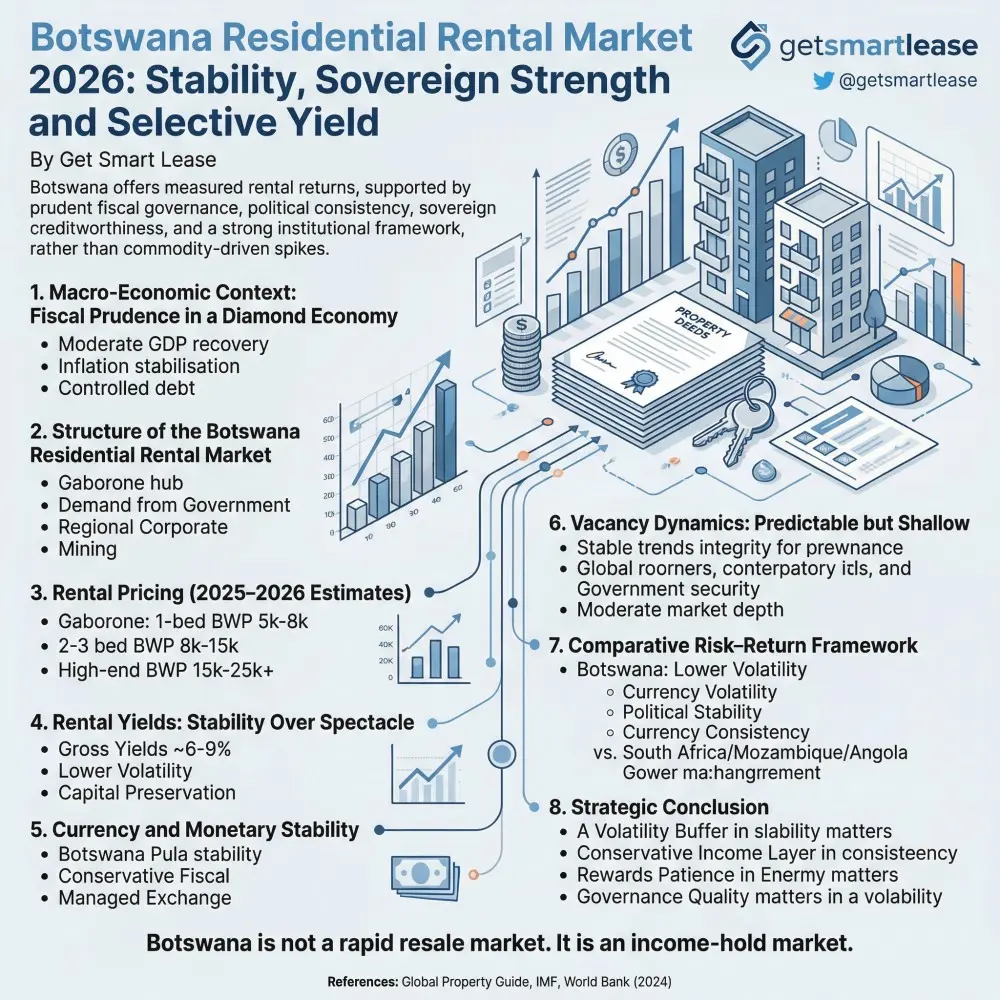
Botswana’s residential rental market entering 2026 presents a markedly different profile from Angola’s oil-linked volatility or Mozambique’s LNG-driven precision cycle.
Botswana is not a high-yield frontier play. It is a stability-driven income market.
Botswana offers measured rental returns, supported by prudent fiscal governance, political consistency, sovereign creditworthiness, and a strong institutional framework, rather than commodity-driven spikes.
This is not a speculative market. It is a structured, stability-oriented rental ecosystem.
1. Macro-Economic Context: Fiscal Prudence in a Diamond Economy
Botswana remains one of Africa’s most politically stable and institutionally disciplined economies. While the country is heavily dependent on diamond exports, macroeconomic management has historically been conservative, supported by sovereign wealth buffers and fiscal oversight (World Bank, 2024).
Recent economic indicators highlight:
- Moderate GDP growth recovery post-pandemic
- Inflation stabilisation
- Controlled public debt levels relative to regional peers
- Strong governance rankings within Sub-Saharan Africa
(IMF, 2024)
However, structural risks remain:
- Diamond price dependency
- Limited economic diversification
- Youth unemployment pressures
- Modest urbanisation pace compared to regional peers
For property investors, Botswana represents:
Lower volatility Lower yield compression cycles Lower macro risk premium
But also lower headline rental yields compared to higher-risk neighbours.
2. Structure of the Botswana Residential Rental Market
Geographic Concentration
Botswana’s formal rental market is primarily concentrated in:
- Gaborone (primary hub)
- Phakalane
- Broadhurst
- Block 10
- Kgale View
Secondary demand exists in:
- Francistown
- Maun (tourism-driven demand)
- Selebi-Phikwe (mining-linked cycles)
Gaborone remains the administrative, corporate, and diplomatic nucleus of the country (Global Property Guide, 2024).
Demand Drivers
Botswana’s rental demand is anchored by:
- Government employment
- Regional corporate headquarters
- Financial services sector
- Mining sector professionals
- Diplomatic and NGO presence
- Tourism-linked executives (Maun)
Unlike Angola or Mozambique, Botswana’s rental demand is less cyclical and less dollarised.It is primarily local-currency (Botswana Pula – BWP) denominated.
3. Rental Pricing (2025–2026 Estimates)
Estimated rental benchmarks in Gaborone:
- 1-bedroom apartment: BWP 5,000–8,000/month
- 2–3 bedroom apartments: BWP 8,000–15,000/month
- High-end gated estates (Phakalane/Kgale): BWP 15,000–25,000+/month
(Global Property Guide, 2024; regional brokerage data)
Rental levels reflect:
- Moderate affordability
- Limited speculative oversupply
- Stable middle-income tenant base
Unlike Luanda or Maputo, Botswana does not experience sharp executive pricing spikes tied to commodity booms.
4. Rental Yields: Stability Over Spectacle
Gross rental yields in Botswana typically range between 6% and 9%, depending on:
- Property location
- Security standards
- Entry pricing
- Tenant profile
(Global Property Guide, 2024)
Compared regionally: CountryGross Yields (Est.)South Africa~10–11%Mozambique~8–12%Angola~9–13%Botswana~6–9%
Botswana offers a lower nominal yield — but also lower structural volatility.
This makes it attractive for:
- Conservative cross-border investors
- Capital preservation strategies
- Low-leverage portfolio allocation
5. Currency and Monetary Stability
The Botswana Pula has historically exhibited greater stability than many Sub-Saharan African currencies due to:
- Conservative fiscal management
- Managed exchange rate policy
- Strong foreign reserves
(IMF, 2024; World Bank, 2024)
For investors, this reduces:
✔ Currency erosion risk ✔ Repatriation uncertainty ✔ Exchange rate timing pressure
However, because leases are not typically USD-indexed, investors do not benefit from the dollar-insulated rental structures seen in Angola or Mozambique.
6. Vacancy Dynamics: Predictable but Shallow
Botswana’s rental market depth is moderate.
Vacancy trends are generally stable, supported by:
- Government employment security
- Corporate office stability
- Controlled housing supply
However, the market is relatively small.
Liquidity risk exists at exit, particularly for higher-end properties.
Botswana is not a rapid resale market.
It is an income-hold market.
7. Comparative Risk–Return Framework
VariableSouth AfricaMozambiqueAngolaBotswanaGross Yields~10–11%~8–12%~9–13%~6–9%Currency RiskModerateElevatedElevatedLowerPolitical RiskModerateModerate-HighModerate-HighLowMarket DepthDeepThinThinModerateCommodity DependenceModerateModerateHighHigh (Diamonds)LiquidityStrongerLimitedLimitedModerate-Low
Botswana offers:
✔ Political stability ✔ Sovereign credibility ✔ Currency consistency ✔ Lower volatility
But provides:
✖ Lower yield premium ✖ Slower capital growth cycles ✖ Smaller market liquidity
8. Strategic Conclusion
Botswana’s residential rental market in 2026 is not designed for aggressive yield chasing.
It is designed for stability. For cross-border investors building a Southern Africa allocation strategy, Botswana may serve as:
- A volatility buffer
- A conservative income layer
- A lower-risk complement to higher-yield markets like Angola and Mozambique
Where Angola rewards risk tolerance, and Mozambique rewards precision
Botswana rewards patience. In this market, Governance quality matters more than commodity hype. Currency stability matters more than yield spikes. Capital preservation may outweigh aggressive income targeting.
References (Harvard Style)
Global Property Guide (2024) Botswana Property Market Analysis. Available at: https://www.globalpropertyguide.com (Accessed: 23 February 2026).
International Monetary Fund (IMF) (2024) Botswana: Article IV Consultation Report. Washington, DC: IMF.
World Bank (2024) Botswana Economic Update: Stability, Growth and Fiscal Outlook. Washington, DC: World Bank.