
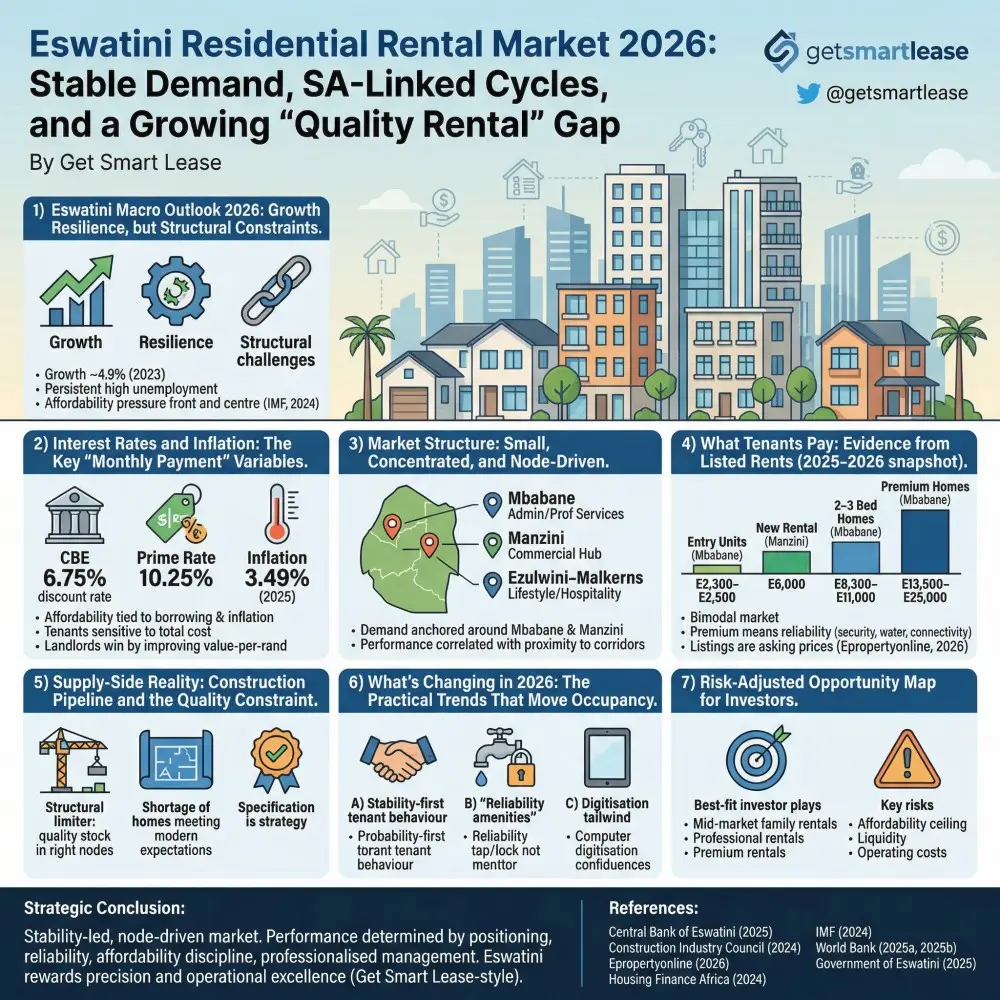
Eswatini’s residential rental market going into 2026 is best understood as a small, institutionally stable, South Africa-linked rental ecosystem with concentrated urban demand and a persistent shortage of “move-in ready” stock in prime nodes. The market is not driven by speculative booms; it is shaped by macro stability, credit conditions, public/private sector employment, and cross-border price transmission from South Africa (IMF, 2024; Central Bank of Eswatini, 2025).
For investors and professional landlords, the opportunity is selective: quality units in the right corridors can achieve strong occupancy and consistent renewals, while poorly specified units (security, water resilience, connectivity, maintenance) are increasingly penalised by tenants.

1) Eswatini Macro Outlook 2026: Growth Resilience, but Structural Constraints
Eswatini’s economy has shown resilience, with the IMF noting growth around 4.9% in 2023 and expectations of mid-single-digit growth in the near term, while highlighting persistent high unemployment and structural challenges (IMF, 2024). At the same time, the World Bank’s recent analysis points to growth supported by investment and consumption but constrained by fiscal pressures and the need for productivity reforms (World Bank, 2025a; World Bank, 2025b).
Why this matters for rentals:
- Stable macro conditions typically support rental payment discipline and tenant retention.
- Structural constraints (jobs, income growth, fiscal tightening) keep affordability pressure front and centre (IMF, 2024).
2) Interest Rates and Inflation: The Key “Monthly Payment” Variables
Rental affordability in Eswatini is closely tied to borrowing costs and inflation—especially because many landlords benchmark risk and returns against deposit rates, lending rates, and rising maintenance costs.
- The Central Bank of Eswatini (CBE) maintained the discount rate at 6.75% and signalled that banks were expected to hold the prime lending rate around 10.25% (Central Bank of Eswatini, 2025).
- The same statement revised the 2025 inflation forecast down to 3.49%, with headline inflation noted at 2.9% (June 2025) (Central Bank of Eswatini, 2025).
- Government macro reporting also reflects an environment where inflation forecasts were revised, and monetary conditions stayed steady, shaping household affordability (Government of Eswatini, 2025).
Implication for 2026 leasing: When inflation cools while rates remain relatively steady, tenants become more sensitive to total monthly housing cost (rent + utilities + commuting), and landlords win by improving value-per-rand, not by pushing aggressive escalations.
3) Market Structure: Small, Concentrated, and Node-Driven
Eswatini’s urban footprint is small and concentrated, with major demand anchored around Mbabane and Manzini (Housing Finance Africa, 2024). That concentration matters because rental liquidity (speed to find a tenant) is not evenly distributed—occupancy performance is strongly correlated with proximity to employment corridors, schools, retail, and road access.
Primary rental nodes
- Mbabane: administrative and professional services concentration; steady demand for mid-to-upper rentals.
- Manzini: commercial hub; broad middle-market rental demand and commuter-driven occupancy.
- Ezulwini–Malkerns corridor (where relevant): lifestyle and hospitality adjacency; pockets of higher-end demand driven by proximity and security/amenity preferences (contextualised by national development patterns and investment focus in official macro reports) (World Bank, 2025a).
4) What Tenants Pay: Evidence from Listed Rents (2025–2026 snapshot)
Eswatini lacks a widely cited public “national rental index” equivalent to PayProp in South Africa. In practice, investors often triangulate market pricing using listing snapshots and broker pipelines—then confirm through actual letting outcomes.
A current listing snapshot from a prominent local portal shows advertised monthly rents spanning:
- E2,300–E2,500 for smaller apartments/entry units in Mbabane areas like Mahwalala (Epropertyonline, 2026)
- E6,000 for a newer rental in Manzini (e.g., Zakhele) (Epropertyonline, 2026)
- E8,300–E11,000 for 2–3 bedroom homes in established Mbabane areas (Epropertyonline, 2026)
- E13,500–E25,000 for higher-end homes in premium Mbabane suburbs such as Riverview (Epropertyonline, 2026)
How to interpret this (Get Smart Lease lens):
- The market is bimodal: an entry-to-mid segment (volume demand) and a premium segment where specification and security justify pricing.
- “Premium” does not mean luxury finishes alone—it means reliability: water resilience, security, parking, maintenance response, and connectivity.
Note: Listings are asking prices, not always achieved rents. They are most useful for bounding ranges and identifying where supply clusters (Epropertyonline, 2026).
5) Supply-Side Reality: Construction Pipeline and the Quality Constraint
A recurring structural limiter across smaller markets is not “units” in general—it’s quality stock in the right nodes.
Eswatini’s Construction Industry Council performance reporting tracks construction activity and approvals, which helps signal pipeline direction and where supply might tighten or loosen (Construction Industry Council, 2024). But even when building activity improves, the rental market often still faces a quality constraint: homes that meet modern expectations (security, efficient layouts, fibre readiness, backup water, professional management) remain limited relative to demand.
Investor takeaway: In Eswatini, specification is strategy. A well-specified 2–3 bedroom in a strong node can outperform a larger but poorly maintained unit.
6) What’s Changing in 2026: The Practical Trends That Move Occupancy
A) Stability-first tenant behaviour
With unemployment still a major macro issue, tenants prioritise predictable monthly costs and reliable service delivery (IMF, 2024). That pushes demand toward landlords offering:
- clear lease terms
- fast maintenance response
- transparent utilities handling
B) “Reliability amenities” become non-negotiable
In smaller markets, tenants will often pay a premium for backup water, secure parking, and strong security—because these directly reduce day-to-day friction. This is where professional property management becomes a yield lever.
C) Digitisation tailwind
The World Bank’s Eswatini Economic Update emphasises digital transformation as a growth and jobs lever, which indirectly supports greater tenant expectations for digital communication, payments, and service responsiveness (World Bank, 2025a). Landlords who digitise rent collection, inspections, and maintenance workflows reduce arrears risk and vacancy time.
7) Risk-Adjusted Opportunity Map for Investors
Best-fit investor plays in Eswatini (2026)
- Mid-market family rentals (Mbabane/Manzini)
- Professional rentals near employment nodes
- Premium rentals (select suburbs only)
Key risks to price correctly
- Affordability ceiling: escalations must be defensible against wage realities (IMF, 2024).
- Liquidity: smaller market depth means longer selling timelines; strategy should be income-hold, not flip.
- Operating costs: maintenance, security, and utilities can erode returns if not engineered into pricing.
Strategic Conclusion
Eswatini’s 2026 rental market is not a speculative yield-chase environment. It is a stability-led, node-driven market where performance is determined by:
- positioning (Mbabane/Manzini and select corridors)
- property reliability (security + water + maintenance)
- affordability discipline
- professionalised management and digital operations
For Get Smart Lease-style investors, Eswatini rewards precision and operational excellence more than narrative.
References
Central Bank of Eswatini (2025) Monetary Policy Statement: 1 August 2025. Available at: Central Bank of Eswatini website (Accessed: 24 February 2026).
Construction Industry Council (CIC) (2024) Eswatini Construction Industry 2023/24 Performance Report. Available at: Construction Industry Council of Eswatini website (Accessed: 24 February 2026).
Epropertyonline (2026) Properties Available to Rent (Eswatini) – Listings Snapshot. Available at: epropertyonline.com (Accessed: 24 February 2026).
Housing Finance Africa (2024) Africa Housing Finance Yearbook 2024 – Eswatini Country Profile (updated for 2024). Available at: Housing Finance Africa (Accessed: 24 February 2026).
International Monetary Fund (IMF) (2024) Kingdom of Eswatini: 2024 Article IV Consultation—Press Release and Staff Report (IMF Country Report No. 2024/304). Washington, DC: IMF.
World Bank (2025a) Eswatini Economic Update: Harnessing the Potential of Digital Technologies for Eswatini’s Growth and Job Creation. Washington, DC: World Bank.
World Bank (2025b) Eswatini Macro Poverty Outlook (MPO). Washington, DC: World Bank.
Government of Eswatini, Ministry of Economic Planning and Development (2025). Economic Bulletin 2025 Quarter 1. Mbabane: Government of Eswatini.