
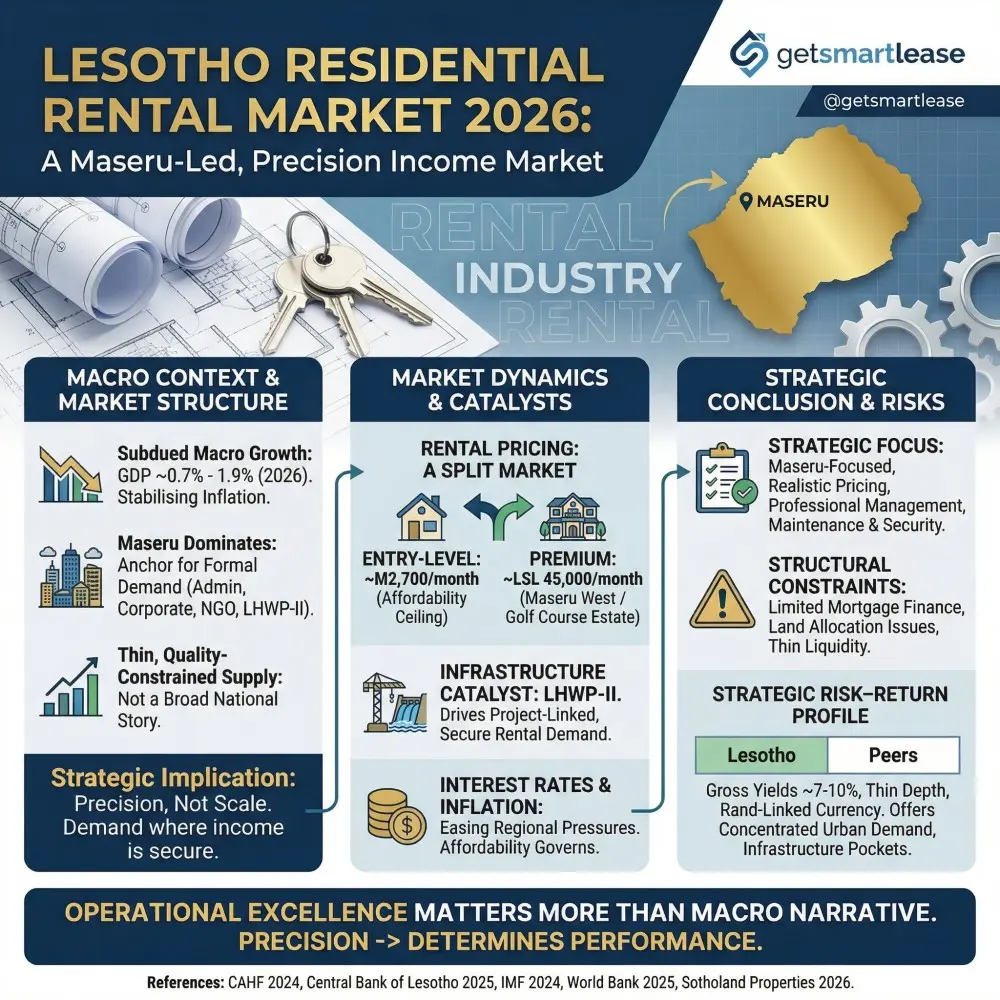
Lesotho’s residential rental market entering 2026 is best understood through three structural realities:
- Subdued macro growth with stabilising inflation
- Concentrated formal demand in Maseru
- A thin, quality-constrained housing supply
Unlike deeper Southern African rental ecosystems, Lesotho does not present a broad national rental story. It is a micro-market economy, with Maseru anchoring the formal residential segment.
For disciplined investors, this is not a scale market; it is a precision market.
1. Macro-Economic Context: Stabilisation Without Acceleration
Lesotho’s economic outlook remains stable but modest. The World Bank projects GDP growth of approximately 0.7% in 2026, reflecting constrained external demand and structural challenges (World Bank, 2025). Meanwhile, the Central Bank of Lesotho forecasts growth closer to 1.9% in 2026, supported largely by infrastructure activity, particularly the Lesotho Highlands Water Project Phase II (LHWP-II) (Central Bank of Lesotho, 2025).
The IMF’s 2024 Article IV consultation highlights continued fiscal and external vulnerabilities, with a need for improved public financial management and economic diversification (IMF, 2024).
Implication for rentals: Rental growth is unlikely to be broad-based. Demand will remain strongest where income streams are secure, such as government, project-linked employment, formal private sector professionals, and cross-border income earners.
2. Market Structure: Maseru Dominates Formal Rental Activity
The Centre for Affordable Housing Finance in Africa (CAHF) identifies urbanisation pressures and land constraints as key drivers shaping Lesotho’s housing market, particularly in Maseru (CAHF, 2024). Urbanisation is estimated at approximately 2.6% annually, increasing housing demand in the capital corridor (CAHF, 2024).
Maseru functions as:
- Administrative capital
- Corporate hub
- Primary node for diplomatic and NGO presence
- Anchor for infrastructure-linked project demand
Secondary towns have limited formal rental liquidity.
3. Rental Pricing: A Split Market
Lesotho’s rental pricing demonstrates a clear dual structure.
Entry-Level / Affordable Formal Segment
CAHF estimates the typical monthly rental for the cheapest newly built formal housing at approximately M2,700 per month (CAHF, 2024). This reflects the affordability ceiling for lower- to middle-income households.
Premium Segment (Maseru West / Golf Course Estate and Similar Nodes)
Current listing evidence shows premium 4-bedroom homes advertised at approximately LSL 45,000 per month (Sotholand Properties, 2026).
It is important to distinguish:
- Listing prices ≠ average rents
- Premium properties represent a narrow, income-secure tenant base
The market is therefore thin but stratified.
4. Interest Rates and Inflation: Affordability Still Governs
The World Bank’s Macro Poverty Outlook notes that Lesotho’s central bank reduced the policy rate to 6.75% by August 2025, reflecting easing regional inflation pressures (World Bank, 2025). Inflation is projected to stabilise near 5% over the medium term (World Bank, 2025).
Given Lesotho’s currency peg to the South African rand, monetary conditions are closely aligned with regional trends.
Rental implication: Easing inflation supports predictable lease escalations, but subdued growth means landlords must remain cautious with pricing. Affordability remains the primary market governor.
5. Infrastructure as a Rental Catalyst: LHWP-II
The Central Bank of Lesotho identifies LHWP-II as a major economic growth driver through 2026 (Central Bank of Lesotho, 2025).
Infrastructure cycles typically create:
- Short-to-medium term contractor accommodation demand
- Preference for secure, managed rentals
- Higher absorption in proximity to project logistics routes
However, project-driven demand can be cyclical and should not be mistaken for permanent structural rental expansion.
6. Structural Constraints: Supply Is Thin, Not Elastic
CAHF highlights:
- Limited access to formal mortgage finance
- Land allocation constraints
- Informal housing dominance
- Income inequality pressures
(CAHF, 2024)
This means the formal rental market remains relatively supply-constrained. In thin markets, small demand shifts can disproportionately affect pricing, both upward and downward.
Liquidity risk at exit must therefore be priced into any investment decision.
7. Strategic Risk–Return Profile
Compared regionally:
CountryEstimated Gross YieldsMarket DepthCurrency RiskSouth Africa~10–11%DeepModerateBotswana~6–9%ModerateLowerLesotho~7–10% (node-dependent)ThinRand-linkedAngola~9–13%ThinElevated
Lesotho offers:
✔ Rand-linked currency stability ✔ Concentrated urban demand ✔ Infrastructure-linked rental pockets
But carries:
✖ Limited liquidity ✖ Narrow tenant base in premium segment ✖ Modest macro growth
Strategic Conclusion
Lesotho’s 2026 residential rental market is:
- Concentrated
- Affordability-sensitive
- Infrastructure-influenced
- Supply-constrained
It is not a speculative yield environment.
It rewards:
✔ Location precision (Maseru-focused) ✔ Realistic pricing ✔ Professional lease management ✔ Strong maintenance and security standards
In Lesotho, operational excellence matters more than macro narrative.
Precision ->not scale -> determines performance.
References
Centre for Affordable Housing Finance in Africa (CAHF) (2024) Lesotho: Africa Housing Finance Yearbook 2024 Country Profile. Available at: https://housingfinanceafrica.org/wp-content/uploads/2025/03/LESOTHO.pdf (Accessed: 24 February 2026).
Central Bank of Lesotho (2025) Lesotho Economic Outlook Update 2024–2026. Maseru: Central Bank of Lesotho. Available at: https://centralbank.org.ls/wp-content/uploads/Lesotho-Economic-Outlook-Update-Jan-2025.pdf (Accessed: 24 February 2026).
International Monetary Fund (IMF) (2024) Kingdom of Lesotho: 2024 Article IV Consultation—Press Release and Staff Report. Washington, DC: IMF. Available at: https://www.imf.org/en/publications/cr/issues/2024/09/10/kingdom-of-lesotho-2024-article-iv-consultation-press-release-staff-report-and-statement-by-554727 (Accessed: 24 February 2026).
Sotholand Properties (2026) Property listing: Maseru West (Golf Course Estate). Available at: https://www.sotholandproperties.co.ls/property-details?id=20e1e74e82a0 (Accessed: 24 February 2026).
World Bank (2025) Lesotho Macro Poverty Outlook (October 2025). Washington, DC: World Bank. Available at: https://thedocs.worldbank.org/en/doc/bae48ff2fefc5a869546775b3f010735-0500062021/related/mpo-lso.pdf (Accessed: 24 February 2026).