
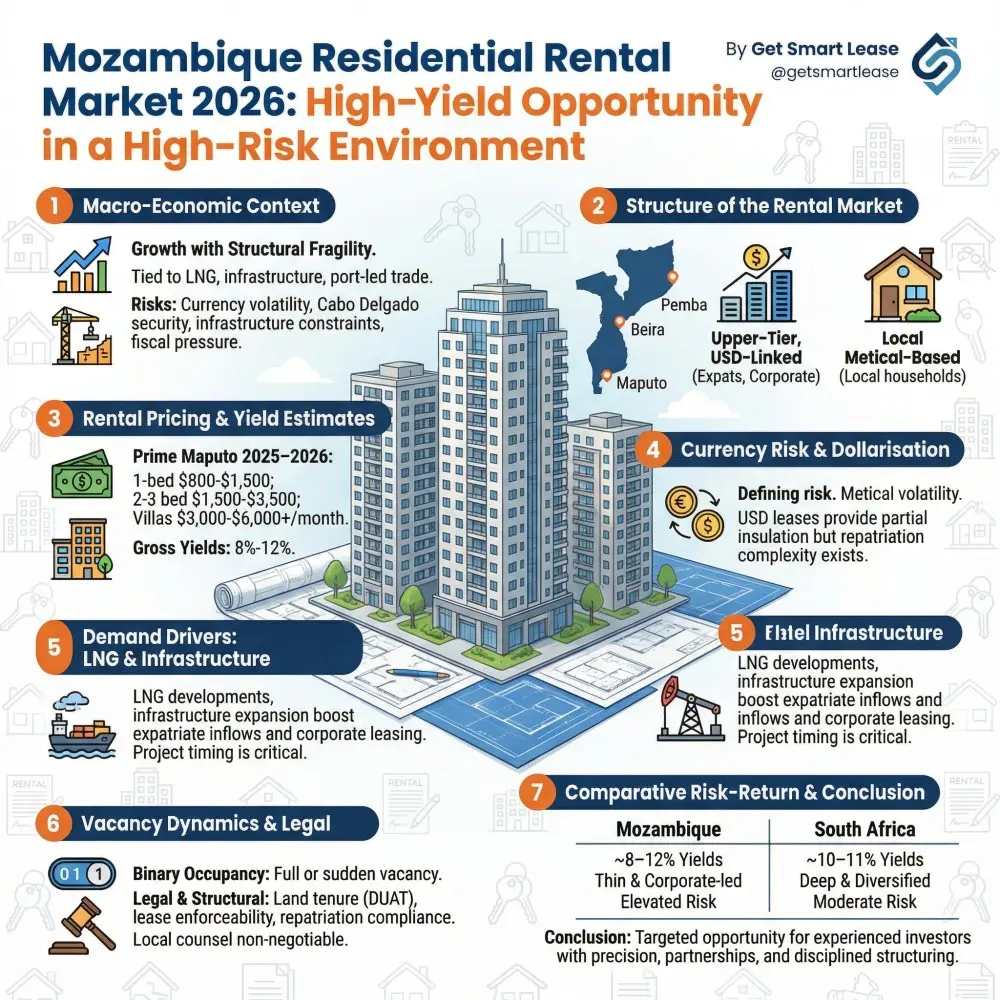
Yet, for disciplined investors with local partnerships and risk controls, Mozambique offers one of the most asymmetric yield opportunities in Southern Africa. This is not a volume market. It is a precision market.
1. Macro-Economic Context: Growth with Structural Fragility
Mozambique’s economic outlook is closely tied to liquefied natural gas (LNG) developments, infrastructure expansion, and port-led trade corridors. GDP growth is projected to remain above regional averages as energy projects resume phased implementation (World Bank, 2024; IMF, 2024).
However, structural risks remain:
- Currency volatility (Mozambican Metical – MZN)
- Security concerns in Cabo Delgado
- Infrastructure and power reliability constraints
- Fiscal pressure and public debt exposure
The IMF notes that while macro-stabilisation has improved, Mozambique remains vulnerable to external shocks and commodity price cycles (IMF, 2024).
For property investors, this macro profile translates into:
- Yield premiums relative to South Africa
- Higher liquidity risk
- Greater dependency on foreign corporate activity
2. Structure of the Mozambique Rental Market
Unlike South Africa’s diversified residential ecosystem, Mozambique’s formal rental sector is concentrated geographically and economically.
Geographic Concentration
The formal, high-value rental market is overwhelmingly centred in:
- Maputo (Polana, Sommerschield, Triunfo, Coop, Costa do Sol)
- Select nodes in Beira
- Emerging LNG-linked activity near Pemba
Maputo remains the anchor market due to diplomatic presence, multinational headquarters, and port-linked commercial activity (Global Property Guide, 2024).
Dual-Market Dynamic
Mozambique operates effectively as two rental markets:
1️⃣ Upper-Tier, USD-Linked Market
- Target tenants: expatriates, energy-sector professionals, NGOs, diplomats
- Lease denomination: Often US dollars
- Furnished, secure developments
- Corporate-backed leases
2️⃣ Local Metical-Based Market
- Target tenants: local professionals and households
- Lease denomination: Mozambican Metical
- Lower rental thresholds
- More informal lease structuring
The upper tier is where institutional-style investors focus due to stronger enforceability and currency insulation.
3. Rental Pricing and Yield Estimates
Rental pricing in prime Maputo suburbs (2025–2026 estimates):
- 1-bedroom apartment: USD $800–$1,500/month
- 2–3 bedroom apartment: USD $1,500–$3,500/month
- High-end villas: USD $3,000–$6,000+/month
(Estimates based on market listings and regional property analysis: Global Property Guide, 2024; private brokerage data).
Gross rental yields in well-positioned urban assets are typically estimated between 8% and 12%, depending on:
- Entry price
- Security standards
- Furnishing quality
- Lease denomination
- Tenant type
(Global Property Guide, 2024)
Compared to South Africa’s ~10–11% gross yields (Global Property Guide, 2025), Mozambique offers comparable or slightly higher headline returns, but with materially higher risk variables.
4. Currency Risk and Dollarisation
Currency risk is one of the defining investment considerations.
The Mozambican Metical has experienced historical volatility driven by:
- Commodity cycles
- Foreign debt pressures
- External financing conditions
(World Bank, 2024)
USD-denominated leases in the upper-tier market provide partial insulation from local currency depreciation. However:
- Purchase prices may still reflect local cost structures
- Repatriation of profits can face regulatory complexity
- Liquidity events may be slow
Currency structuring, therefore, becomes as important as property selection.
5. Demand Drivers: LNG and Infrastructure
Mozambique’s LNG developments are widely regarded as the most significant medium-term demand catalyst.
Major international energy projects are expected to:
- Increase expatriate inflows
- Boost executive housing demand
- Strengthen corporate leasing absorption
- Support USD-denominated rental stability
(World Bank, 2024; IMF, 2024)
However, project timing remains critical. Delays or security disruptions in Cabo Delgado directly affect rental absorption cycles in both Pemba and Maputo.
Unlike diversified economies, Mozambique’s rental demand is partially project-dependent.
6. Vacancy Dynamics: Binary Occupancy Patterns
Mozambique does not exhibit the same deep, diversified tenant pool seen in South Africa.
Premium developments often experience:
- Full occupancy under corporate lease cycles OR
- Sudden vacancy pending expatriate rotation
This creates “binary occupancy” risk.
Professional leasing networks and corporate relationships are, therefore, more important than public listing exposure.
Passive ownership models are significantly less effective in this market.
7. Legal and Structural Considerations
Foreign investors must consider:
- Land tenure regulations (DUAT – Direito de Uso e Aproveitamento da Terra)
- Lease enforceability
- Property registration frameworks
- Repatriation compliance
Legal structuring via local counsel is non-negotiable.
Mozambique’s legal environment has improved, but administrative processes can be slower and more relationship-dependent compared to South Africa (IMF, 2024).
8. Comparative Risk–Return Analysis: Mozambique vs South Africa
VariableSouth AfricaMozambiqueGross Yields~10–11%~8–12%Market DepthDeep & diversifiedThin & corporate-ledCurrency RiskModerateElevatedPolitical RiskModerateHigherLiquidityRelatively strongLimitedInstitutional MaturityAdvancedEmerging
Mozambique offers yield asymmetry, but with elevated volatility exposure.
It rewards:
✔ Active management ✔ Local intelligence ✔ Corporate tenant pipelines ✔ Currency-aware structuring
It penalises:
✖ Passive investing ✖ Poor security standards ✖ Weak legal preparation
Strategic Conclusion
Mozambique’s residential rental market in 2026 is not a mainstream income play.
It is a targeted opportunity environment.
For experienced cross-border investors, the combination of:
- USD-linked upper-tier leases
- LNG-driven demand catalysts
- Constrained premium supply
creates selective high-yield opportunities.
However, this is a market where risk management capability determines outcome more than macro optimism.
Precision, partnerships, and disciplined structuring are essential.
References
Global Property Guide (2024) Mozambique Property Market Analysis. Available at: https://www.globalpropertyguide.com (Accessed: 17 February 2026).
Global Property Guide (2025) South Africa Rental Market Analysis 2025. Available at: https://www.globalpropertyguide.com (Accessed: 18 February 2026).
International Monetary Fund (IMF) (2024) Mozambique: Article IV Consultation Report. Washington, DC: IMF.
World Bank (2024) Mozambique Economic Update: Growth, Risks and Energy Developments. Washington, DC: World Bank.