
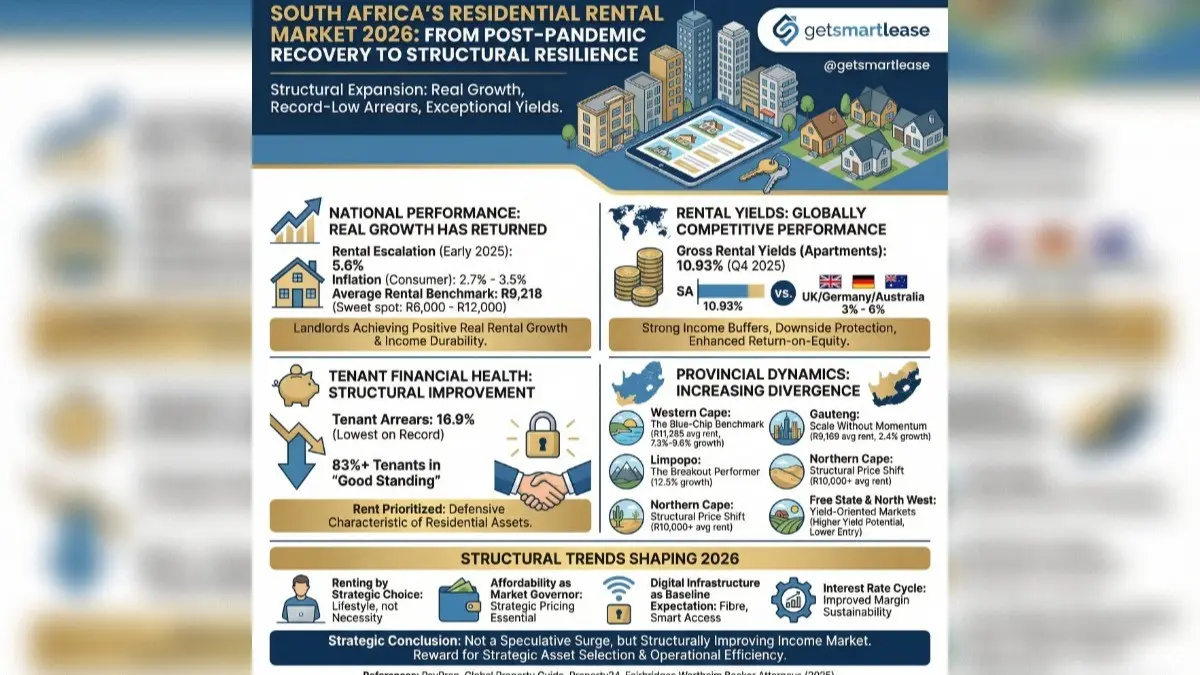
The South African residential rental market has entered 2026 in one of its strongest positions in nearly a decade. With above-inflation rental growth, historic-low tenant arrears, and gross yields approaching 11%, the sector has shifted from post-pandemic recovery into structural resilience.
For landlords, investors, and property professionals, the key question is no longer whether the market is recovering, but how to strategically position within this new cycle.
South Africa Rental Growth 2026: Above Inflation for the First Time in Years
National rental growth accelerated to 5.6% year-on-year in early 2025, marking the strongest escalation since 2017 (PayProp, 2025). While growth moderated slightly to around 5.0% by mid-2025, it remains comfortably above inflation, which has cooled to approximately 2.7%–3.5% (Global Property Guide, 2025).
Why This Matters for Landlords
When rental growth exceeds inflation:
- Landlords achieve positive real income growth
- Cash flow stability improves
- Return on equity strengthens
- Portfolio resilience increases
After several years of margin compression, real rental growth has returned, restoring confidence to income-focused investors.
Average Rent in South Africa 2026: Where the Market Is Concentrated
The average national rent now stands at approximately R9,218 per month (PayProp, 2025).
Demand remains densest in the R6,000 to R12,000 price band, confirming that the mid-market segment continues to anchor the rental ecosystem (Property24, 2025).
Properties positioned within this affordability corridor demonstrate:
- Faster occupancy rates
- Lower turnover volatility
- Higher escalation acceptance
Strategic pricing within this band remains critical for vacancy minimisation.
Tenant Arrears in South Africa: Record Lows Signal Stability
One of the most significant indicators entering 2026 is tenant payment performance.
Arrears declined to a historic low of 16.9% in late 2025, with more than 83% of tenants classified as being in good standing (PayProp, 2025).
This is particularly noteworthy given that average household debt-to-income ratios remain elevated at approximately 52.1% (Global Property Guide, 2025).
What This Indicates
- Rent is being prioritised above discretionary debt
- Payment discipline has improved post-pandemic
- Residential rental assets remain defensive in nature
For professional landlords, predictable income flow is often more important than capital appreciation. Current arrears data support this narrative of stability.
Rental Yields in South Africa 2026: Among the Highest Globally
Gross rental yields for apartments averaged 10.93% nationally in Q4 2025 (Global Property Guide, 2025).
By international comparison:
- UK yields typically range between 3%–5%
- Germany averages 3%–4%
- Australia averages 4%–6%
South Africa’s double-digit yield environment remains globally competitive and income-attractive.
Secondary provinces, in particular, continue to deliver strong percentage returns relative to capital invested.
Provincial Rental Market Trends 2026
Western Cape Rental Market: Premium Performance
- Average Rent: ~R11,285
- Growth: 7.3%–9.6%
The Western Cape remains South Africa’s most expensive and consistently high-demand rental province (PayProp, 2025; Property24, 2025).
Drivers include semigration, infrastructure stability perceptions, and lifestyle positioning. It continues to function as a “blue-chip” rental market.
Limpopo Rental Growth: The Breakout Province
- Growth Rate: ~12.5%
Limpopo has emerged as the standout performer in percentage growth terms (PayProp, 2025). Stronger regional demand and base-level pricing adjustments have accelerated rental escalation.
Yield-focused investors are increasingly monitoring secondary urban nodes in this province.
Gauteng Rental Market: Deep Tenant Pool, Muted Growth
- Average Rent: ~R9,169
- Growth: 2.4%
Despite housing the largest tenant base, elevated supply levels have suppressed pricing power (Property24, 2025).
However, constrained development pipelines could support improved rental momentum over the medium term.
Affordable and High-Return Provinces
- Free State: Strong rebound at 7.7% growth
- North West: Most affordable province (~R6,798 average rent)
These provinces offer lower entry costs and strong percentage-based yield opportunities (PayProp, 2025).
Key Rental Market Trends Shaping 2026
1. Renting by Choice, Not Necessity
Younger professionals increasingly view renting as a strategic lifestyle decision. Mobility, flexibility, and reduced long-term debt exposure are influencing behaviour (Global Property Guide, 2025).
This trend strengthens long-term structural rental demand.
2. Affordability Remains the Primary Market Driver
Approximately 80% of rental agents report affordability as the main driver of tenant relocations (Property24, 2025).
The market is resilient but price-sensitive. Disciplined escalation strategies remain essential to protect occupancy levels.
3. Digital Infrastructure Is Now Standard
Modern tenants expect:
- Fibre connectivity
- Smart access systems
- Online lease management
- Digital maintenance tracking
Properties without these features risk extended vacancy periods (PayProp, 2025).
Digital integration is no longer a competitive advantage; it is baseline infrastructure.
4. Interest Rate Cuts and Their Impact on Rental Property Investment
With the prime lending rate reduced to approximately 10.25% by early 2026, landlord margins have improved (Global Property Guide, 2025).
Lower rates support:
- Improved cash flow
- Refinancing opportunities
- Development feasibility
However, prolonged rate cuts may gradually encourage some long-term tenants to enter the ownership market, potentially shifting demand patterns over time.
South Africa Rental Market Outlook 2026
The South African rental sector is no longer in recovery mode; it is operating within a structurally strengthened income cycle.
Key fundamentals include:
- Above-inflation rental growth
- Historic-low arrears
- Globally competitive yields
- Regional performance diversification
- Behavioural shift toward long-term renting
For landlords and investors, 2026 represents one of the most balanced income environments in recent years. Strategic pricing, digital readiness, and disciplined tenant vetting will define performance in this next phase.