
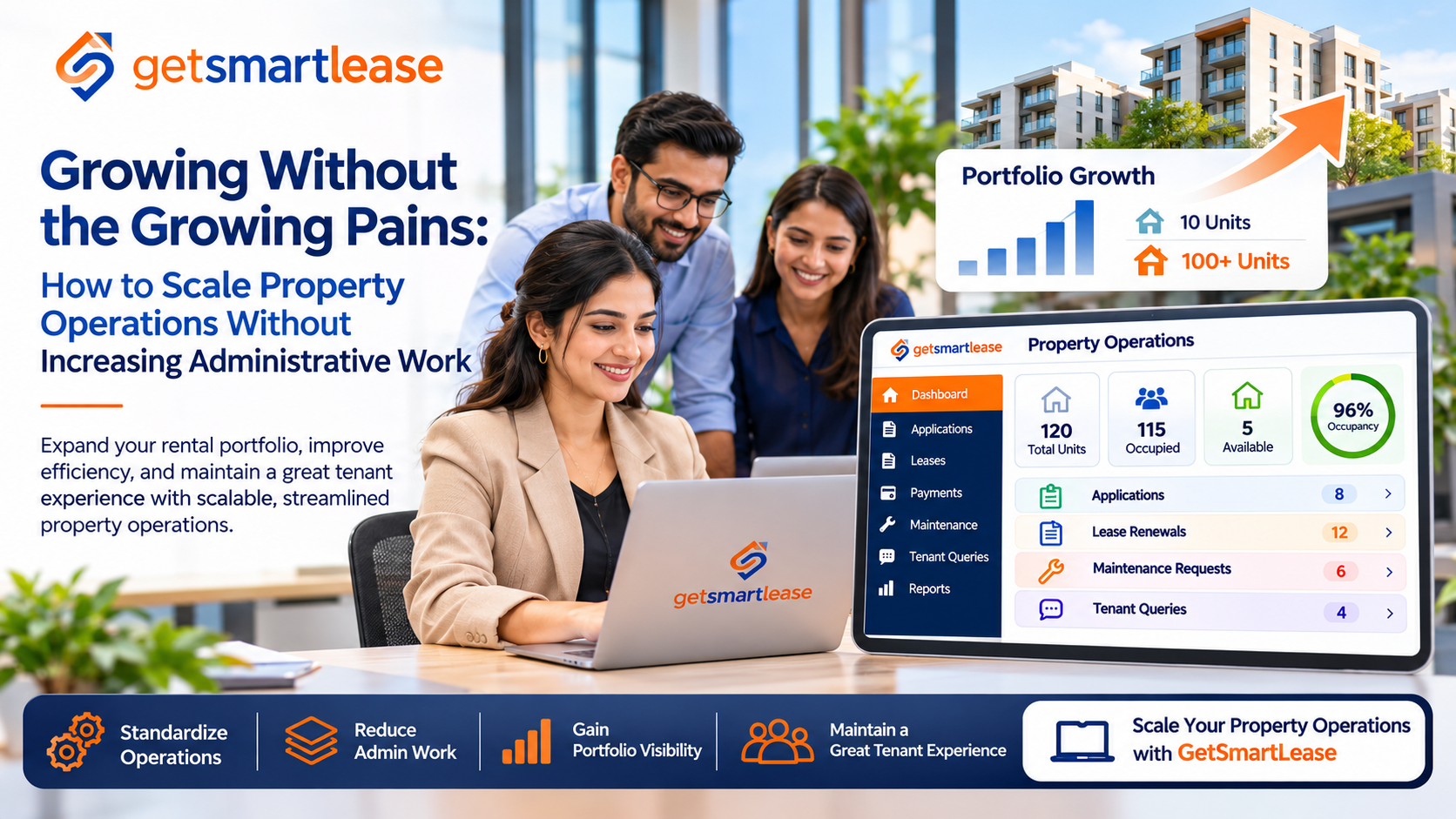
When Portfolio Growth Becomes an Operational Challenge
Growing a rental portfolio is an exciting milestone for any property management business.
More properties can mean new revenue opportunities, stronger market presence, and greater business potential.
But growth also introduces additional responsibilities.
More tenants mean more communication. More leases mean more documentation. More properties mean more inspections, maintenance requests, payments, and operational decisions.
Processes that worked well for a small portfolio may become difficult to maintain as the business expands.
A spreadsheet that once managed ten tenants may become complicated with hundreds of records. Informal communication between team members may no longer be sufficient. Manual reminders may become increasingly difficult to manage.
The challenge isn't simply managing more properties.
It's building an operational structure that can support growth without becoming overwhelmed by it.
1. Recognize When Existing Processes Stop Scaling
Many property management businesses begin with simple tools and manual processes.
These approaches can work effectively when portfolios are small and responsibilities are manageable.
However, as operations grow, warning signs may begin to appear:
Increasing time spent on administrative tasks
Difficulty tracking lease expirations
Repeated data entry across different systems
Inconsistent tenant communication
Delays in processing rental applications
Difficulty monitoring outstanding payments
Growing dependence on individual team members
These challenges may indicate that existing processes are reaching their operational limits.
Recognizing these signs early allows businesses to improve their systems before growth becomes difficult to manage.
2. Standardize Operations Across Properties
Managing each property differently can create unnecessary complexity.
While individual properties may have unique requirements, core operational processes should follow consistent standards wherever possible.
These include:
Tenant application processing
Lease preparation and signing
Rental payment management
Document collection
Tenant query resolution
Lease renewals and cancellations
Move-in and move-out procedures
Standardized workflows make it easier to introduce new properties into an existing portfolio without redesigning every process.
They also help new employees understand their responsibilities more quickly.
3. Reduce the Administrative Cost of Every New Tenant
Every new tenant introduces a series of operational activities.
Applications need to be reviewed, documents collected, agreements prepared, signatures obtained, payments confirmed, and records maintained.
If every activity requires manual coordination, administrative workloads increase as tenant numbers grow.
Digital workflows can help reduce this burden by connecting different stages of the rental lifecycle.
For example:
Application → Review → Lease Agreement → Signatures → Payment → Unit Allocation
When relevant information moves between these stages, teams can reduce unnecessary duplication and repetitive administrative work.
The objective is to make each additional tenancy easier to manage without compromising accuracy or service quality.
4. Build a Portfolio-Wide View of Operations
As property portfolios expand, managing each property separately becomes increasingly difficult.
Property managers need both an individual property view and a broader understanding of portfolio performance.
A centralized operational view can help teams monitor:
Total and available rental units
Occupancy levels
Active and upcoming leases
Outstanding rental payments
Pending applications
Unresolved tenant queries
Upcoming operational deadlines
This broader visibility helps managers identify which properties require attention without manually reviewing every record.
It also supports more informed decisions about resource allocation and business growth.
5. Reduce Dependence on Individual Employees
A growing property management business should not depend entirely on one person's knowledge of its operations.
When important information exists only in someone's inbox, spreadsheet, or memory, staff absences and team changes can disrupt everyday activities.
Scalable operations require information and responsibilities to be accessible to authorized team members.
Centralized records, documented processes, clear statuses, and role-based access can help maintain operational continuity.
This allows businesses to grow their teams without losing valuable operational knowledge.
6. Maintain Tenant Experience as the Portfolio Expands
One of the biggest risks of rapid growth is a decline in service quality.
As tenant numbers increase, property teams may struggle to provide the same level of responsiveness and attention.
Tenants may experience slower updates, inconsistent communication, or longer waiting times.
Scalable property operations should protect the tenant experience through:
Accessible digital services
Clear communication
Consistent application and leasing processes
Transparent payment information
Structured tenant query management
Timely notifications and updates
A tenant's experience should not become more complicated simply because the property management business has grown.
7. Measure Efficiency, Not Just Portfolio Size
Growth is often measured by the number of properties, rental units, or active tenants.
However, operational efficiency is equally important.
Property managers should also consider questions such as:
How much administrative time is required per tenancy?
How long does it take to process an application?
How quickly are tenant queries resolved?
How many operational tasks require manual intervention?
How efficiently are outstanding payments managed?
Is service quality remaining consistent as the portfolio grows?
These measurements can help businesses understand whether their operational capabilities are keeping pace with expansion.
Successful growth is not only about managing more properties. It is about managing them sustainably.
8. Build Systems Before You Need Them
Waiting until operations become overwhelmed can make improvements more difficult.
Property managers can prepare for future growth by establishing scalable processes early.
This may involve centralizing information, introducing digital workflows, standardizing procedures, and reducing repetitive administrative activities before they become major bottlenecks.
A well-organized operational foundation gives businesses greater flexibility when new properties, tenants, or team members are introduced.
Instead of constantly adapting to growth, teams can be prepared to support it.
Growth Should Create Opportunities, Not Complexity
Expanding a rental portfolio should allow property management businesses to create more value, not simply more administrative work.
The strongest operational models are designed to accommodate increasing responsibilities while maintaining consistency, visibility, and service quality.
Technology alone does not guarantee successful growth. However, when combined with clear processes and effective management, it can help businesses handle expansion more efficiently.
The future of property operations is not about asking teams to work harder as portfolios grow.
It is about building systems that grow alongside them.
Scale Smarter With GetSmartLease
GetSmartLease helps property management teams bring essential rental activities into a connected digital environment.
From tenant applications and lease management to rental payments, document management, and tenant queries, structured digital workflows can help reduce administrative complexity and improve operational visibility.
By building a stronger operational foundation, property managers can focus more on business growth, portfolio performance, and tenant relationships.
More properties. Less complexity. Smarter growth with GetSmartLease.
Discover more at https://blog.getsmartlease.com/