
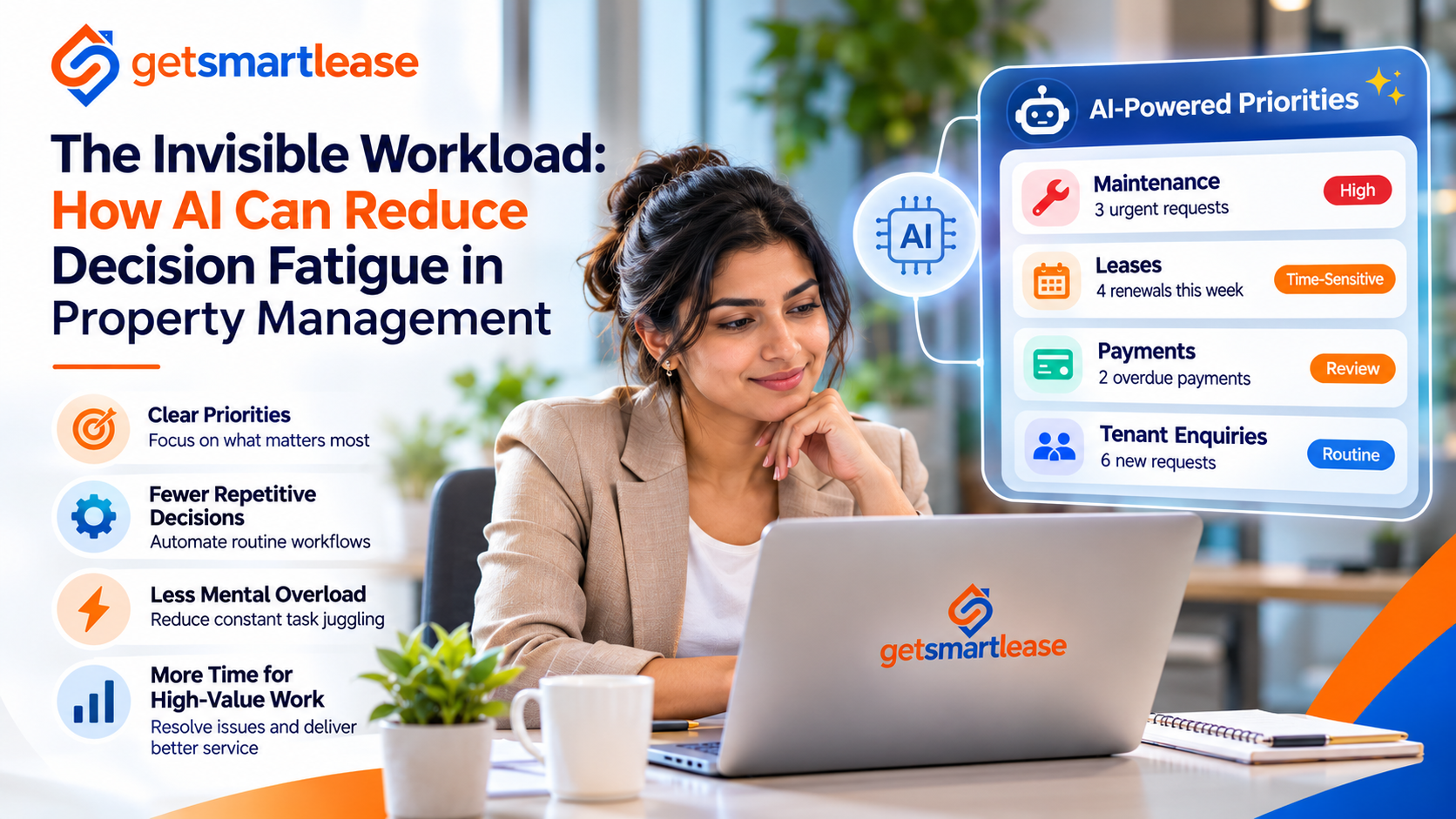
Property management is a profession built around decisions.
Every day, property managers must decide which maintenance request needs immediate attention, which tenant enquiry requires a response, which lease renewal should be prioritized, and which outstanding payment needs follow-up.
Individually, these decisions may seem simple.
But when multiplied across dozens of properties, hundreds of tenants, and multiple operational processes, they create a significant mental workload.
This challenge is known as decision fatigue.
As the number of decisions increases, maintaining the same level of attention and consistency throughout the day can become more difficult.
Artificial intelligence offers a new opportunity to address this challenge—not by replacing property managers' decisions, but by helping them make those decisions with greater clarity and confidence.
1. The Hidden Cost of Constant Decision-Making
Property management involves more than completing administrative tasks.
It requires continuous evaluation and prioritization.
Consider a typical working day.
A property manager might need to:
Review pending rental applications
Identify urgent maintenance requests
Follow up on overdue payments
Respond to tenant complaints
Check upcoming lease expirations
Approve documents
Coordinate with property owners
Monitor operational performance
Each activity requires attention.
The challenge becomes greater when information is spread across different systems, messages, and dashboards.
Property managers may spend considerable time deciding what to work on before they can begin the work itself.
The problem isn't always the number of tasks. It's the effort required to determine which task matters most.
2. Why More Information Doesn't Always Mean Better Decisions
Modern property management platforms provide access to large amounts of operational data.
Dashboards can display occupancy rates, outstanding payments, active leases, maintenance requests, and application statuses.
This visibility is valuable.
However, having more information doesn't automatically make decisions easier.
Imagine opening a dashboard showing:
35 outstanding maintenance requests
18 upcoming lease expirations
12 overdue payments
9 incomplete rental applications
6 unresolved tenant enquiries
These numbers explain the current workload.
But they don't necessarily explain where to begin.
A property manager must still examine individual records, understand their importance, and decide what requires attention.
AI-powered decision support can help bridge this gap.
3. Turning Information Into Clear Priorities
One of the most practical applications of AI is helping property teams prioritize their daily workload.
Instead of displaying every task with equal importance, an intelligent system could consider factors such as urgency, deadlines, dependencies, and operational impact.
For example, a dashboard might highlight:
High priority: A maintenance request reporting a possible safety issue.
Time-sensitive: A lease approaching its notice deadline.
Requires review: A payment discrepancy that needs investigation.
Routine: A document request that can be handled through an automated workflow.
This approach helps property managers focus on tasks that require immediate attention without manually reviewing every item.
Importantly, prioritization rules should remain transparent and allow staff to override recommendations when necessary.
4. Reducing Repeated Decisions Through Standardized Workflows
Many property management decisions follow established business rules.
For example:
When an application is incomplete, the applicant needs to be notified.
When a payment becomes overdue, the appropriate follow-up process should begin.
When a lease approaches expiration, renewal activities may need to start.
When a maintenance request is completed, the tenant should receive an update.
These situations don't always require a property manager to decide the next step from scratch.
Workflow automation can apply predefined rules consistently.
AI can support these workflows by interpreting incoming information and suggesting the appropriate action.
This reduces the number of repetitive decisions employees must make throughout the day.
5. Helping Teams Manage Maintenance Priorities
Maintenance management is an area where decision fatigue can become particularly noticeable.
Property managers may receive multiple requests involving different properties, tenants, and levels of urgency.
A leaking tap, a broken appliance, an electrical concern, and a routine inspection shouldn't necessarily receive the same priority.
AI can assist by categorizing requests and identifying information that may indicate urgency.
For example, a system could flag a message mentioning exposed electrical wiring for immediate human review.
It could also group similar maintenance issues, highlight recurring problems, and identify requests that have remained unresolved longer than expected.
The property manager can then make informed decisions without having to manually organize every request.
6. Making Lease Management Decisions Easier
Lease management involves numerous dates, documents, and responsibilities.
Property teams need to track lease expirations, renewal requests, notice periods, signatures, and approvals.
When these activities are managed manually, employees must repeatedly check which leases need attention.
An AI-assisted system could organize upcoming lease activities into clear categories.
For example:
Action required today: A lease awaiting an approval needed to meet a deadline.
Upcoming: Leases entering their renewal period.
Waiting for tenant: Agreements sent for signature.
Completed: Renewals that have progressed successfully.
This structure makes it easier to understand the current workload and identify the next appropriate action.
7. Supporting Financial Decisions Without Removing Control
Financial operations involve decisions that require accuracy and accountability.
Property managers may need to review outstanding balances, payment discrepancies, refund requests, and unusual transactions.
AI can help organize this information and identify potential exceptions.
For example, an intelligent system might highlight a payment that doesn't match the expected invoice amount.
Rather than automatically making a financial adjustment, the system can present the relevant details for review.
This approach reduces the effort required to investigate routine discrepancies while keeping important financial decisions under human control.
8. Reducing Interruptions and Context Switching
Decision fatigue isn't caused only by the number of decisions.
Frequent interruptions can also make work more demanding.
A property manager may begin reviewing a rental application, receive a maintenance notification, switch to a payment enquiry, and then return to the original application.
Repeatedly moving between unrelated activities requires additional concentration.
AI-powered systems can help organize notifications and tasks based on urgency.
Routine updates can be grouped into summaries, while genuinely urgent issues can be highlighted immediately.
This allows property managers to work with fewer unnecessary interruptions.
The result can be a more focused and manageable working day.
9. From Dashboards to Decision-Support Systems
Traditional dashboards primarily answer:
"What's happening across my properties?"
AI-powered decision-support systems can help answer a more useful question:
"What needs my attention, and why?"
For example, instead of displaying:
"20 maintenance requests are open."
An intelligent dashboard could highlight:
"Three requests may require urgent review, five are awaiting updates, and twelve are progressing normally."
Instead of displaying:
"15 leases are expiring soon."
It could identify:
"Four leases require renewal action this week."
This shift transforms dashboards from passive reporting tools into practical operational assistants.
10. Keeping Human Judgment at the Center
Reducing decision fatigue doesn't mean allowing AI to make every decision.
Property management involves people, financial obligations, legal responsibilities, and situations that require empathy.
AI recommendations should be treated as decision support rather than unquestionable instructions.
Property managers should be able to:
Understand why a task was prioritized
Review the information behind a recommendation
Correct inaccurate data
Override automated suggestions
Escalate complex situations
Maintain responsibility for important decisions
The objective is to reduce unnecessary mental effort while preserving professional judgment.
11. Building a More Focused Property Management Operation
Property management companies can begin addressing decision fatigue by examining how their teams currently manage daily priorities.
Useful questions include:
How much time do employees spend deciding what to work on?
Which tasks require repeated manual checks?
Are urgent requests clearly distinguished from routine activities?
Do employees receive too many notifications?
Can existing workflows automatically identify the next action?
These questions can help organizations identify opportunities to improve prioritization, reduce interruptions, and simplify operational decision-making.
The goal isn't to automate every decision.
It's to create an environment where employees can concentrate on decisions that genuinely require their expertise.
Final Thoughts
Property management will always involve decisions.
But not every decision should require the same amount of time, attention, or effort.
AI and automation can help property teams organize information, identify priorities, standardize routine workflows, and reduce unnecessary interruptions.
Instead of spending the day constantly deciding what needs attention, property managers can focus on resolving important issues and delivering better service.
The future of intelligent property management isn't just about doing more work in less time.
It's about making the working day easier to manage, one better-informed decision at a time.
GetSmartLease — Smarter Property Management, Better Experiences.
Explore more insights at https://blog.getsmartlease.com/