
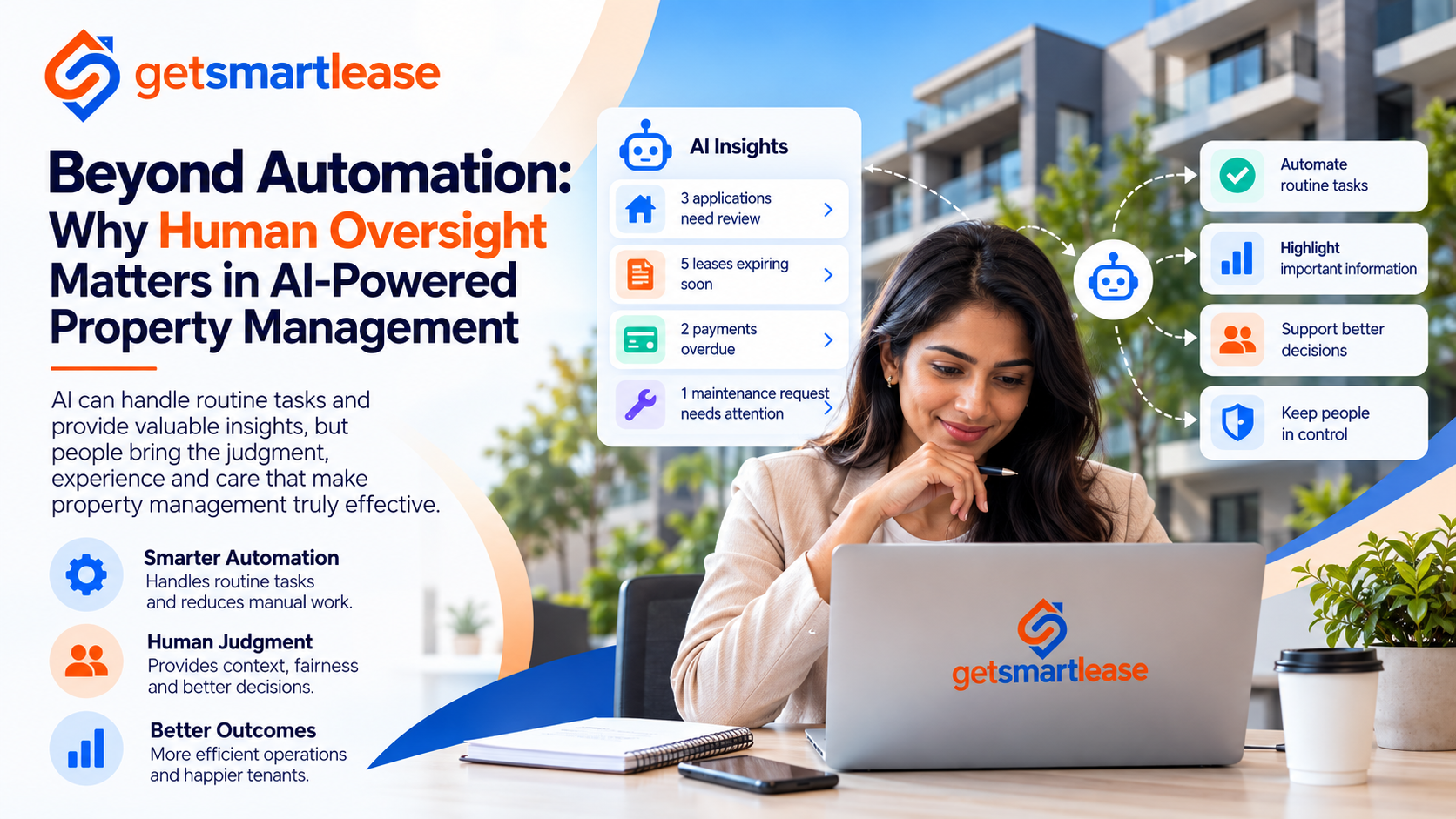
Artificial intelligence is becoming an important part of modern property management.
From rental applications and payment processing to maintenance coordination and tenant communication, AI-powered tools are creating opportunities to make property operations faster, more organized, and more efficient.
But as property management becomes increasingly automated, an important question emerges:
How much responsibility should we give to AI, and when should people remain involved?
While automation can simplify repetitive tasks, property management involves real people, financial responsibilities, contractual obligations, and decisions that directly affect tenants and property owners.
The future of intelligent property management isn't about removing human involvement.
It's about finding the right balance between automation and human judgment.
1. Automation Can Process Information, but Context Still Matters
AI systems can analyze large volumes of information much faster than traditional manual processes.
For example, an AI-powered property management system might identify:
Rental applications with missing documents
Payments that require follow-up
Maintenance requests that appear urgent
Leases approaching expiration
Unusual changes in property performance
These insights can help property teams prioritize their work.
However, not every situation can be understood through data alone.
A delayed payment might have a reasonable explanation. A maintenance issue may require special consideration. A rental application might involve circumstances that need additional review.
AI can identify patterns, but property managers provide the context needed to make responsible decisions.
2. Keeping People Involved in Important Rental Decisions
Rental applications are one area where human oversight is especially important.
AI can assist by checking document completeness, organizing applicant information, and highlighting inconsistencies.
But decisions about accepting or rejecting applicants should follow fair, consistent, and legally compliant processes.
Property managers must ensure that automated recommendations don't introduce unfair treatment or rely on inappropriate information.
A responsible approach involves using AI to support administrative work while maintaining meaningful human review for decisions affecting applicants.
This helps property teams benefit from automation without losing accountability.
3. AI-Assisted Communication Still Needs Empathy
Tenant communication is another area where automation offers significant benefits.
AI-powered tools can answer routine questions, provide application updates, send reminders, and help categorize enquiries.
For straightforward requests, automated responses can improve convenience.
But consider situations involving:
Financial difficulties
Tenant complaints
Lease disputes
Emergency maintenance
Personal circumstances
Sensitive requests
These conversations often require empathy, flexibility, and careful judgment.
A generic automated response may not adequately address the tenant's situation.
The strongest communication systems should recognize when a conversation needs human attention and provide a smooth way to escalate it.
4. Financial Automation Requires Accuracy and Accountability
Automated payment workflows can simplify rent collection and financial administration.
Systems may help generate invoices, track payments, send reminders, and update account statuses.
However, financial processes also require strong controls.
An incorrect payment status, duplicate transaction, or inaccurate invoice could create confusion for both tenants and property managers.
For this reason, automated financial workflows should include:
Payment validation
Clear transaction records
Error detection
Exception handling
Appropriate approval controls
Audit trails
Automation should make financial processes more reliable, not simply faster.
5. Building Trust Through Transparent Automation
When AI becomes part of property management, transparency matters.
Property managers need to understand what their systems are doing.
Tenants should also receive clear information when automated processes affect their experience.
For example, if an automated workflow sends a payment reminder, the property team should be able to identify why the reminder was triggered.
If an AI system flags an application for review, staff should be able to examine the underlying information rather than blindly accepting the recommendation.
Transparency makes automation easier to manage, evaluate, and improve.
Technology becomes more valuable when people can understand and trust its actions.
6. Human Oversight Helps Prevent Small Errors From Becoming Bigger Problems
Automation can execute repetitive tasks consistently, but incorrect configurations or inaccurate information can also cause repeated mistakes.
Imagine an automated workflow sending renewal reminders based on an incorrect lease expiration date.
Without monitoring, the same error could affect multiple tenants.
Human oversight helps identify these problems before they spread.
Property management teams should regularly review:
Automated notifications
Workflow rules
AI-generated recommendations
Data accuracy
Exception reports
Customer feedback
The goal is not to manually check every automated action.
Instead, teams should establish controls that identify unusual activity and bring important exceptions to the appropriate people.
7. The Role of AI in Supporting Better Decisions
One of AI's greatest opportunities in property management is decision support.
Rather than making every decision automatically, AI can help property managers understand their options.
For example, a system could highlight properties with increasing maintenance costs, identify recurring service issues, or summarize outstanding lease activities.
These insights allow property teams to investigate potential problems and make more informed decisions.
The relationship becomes collaborative:
AI analyzes information.
Automation coordinates routine actions.
People provide judgment and accountability.
This approach combines technological efficiency with professional experience.
8. Designing Property Management Workflows With Human Oversight
Not every workflow needs the same level of human involvement.
A useful approach is to classify tasks based on their complexity and potential impact.
Low-risk routine tasks
Examples include sending general notifications, organizing documents, and updating routine workflow statuses.
These activities may be suitable for automation with appropriate monitoring.
Tasks requiring review
Examples include identifying unusual payment activity, reviewing incomplete applications, or prioritizing maintenance requests.
AI can assist, but staff may need to verify the information before taking action.
High-impact decisions
Examples include application rejections, lease disputes, financial adjustments, and legal or contractual decisions.
These require appropriate human oversight and clearly defined approval processes.
By matching the level of automation to the importance of the decision, property management businesses can create safer and more dependable workflows.
9. Preparing Property Teams for AI Adoption
Successful AI adoption isn't only about choosing the right technology.
Property teams also need to understand how to work alongside it.
Employees should know:
Which processes are automated
What information AI uses
When human review is required
How to correct inaccurate information
How to escalate unusual situations
Who is responsible for important decisions
Clear procedures and training help teams use AI confidently while maintaining control over property operations.
10. The Future Is Human-Centered Automation
The most effective property management platforms won't necessarily be those that automate the greatest number of tasks.
They will be those that automate the right tasks.
Routine administration can happen automatically.
AI can organize information and identify patterns.
Property managers can concentrate on complex situations, relationships, service quality, and decisions that require experience.
This creates a more balanced approach to digital transformation.
Instead of replacing human expertise, intelligent technology makes that expertise more effective.
Final Thoughts
AI and automation are creating exciting possibilities for property management.
They can reduce repetitive work, improve visibility, accelerate workflows, and help property teams deliver more consistent service.
But efficiency alone shouldn't define successful automation.
Accuracy, fairness, transparency, accountability, and tenant trust matter just as much.
The future of property management isn't simply about making systems more intelligent.
It's about using that intelligence responsibly.
Because the smartest property management technology doesn't remove people from important decisions—it helps them make better ones.
GetSmartLease — Smarter Property Management, Better Experiences.
Explore more insights at https://blog.getsmartlease.com/