
Digital Leasing Has a Clarity Problem
The rental journey has become increasingly digital.
Prospective tenants can submit applications online, upload documents, receive approvals, sign agreements electronically, and make payments without visiting a property management office.
Yet a process can be completely digital and still leave people asking:
What happens next?
For tenants, uncertainty might mean wondering whether a document was received or whether another action is required.
For property teams, it might mean checking applications individually, searching for missing information, or following up manually because it's unclear who needs to act.
The next opportunity for digital leasing isn't simply adding more technology.
It's creating clarity at every stage.
1. Start With Clear Application Requirements
A smooth digital journey begins before the applicant clicks "Submit."
Applicants should understand what information and documentation they need to provide.
If requirements aren't clear, applications may arrive incomplete, creating additional work for both sides.
A well-designed digital application can communicate:
- Required personal information
- Supporting documents
- Important rental details
- Mandatory fields
- Outstanding requirements
Instead of discovering missing information later, applicants can address it earlier.
2. Confirm What's Been Completed
Submitting information into a digital system shouldn't feel like sending it into a black box.
Once an applicant completes an important action, provide confirmation.
For example:
Application successfully submitted.
Documents received.
Application approved.
Lease successfully signed.
Payment received.
These small confirmations provide reassurance while reducing unnecessary status enquiries.
3. Separate Status From Action
Knowing the current status is useful.
Knowing what to do next is even more useful.
Consider:
Status: Lease Sent
That's informative, but it doesn't necessarily explain the next action.
Now compare it with:
Status: Lease Sent
Next action: Tenant to review and sign
The second version immediately clarifies responsibility.
Digital leasing workflows become easier to manage when every stage answers two questions:
Where are we?
Who needs to do what next?
4. Make Missing Requirements Visible
One missing document can hold up an otherwise complete application.
But if nobody realizes something is missing, the application can simply remain waiting.
Property teams should be able to identify incomplete applications without manually opening every record.
Applicants should also receive clear guidance about outstanding requirements.
Instead of:
Application incomplete
provide something actionable:
Action required: Upload proof of identification.
Clarity turns a problem into a task that can be completed.
5. Make Internal Responsibilities Clear
Not every leasing action belongs to the applicant.
Property teams may need to review information, approve applications, prepare agreements, counter-sign documents, confirm payments, or complete move-in preparations.
Without clear ownership, tasks can remain unattended.
A connected workflow can assign or surface the next responsibility:
Review required — Leasing Team
Approval required — Property Manager
Signature required — Tenant
Counter-signature required — Property Manager
Everyone can see where responsibility currently sits.
6. Use Communication to Support the Workflow
Digital leasing communication works best when it is connected to actual progress.
Instead of sending generic messages, updates can correspond with meaningful events.
For example:
We've received your application and it is now being reviewed.
Or:
Your application has been approved. Your lease is being prepared.
Or:
Your lease is complete. Please finish the remaining move-in requirements.
This makes communication useful rather than simply frequent.
7. Show Progress Without Overwhelming the Tenant
Tenants don't need to see every internal property management task.
They need enough information to understand their own journey.
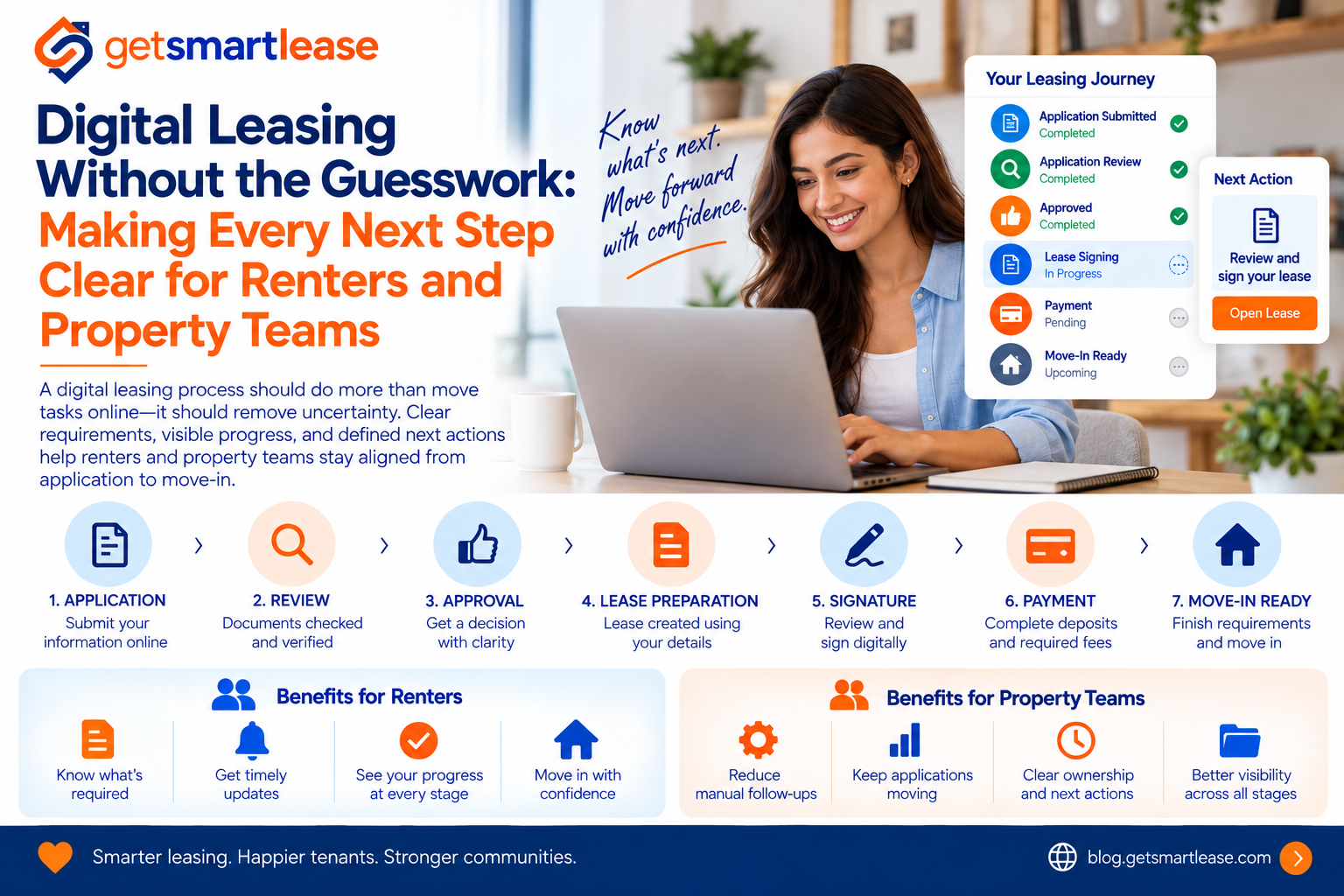
A simple progress view might show:
Application Submitted ✓
Application Review ✓
Approved ✓
Lease Signing — In Progress
Payment — Upcoming
Move-In — Upcoming
A clear progress indicator can communicate a large amount of information without requiring lengthy explanations.
8. Make Payments Part of the Journey
Payment requirements can create another point of uncertainty.
After signing, tenants may wonder:
How much do I need to pay?
When is it due?
Has my payment been received?
Is anything else outstanding?
Digital leasing can make payment requirements part of the same journey instead of treating them as an unrelated process.
The transition becomes clearer:
Lease Signed → Payment Required → Payment Confirmed → Move-In Preparation
9. Create a Clear Move-In Finish Line
The final stage should answer one important question:
Am I ready to move in?
There may still be several requirements after signing and payment.
A move-in checklist could include:
- Required payments completed
- Documents submitted
- Lease fully executed
- Move-in date confirmed
- Property instructions provided
- Access or key arrangements confirmed
Once everything is complete, the tenant reaches a simple, meaningful status:
Move-In Ready ✓
Fewer Questions Can Signal a Better Process
Tenant questions aren't necessarily a problem. Personal communication remains an important part of property management.
But repeated questions such as:
“Did you receive my document?”
“What's happening with my application?”
“Do I need to do anything?”
“What happens next?”
can reveal places where the process itself isn't communicating clearly enough.
Good digital leasing doesn't eliminate communication.
It eliminates avoidable uncertainty.
Clarity Helps Property Teams Too
The same principles that make leasing easier for tenants can improve internal operations.
Property teams gain better visibility into:
- Applications requiring attention
- Outstanding documents
- Pending reviews
- Required approvals
- Unsigned agreements
- Outstanding payments
- Upcoming move-ins
Instead of searching for work, teams can focus on completing it.
From Digital Process to Guided Journey
Moving leasing online was an important first step.
Connecting the stages made the process stronger.
The next improvement is making the entire journey easier to understand.
At every stage, tenants and property teams should be able to answer:
What's complete?
What's happening now?
Who needs to act?
What's next?
When those answers are clear, digital leasing becomes more than a collection of online tasks.
It becomes a guided rental journey.
Make the Next Step Obvious
The best digital experiences often feel simple because they don't make users figure out what to do.
Digital leasing should work the same way.
From the first application to the final move-in confirmation, each completed action should naturally lead toward the next one.
For property teams, that can mean fewer manual follow-ups and better control over leasing activity.
For tenants, it can mean less uncertainty and a rental journey that's easier to navigate.
Because a smarter digital leasing process doesn't just move people forward—it makes the path forward clear.