
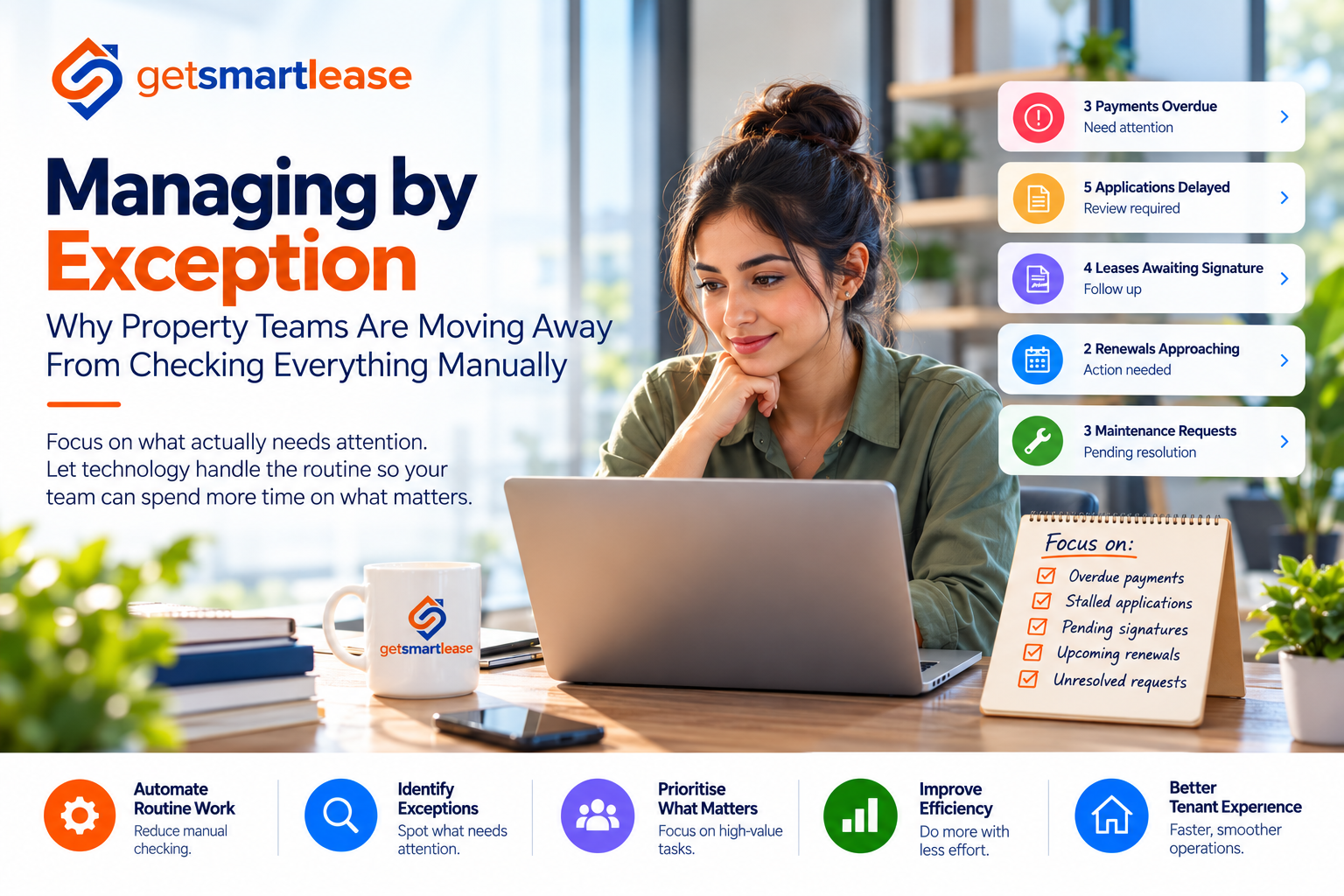
A large part of property management involves checking.
Checking whether rent has been paid.
Checking whether an applicant submitted the required documents.
Checking whether a lease has been signed.
Checking whether a tenant request has been resolved.
Checking which leases are approaching renewal.
Individually, these checks may only take a few minutes. Across hundreds of tenants, leases, payments, and applications, however, they can consume a significant amount of a property team's time.
Technology is beginning to change this model.
Instead of asking employees to continuously check whether everything is working correctly, property management systems can increasingly identify situations where something isn't progressing as expected.
This approach is known as management by exception.
And it could become an important part of the next generation of rental operations.
1. The Problem With Checking Everything
Imagine a property manager responsible for 500 active leases.
Most tenants may pay on time.
Most documents may be submitted correctly.
Most lease processes may progress without problems.
Yet employees may still need to review large amounts of information simply to confirm that everything is normal.
That creates an inefficient situation.
Teams spend valuable time checking routine processes instead of focusing on the smaller number of cases that actually require attention.
Exception-based management reverses that approach.
Instead of asking:
“Is everything okay?”
the system helps answer:
“What isn't okay?”
2. What Is an Exception?
An exception is something that falls outside the expected workflow.
In rental operations, that could include:
- A payment becoming overdue
- An application remaining under review too long
- A required document being missing
- A lease waiting for a signature
- A renewal deadline approaching
- A tenant request remaining unresolved
- A workflow failing to progress
- A transaction requiring verification
These situations don't necessarily mean something has gone seriously wrong.
They simply indicate that human attention may be required.
3. Applications Are a Natural Starting Point
Rental applications involve multiple steps.
An applicant may need to complete forms, upload documents, pass through review, receive approval, sign a lease, and complete required payments.
Most applications may progress normally.
But some will stall.
Instead of employees manually opening every application to check its progress, a system can surface applications where something unusual has happened.
For example:
Application incomplete for 3 days → Needs attention
Required document missing → Follow-up required
Review taking longer than expected → Check status
The property team can then focus on those specific applications.
4. Payment Management Can Become More Focused
Payments are another strong example.
If hundreds of tenants are paying rent, employees shouldn't necessarily need to manually verify every successful transaction.
The more valuable information is often the exceptions.
For example:
Payment failed
Payment overdue
Unexpected transaction status
Payment received but not matched
Required lease fee outstanding
Instead of searching for payment problems, the system can bring those problems directly to the team's attention.
5. Lease Management Can Highlight What Needs Action
Lease management contains many dates and milestones.
There are lease start dates, expiration dates, renewal periods, signatures, amendments, cancellations, and other events.
Monitoring all of them manually becomes increasingly difficult as a portfolio grows.
Exception-based workflows can highlight situations such as:
📅 Lease approaching expiry
✍️ Signature still outstanding
📄 Required document missing
🔄 Renewal decision pending
⚠️ Lease workflow stalled
Employees can then focus on leases requiring action rather than repeatedly reviewing every active lease.
6. Dashboards Are Changing From Reporting to Prioritization
Traditional dashboards answer questions such as:
How many applications do we have?
How much rent was collected?
How many leases are active?
Those metrics remain useful.
But operational dashboards are increasingly expected to answer another question:
“What should I work on next?”
Instead of simply showing:
42 applications under review
a dashboard could highlight:
5 applications have been waiting longer than expected.
Instead of:
380 active leases
it could show:
12 leases require renewal action this month.
The dashboard becomes less about displaying numbers and more about directing attention.
7. Automation Makes Exception Management Possible
Exception-based management works best when routine processes are automated.
If an application progresses normally, the workflow can continue.
If a payment succeeds, the transaction can be recorded.
If a required document arrives, the process can move forward.
Human intervention becomes necessary mainly when something doesn't happen as expected.
This creates a different relationship between people and technology.
Software handles predictable processes.
People handle exceptions.
8. AI Could Help Determine What Matters Most
Not every exception has the same urgency.
A document that is one day late may not require the same attention as a failed payment or a lease expiring tomorrow.
This is where AI could become increasingly useful.
AI-assisted property systems may eventually help evaluate multiple operational signals and prioritize them.
Instead of presenting employees with 50 notifications, the system could identify the five situations most likely to require immediate attention.
That would move property technology from simply detecting exceptions toward prioritizing them intelligently.
9. Property Managers Can Spend More Time Managing
There is an important human benefit to this shift.
Property managers are valuable because they can communicate, negotiate, solve problems, make decisions, and manage relationships.
They shouldn't need to spend most of their time confirming that routine processes happened correctly.
When technology handles monitoring, employees can spend more time on work where human judgment actually matters.
That could include:
- Supporting tenants
- Resolving complex issues
- Managing property performance
- Working with owners
- Improving occupancy
- Planning renewals
- Making operational decisions
Technology doesn't replace the property manager.
It helps remove some of the unnecessary checking around the role.
From Monitoring Everything to Managing What Matters
Property operations are gradually moving through an important evolution:
Manual Checking → Automated Tracking → Exception Detection → Prioritization → Intelligent Assistance
The goal isn't to eliminate oversight.
It's to make oversight more focused.
Instead of employees constantly searching for problems, systems can help bring the right problems to the right people at the right time.
What This Means for Property Teams
As rental operations become increasingly digital, property teams can ask:
- Does our system tell us what requires attention?
- Can we identify stalled workflows automatically?
- Are overdue payments clearly surfaced?
- Can upcoming lease actions be prioritized?
- Can routine processes continue without manual checking?
- Can employees quickly understand why something has been flagged?
These capabilities can become particularly valuable as portfolios grow.
Looking Ahead
Property management has spent years becoming more digital.
The next challenge is making those digital operations easier to manage at scale.
More dashboards, notifications, and data aren't necessarily the answer.
Property teams need technology that helps separate routine activity from meaningful exceptions.
That's why management by exception could become an increasingly important industry trend.
The future of property operations may not involve property managers watching everything.
It may involve technology watching the routine—and bringing people in when their attention actually matters.