
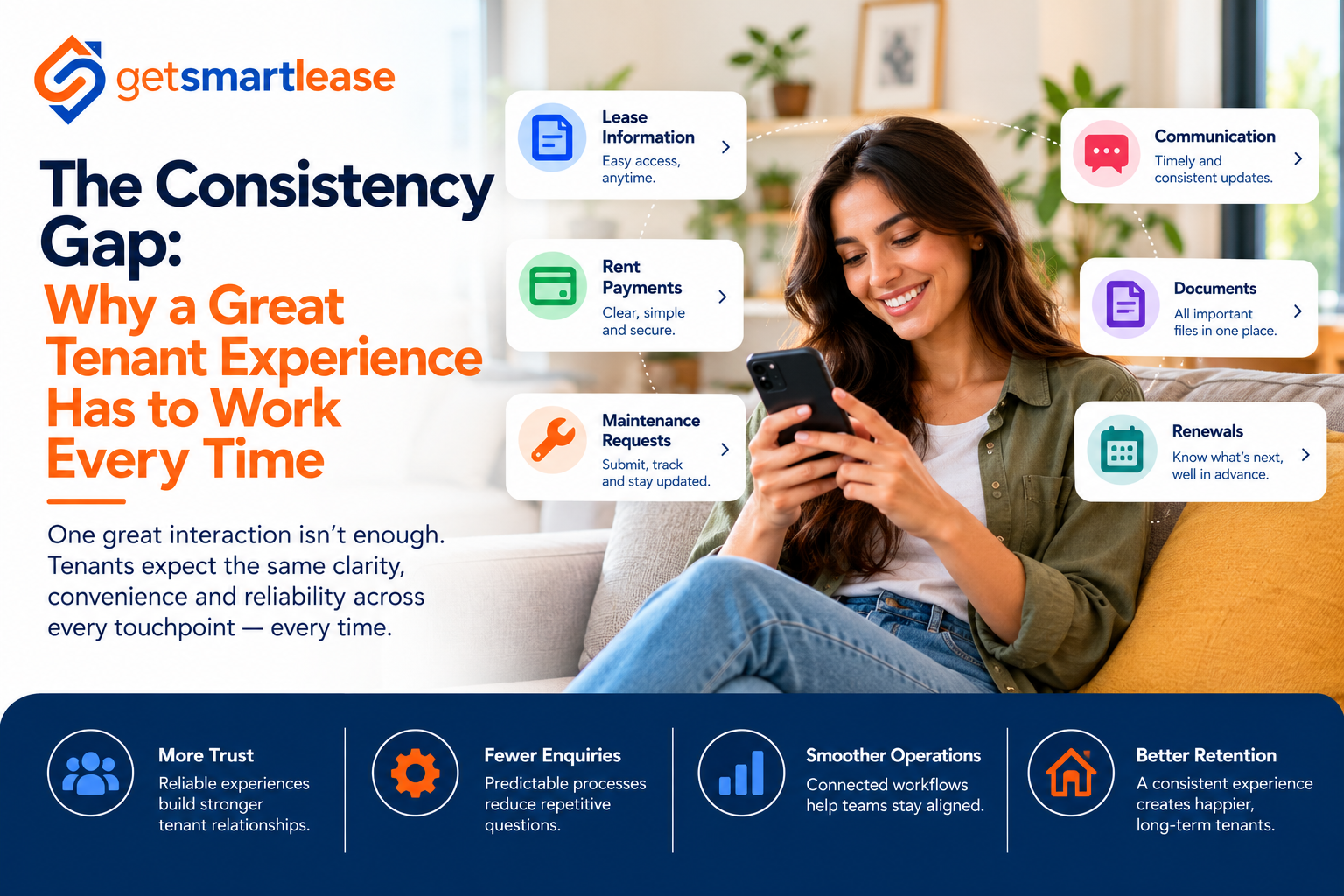
A Great Experience Once Isn't Enough
Imagine a tenant's first maintenance request.
They submit it easily, receive an immediate confirmation, get regular updates, and have the issue resolved without needing to follow up.
A few months later, they submit another request.
This time, there's no confirmation.
They wait.
They send an email.
Then they call the property office because they aren't sure whether anyone received the request.
The same property management company has delivered two completely different experiences.
And that's where an important tenant experience problem begins:
inconsistency.
Tenants don't judge property management based only on its best interaction. Their overall perception develops through dozens of everyday experiences throughout the tenancy.
The goal, therefore, isn't simply to create good experiences.
It's to make good experiences repeatable.
1. Tenants Experience One Property Management Brand
Inside a property management organization, responsibilities may be divided across different teams.
One team handles leasing.
Another handles payments.
Another manages maintenance.
Someone else may handle renewals or tenant enquiries.
Those divisions make sense operationally.
But tenants don't necessarily see them.
From their perspective, they're interacting with one property management company.
If lease communication is excellent but maintenance communication is confusing, the tenant doesn't think:
"The leasing team was good, but the maintenance workflow needs improvement."
They simply experience inconsistency.
That means every team contributes to the same tenant relationship.
2. Make Common Processes Predictable
Predictability is one of the simplest ways to reduce tenant frustration.
When tenants perform a familiar action, they should have a reasonable idea of what will happen next.
For example, after submitting a maintenance request:
Submitted → Confirmed → Assigned → Updated → Completed
After making a payment:
Payment initiated → Processed → Confirmed → Recorded
During renewal:
Renewal notice → Terms reviewed → Decision → Documentation → Confirmation
Processes don't need to be identical.
But they should follow clear patterns.
When tenants understand the process, they spend less time wondering what happens next.
3. Standardize Important Communications
Communication can quickly become inconsistent when every property manager handles the same situation differently.
One tenant may receive detailed maintenance updates.
Another may receive only a completion message.
Another may receive nothing unless they ask.
Creating communication standards can help.
For common situations, property teams can establish when tenants should receive updates.
Examples include:
- Maintenance request received
- Maintenance scheduled
- Maintenance delayed
- Payment received
- Payment overdue
- Document available
- Inspection scheduled
- Lease approaching expiration
- Renewal request received
Templates can also help maintain clarity while still allowing property managers to personalize messages when necessary.
Consistency doesn't mean sounding robotic.
It means making sure important information isn't forgotten.
4. Keep Information Consistent Across Channels
Another source of frustration occurs when different channels provide different information.
Imagine that a tenant portal shows one payment status while an email says something else.
Or a tenant receives a renewal date in one message that doesn't match the date shown elsewhere.
Even small discrepancies can reduce confidence.
Property managers should aim for a single reliable source of information wherever possible.
Tenant, lease, payment, document, and maintenance information should remain connected so that teams aren't working from conflicting records.
When information is consistent internally, communication becomes more reliable externally.
5. Create a Consistent Maintenance Experience
Maintenance is one of the areas where consistency matters most because it directly affects the tenant's home.
Not every maintenance issue can be resolved at the same speed.
A leaking pipe and a broken cupboard handle naturally require different priorities.
But the experience around the repair can still be consistent.
Every tenant should know:
- How to report an issue
- Whether the request was received
- What its current status is
- Whether access is required
- When something changes
- When the request is completed
Even when resolution times differ, the process should remain understandable.
6. Don't Make Tenants Repeat Themselves
Consistency also means preserving context.
Suppose a tenant contacts the property team about an unresolved issue.
If they have to explain the entire situation every time they speak with someone new, the experience feels disconnected.
Property teams should be able to understand previous interactions and see relevant information.
That might include:
- Previous enquiries
- Maintenance history
- Lease information
- Documents
- Payment information
- Previous updates
The tenant shouldn't have to become the record-keeping system.
Connected information allows the conversation to continue instead of restarting every time.
7. Use Automation to Support Consistency
Many inconsistent experiences aren't caused by poor service.
They're caused by busy teams.
Someone forgets to send an update.
A reminder isn't sent.
A status changes but the tenant isn't informed.
Automation can help make routine communication more dependable.
For example:
Maintenance submitted → automatically acknowledge it
Payment completed → send confirmation
Inspection approaching → send reminder
Lease approaching expiration → alert the relevant team
Automation is particularly useful for predictable events.
It doesn't replace human interaction.
It helps ensure that basic steps happen consistently even when teams are busy.
8. Make Self-Service Consistent Too
Tenant self-service should follow the same principle.
If tenants can view payment information online, they should also be able to understand its status.
If they can submit maintenance requests digitally, they should be able to track what happens afterward.
If documents are available online, they should be organized and easy to identify.
Offering a digital feature without completing the experience can create new frustration.
A useful question is:
Can the tenant complete the whole routine task without unnecessary assistance?
If the answer is no, there may still be a gap in the experience.
9. Learn From Exceptions
Even well-designed processes sometimes fail.
A maintenance request may be delayed.
A notification may not reach the tenant.
A payment may require manual investigation.
These exceptions can provide valuable information.
Instead of treating them only as isolated problems, property managers can ask:
Why did the normal process fail?
Could the same thing happen again?
Can the workflow be improved?
This approach turns operational exceptions into opportunities to strengthen the overall tenant experience.
10. Measure Experience Across the Entire Tenancy
A single satisfaction score doesn't always tell the full story.
A tenant may have an excellent move-in experience but poor maintenance experiences later.
Or they may have smooth payments throughout the year but encounter confusion during renewal.
Property managers should therefore look across different tenant touchpoints.
For example:
Move-In → Payments → Maintenance → Communication → Documents → Renewal
Where are tenants contacting the team most frequently?
Where are delays occurring?
Which processes generate repeated questions?
Where does feedback become negative?
Looking at the entire journey can reveal inconsistencies that aren't visible when each process is measured separately.
Consistency Builds Trust
Tenant trust isn't usually created by one impressive interaction.
It's created when tenants repeatedly experience reliable service.
They know where to find information.
They know how to report a problem.
They receive confirmation when they complete an action.
They understand what happens next.
And when something changes, they're informed.
Over time, these predictable interactions create confidence.
The tenant doesn't need to wonder:
"Will this work properly this time?"
They already know what to expect.
Create More Connected Experiences With GetSmartLease
As property portfolios grow, maintaining consistency across tenants, properties, leases, payments, documents, and everyday operational activities becomes increasingly difficult.
GetSmartLease helps bring key property management processes together, giving teams greater visibility across the tenant lifecycle.
Connected workflows can help reduce information gaps, support more consistent processes, and make it easier for property teams to deliver reliable tenant experiences at scale.
Because a great tenant experience shouldn't depend on the day, the team member, or the type of request.
It should work every time.