
Property Operations Are Full of Handoffs
A rental process may begin with one person, but it rarely stays with them.
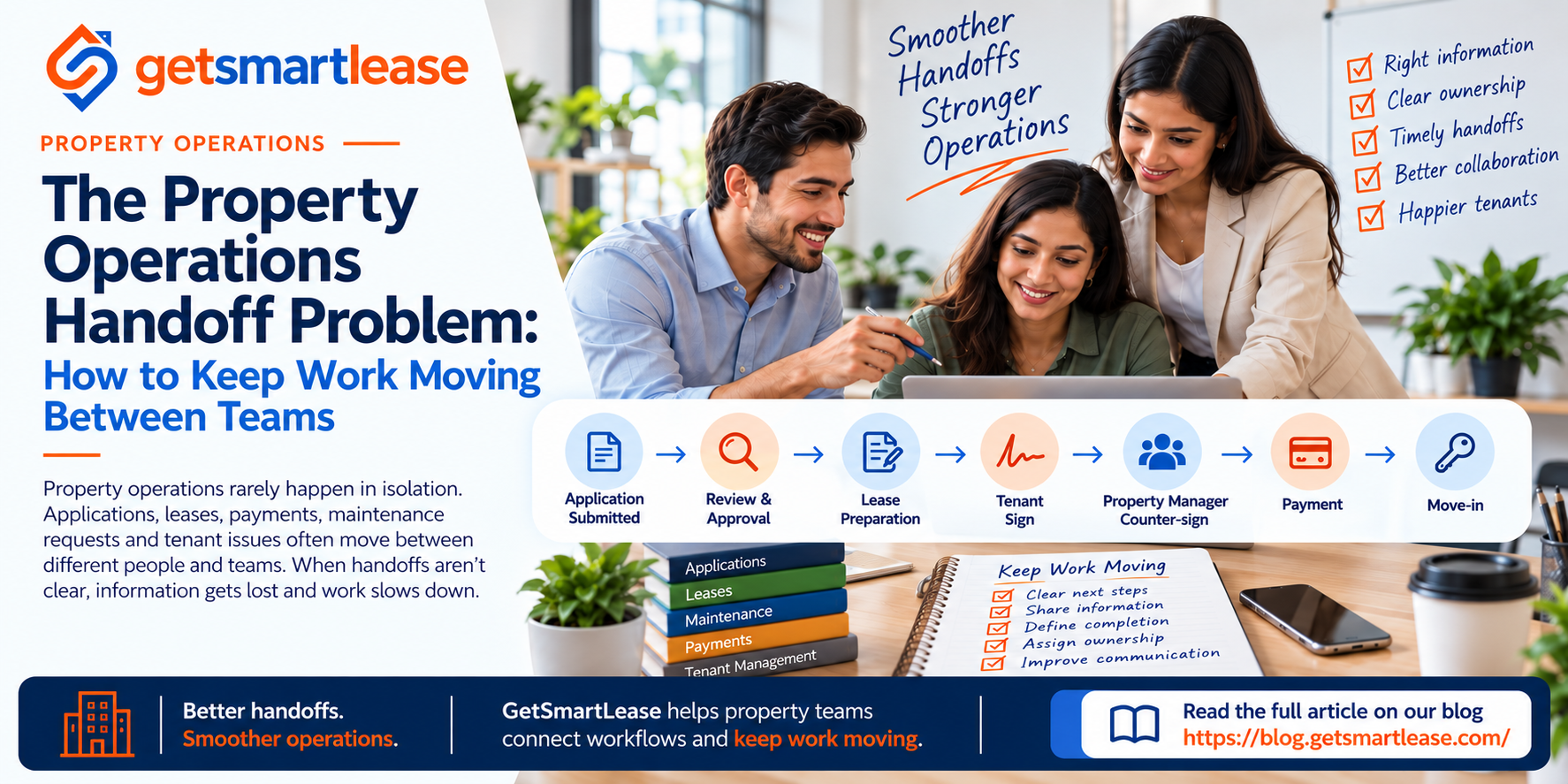
A tenant submits an application.
Someone reviews it.
Another person prepares the lease.
The tenant signs.
The property manager counter-signs.
Payment is completed.
Documents are stored.
The tenant moves in.
Each stage may involve a different person, system, or responsibility.
The same thing happens with maintenance, payments, renewals, tenant queries, inspections, and move-outs.
That means one of the biggest operational risks isn't necessarily the task itself.
It's the handoff between tasks.
What Is an Operational Handoff?
A handoff happens whenever responsibility for a process moves from one person, team, or stage to another.
For example:
Application submitted → Application review
Application approved → Lease preparation
Lease signed → Payment
Maintenance request → Contractor assignment
Contractor completion → Tenant confirmation
Lease approaching expiry → Renewal process
Every arrow represents a moment when information and responsibility need to move together.
If either one gets lost, the workflow can stall.
1. Make the Next Owner Clear
A common handoff problem is simple:
Everyone knows the current task is finished, but nobody knows who owns the next one.
Imagine an application has been approved.
What happens next?
Does someone automatically start preparing the lease?
Does the leasing team receive a notification?
Does the property manager need to manually check approved applications?
Without clear ownership, completed work can sit waiting unnecessarily.
Every workflow should answer:
Who owns the next step?
Clear ownership keeps work moving without requiring someone to constantly coordinate it manually.
2. Carry Information Forward
Tenants shouldn't need to provide the same information repeatedly simply because their application moved to another stage.
The same applies internally.
If information has already been collected during an application, relevant details should be available when preparing the lease.
If maintenance history exists for a unit, teams handling a new issue should be able to reference it.
If a tenant query has already been discussed with another team member, the next person shouldn't have to reconstruct the entire conversation.
Good handoffs carry context forward.
3. Define What “Complete” Actually Means
Sometimes work is handed off before it is truly ready.
An application may be marked reviewed even though a required document is missing.
A maintenance request may be marked completed before the tenant confirms the issue has been resolved.
A lease may move forward before all signatures are collected.
Clear completion criteria help prevent incomplete work from creating problems later in the process.
Before moving to the next stage, teams should know exactly what must be finished.
4. Make Status Changes Trigger the Next Step
Statuses shouldn't exist only for reporting.
They can also help drive workflows.
For example:
Application Approved
→ Begin lease preparation
Lease Sent
→ Wait for tenant signature
Tenant Signed
→ Request property manager signature
Lease Fully Signed
→ Continue to payment or move-in preparation
Maintenance Completed
→ Request tenant confirmation
When status changes are connected to next actions, fewer transitions depend entirely on someone remembering what to do.
5. Keep Communication With the Process
Important operational information often disappears into email threads, messages, or phone conversations.
This becomes particularly problematic during handoffs.
The next person may see the task but not understand what has already been discussed.
Where possible, relevant communication should remain connected to the tenant, property, application, lease, or request it relates to.
That gives the next person context without forcing them to search through separate channels.
6. Avoid the “I Thought Someone Else Was Doing It” Problem
This phrase reveals one of the most common operational failures.
When responsibility is implied rather than assigned, tasks can remain untouched.
A stronger workflow makes responsibility visible.
For each important item, teams should be able to identify:
Current owner
Current status
Next action
Due date
Next owner
That creates accountability while making collaboration easier.
7. Use Automation at Predictable Handoffs
Many handoffs happen repeatedly and predictably.
These are ideal opportunities for automation.
For example:
Application approved → Notify leasing team
Document uploaded → Notify reviewer
Tenant signs lease → Notify property manager
Payment received → Update payment status
Maintenance assigned → Notify responsible person
Lease approaching expiry → Create renewal task
Automation doesn't need to make every decision.
Sometimes its most valuable role is simply making sure the right person knows that it's their turn.
8. Give Managers Visibility Into Stalled Work
Even well-designed workflows occasionally get stuck.
Managers need a way to identify these situations quickly.
Instead of reviewing every application, lease, maintenance request, or payment individually, they should be able to see exceptions such as:
Applications waiting too long for review
Leases awaiting signatures
Missing documents
Maintenance requests without updates
Payments requiring follow-up
Renewals without decisions
Tasks without assigned owners
This changes management from constantly checking everything to focusing on work that actually needs intervention.
Smooth Handoffs Create Smoother Tenant Experiences
Operational handoffs aren't only an internal efficiency issue.
Tenants experience them too.
When handoffs fail, tenants may be asked for information twice, wait longer for responses, receive conflicting updates, or have to contact the property manager to find out what's happening.
When handoffs work well, the experience feels continuous.
The tenant doesn't need to understand which department or workflow stage is involved.
They simply see that progress continues.
Build Continuous Property Operations
Efficient property operations aren't just a collection of well-managed individual tasks.
They're connected processes.
Applications should flow into leasing.
Leasing should flow into payments and move-in.
Maintenance requests should flow from reporting to resolution.
Lease expirations should flow into renewals or move-outs.
Information, responsibility, and communication should move with them.
When those connections are clear, property teams spend less time chasing updates and more time moving work forward.
Connecting the Handoffs With GetSmartLease
GetSmartLease helps property teams manage important rental processes through more connected digital workflows.
By improving visibility across applications, leasing, documents, payments, tenant management, and ongoing property operations, teams can maintain context as work moves from one stage to another.
Because strong property operations aren't just about completing each task.
They're about making sure the next task starts without getting lost in between.