
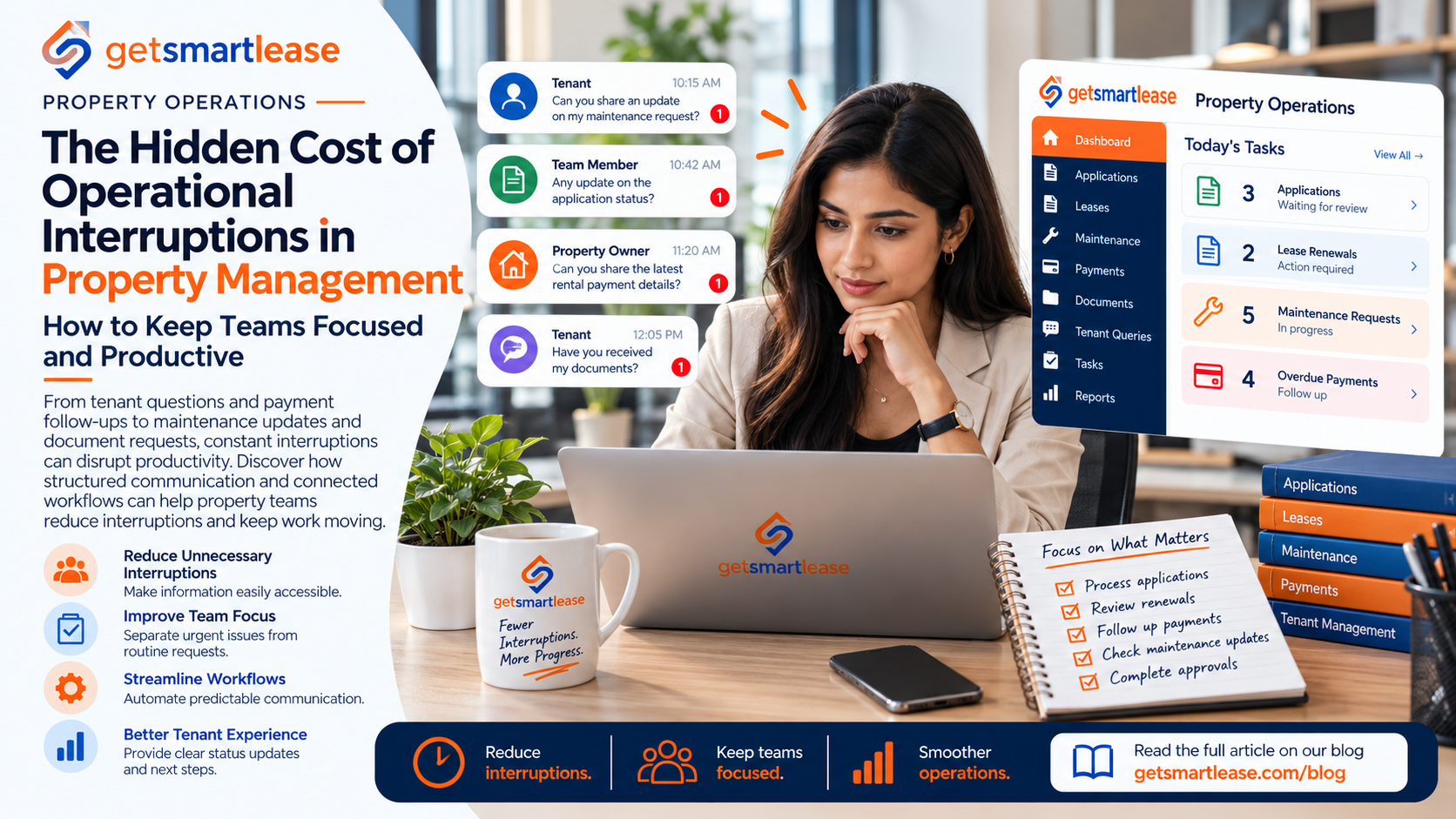
Property Management Is a Constant Balancing Act
A property manager starts the day with a clear plan.
There are lease renewals to review, tenant applications to process, outstanding payments to follow up on, and documents waiting for approval.
But before the first task is completed, the interruptions begin.
A tenant calls about a maintenance request.
A colleague asks for an application update.
An owner needs information about rental payments.
Someone cannot locate a signed lease agreement.
Another tenant wants to know whether their documents were received.
By lunchtime, the original task list has barely moved.
This is a common operational challenge in property management: the hidden cost of constant interruptions.
While responding to people is an essential part of the job, repeatedly switching between tasks can make everyday operations less efficient.
The solution isn't to stop communicating. It's to build processes that reduce unnecessary interruptions.
1. Understand Where Interruptions Come From
Not every interruption is unexpected.
Many are caused by missing information, unclear responsibilities, or limited visibility into existing processes.
Common sources include:
Tenants requesting updates on maintenance issues
Staff checking application or lease statuses
Owners asking for payment information
Repeated document requests
Unclear task ownership
Manual approval follow-ups
Questions about upcoming lease deadlines
When information isn't readily accessible, people naturally turn to phone calls, emails, and messages.
Over time, these requests can consume a significant portion of the working day.
The first step toward reducing interruptions is identifying which questions could be answered without requiring another person's involvement.
2. Make Information Accessible Before Someone Asks
Many interruptions happen because someone needs information that already exists.
For example, a tenant may contact the property manager simply to confirm whether an application has been received.
A team member may ask whether a lease has been signed.
An owner may request a payment update that has already been recorded.
When relevant information is available through a centralized system, these questions become easier to answer.
Self-service access and clear status visibility can reduce unnecessary back-and-forth communication.
Instead of repeatedly asking for updates, users can check the progress of their requests when appropriate.
3. Separate Urgent Issues From Routine Requests
Not every incoming request needs immediate attention.
An emergency maintenance issue may require urgent action, while a general document inquiry may be handled through a normal workflow.
Without clear prioritization, property teams can spend too much time responding to whichever message arrived most recently.
A structured approach can classify requests based on urgency and operational impact.
For example:
Critical: Safety-related maintenance emergencies requiring immediate escalation.
High Priority: Issues affecting essential services or time-sensitive deadlines.
Routine: General inquiries, document requests, and standard administrative updates.
Clear priorities help teams respond appropriately while protecting time for important planned work.
4. Reduce Repeated Status-Checking
One of the most avoidable interruptions in property operations is the repeated question:
"Any update on this?"
These requests often arise when the next step or expected timeline isn't clear.
A maintenance request might be progressing normally, but the tenant has no visibility into its status.
A lease might be awaiting a signature, but the responsible team member doesn't know who needs to act.
Connected workflows can help address this by making progress visible.
For example:
Request Submitted → Under Review → Assigned → In Progress → Completed
When users can see relevant status changes and receive timely updates, they may have less need to request information manually.
5. Use Automation to Handle Predictable Communication
Many property management messages follow recurring patterns.
Payment reminders, lease renewal notifications, document requests, and application updates are examples of communication that can often be supported by automation.
Consider a tenant application workflow:
Application Submitted → Confirmation Sent
Documents Missing → Document Request
Application Reviewed → Status Update
Lease Ready → Signature Notification
Rather than manually sending every routine message, the system can help initiate communication at the appropriate stage.
This reduces repetitive administrative work while keeping tenants informed.
Automation should also allow human intervention when a situation requires explanation, judgment, or personal attention.
6. Protect Time for High-Value Property Management Work
Property managers do more than respond to requests.
They also need time for activities that support long-term operational performance.
These include:
Reviewing lease renewals
Monitoring outstanding payments
Planning property maintenance
Evaluating recurring tenant concerns
Improving operational processes
Coordinating with property owners
Reviewing portfolio performance
Constant interruptions can make these activities difficult to complete.
Better task organization and communication workflows can help teams protect focused working time without reducing service quality.
7. Give Every Request a Clear Owner
An interruption often becomes more disruptive when nobody knows who should handle it.
A tenant issue might be forwarded between several employees.
A document request may remain pending because responsibility is unclear.
A payment exception might require repeated internal discussions.
Clear ownership helps prevent this confusion.
Every operational request should ideally have:
A responsible person → A priority → A current status → A next action
This makes it easier to route requests appropriately and reduces unnecessary internal coordination.
8. Measure the Causes of Repeated Interruptions
Property teams can learn a great deal by reviewing the requests they receive most frequently.
For example:
Are tenants repeatedly asking about maintenance progress?
Do staff frequently search for lease documents?
Are payment questions increasing near month-end?
Are application updates generating unnecessary follow-ups?
Are certain workflows causing repeated internal clarification?
These patterns may reveal opportunities to improve communication, system visibility, or process design.
Instead of simply responding faster to every interruption, teams can address the underlying reason the interruption occurs.
Better Tenant Service Doesn't Require Constant Availability
Good tenant service is often associated with fast responses.
Responsiveness matters, especially when tenants face urgent problems.
But effective service also depends on clear information, predictable processes, and reliable communication.
When tenants understand what's happening and what comes next, they may not need to contact the property manager as frequently.
This creates a better experience for both sides.
Tenants receive greater clarity, while property teams can focus on completing work rather than repeatedly explaining its progress.
Build Property Operations That Support Focus
The goal of modern property operations isn't to eliminate every interruption.
Unexpected issues will always be part of managing rental properties.
The goal is to reduce avoidable interruptions and make necessary ones easier to handle.
Centralized information, clear task ownership, structured requests, automated updates, and better operational visibility can all contribute to a more productive working environment.
When teams spend less time searching for information and responding to repeated questions, they can devote more attention to decisions and activities that genuinely require their expertise.
How GetSmartLease Supports More Organized Property Operations
GetSmartLease helps property teams manage important rental activities through connected digital workflows.
By bringing applications, leasing, documents, payments, tenant information, and related processes into a more structured environment, property managers can improve operational visibility and reduce unnecessary administrative back-and-forth.
The result is a more organized approach to everyday rental management, where teams can focus on what matters instead of constantly chasing information.
Fewer interruptions. Clearer workflows. More productive property operations with GetSmartLease.
Discover smarter property management: https://blog.getsmartlease.com/