
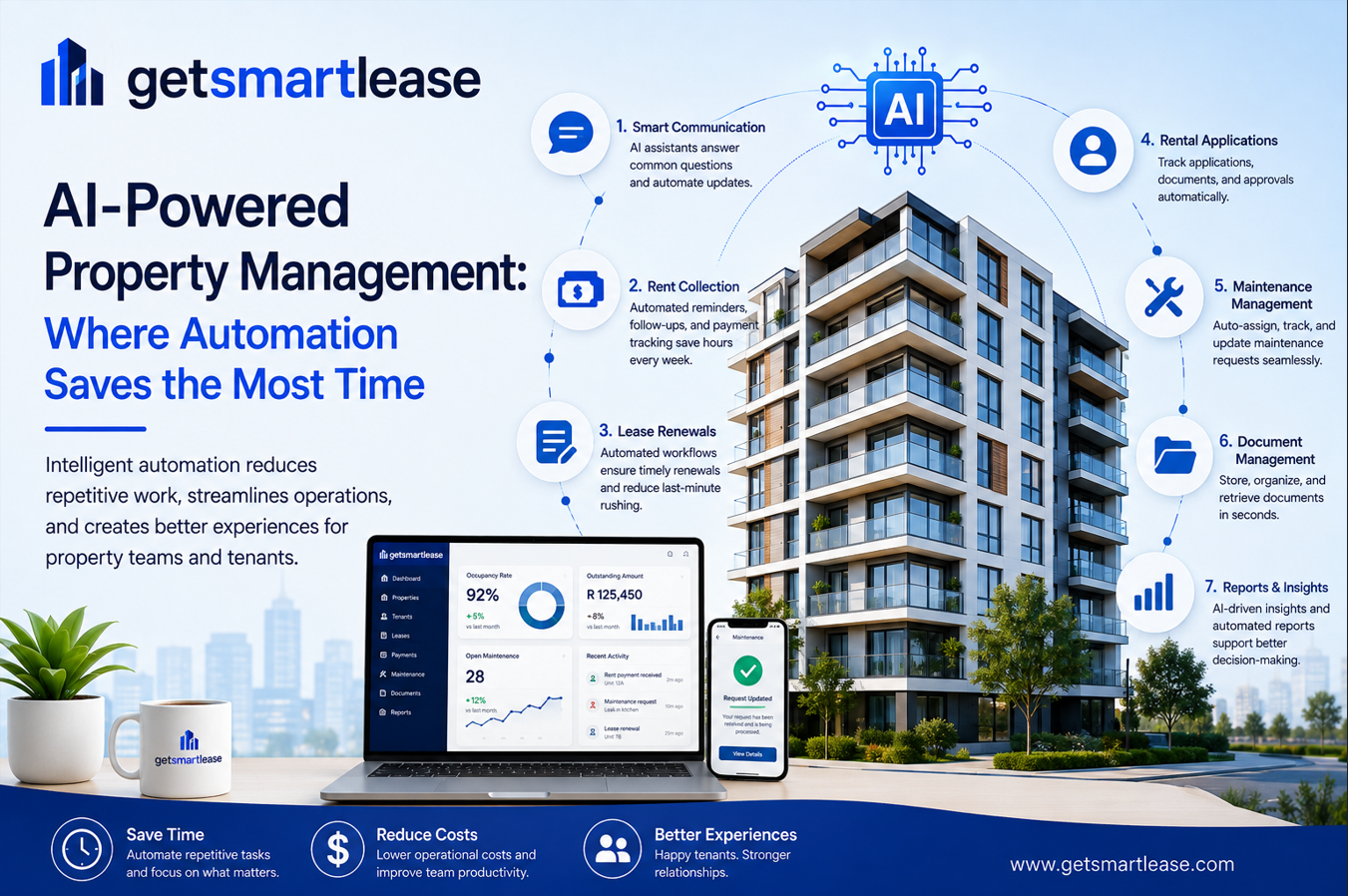
AI-Powered Property Management: Where Automation Saves the Most Time
Property management involves much more than managing buildings.
Every day, teams handle tenant enquiries, payments, lease documents, maintenance requests, applications, inspections, reminders, reports, and countless follow-ups.
Individually, these tasks may only take a few minutes. Across hundreds of tenants and properties, however, those minutes quickly become hours.
This is where AI and automation can make a significant difference.
Rather than simply adding more software, property management businesses can use intelligent automation to reduce repetitive work and allow their teams to focus on decisions and relationships that genuinely require human attention.
Here are some of the areas where automation can have the greatest impact.
1. Tenant Enquiries and Routine Communication
Property managers often answer the same questions repeatedly:
- When is my rent due?
- Where can I find my lease?
- Has my maintenance request been received?
- What documents do I need to submit?
- When does my lease expire?
AI-powered assistants can help answer common questions instantly using information already available within the property management system.
Automation can also send updates when something changes.
For example, tenants could automatically receive confirmation when a maintenance request is submitted, an application progresses, or a document becomes available.
This reduces repetitive communication while keeping tenants informed.
2. Rent Collection and Payment Follow-Ups
Manually checking payments and sending reminders can consume a considerable amount of administrative time.
Automated payment workflows can help manage the process from beginning to end.
A system can:
- Send upcoming payment reminders
- Notify tenants about overdue payments
- Record payment status
- Generate payment confirmations
- Escalate accounts requiring attention
Instead of reviewing every account manually, property managers can focus primarily on exceptions that require intervention.
3. Lease Renewal Management
Lease renewals involve dates, documents, communication, approvals, and follow-ups.
Without automation, important renewal activities can easily become last-minute tasks.
An automated workflow can monitor lease expiration dates and trigger actions at predetermined intervals.
For example:
90 days before expiry: Flag the lease for review.
60 days before expiry: Start the renewal process.
30 days before expiry: Send follow-ups where required.
This gives property managers a structured renewal process while reducing the need to manually track individual lease dates.
4. Rental Applications
Rental applications often require significant coordination.
Property managers may need to verify whether applicants have completed forms, submitted documents, signed agreements, or responded to requests.
Automation can track these steps automatically.
Instead of repeatedly checking each application, teams can see which applications are progressing normally and which require attention.
AI could further assist by organizing information and highlighting incomplete or unusual application data for human review.
The result is a faster and more organized application process.
5. Maintenance Coordination
Maintenance management involves communication between tenants, property managers, owners, and service providers.
Automation can simplify much of this coordination.
When a tenant reports an issue, the system could automatically:
- Create a maintenance request.
- Categorize the issue.
- Notify the appropriate team.
- Track its status.
- Send progress updates to the tenant.
- Close the workflow once completed.
AI can also help classify requests based on their descriptions and identify potentially urgent issues.
Property managers remain in control while spending less time coordinating routine updates.
6. Document Management
Property management generates a large number of documents.
These may include:
- Lease agreements
- Application documents
- Invoices
- Inspection reports
- Payment records
- Tenant notices
- Property documentation
When documents are managed manually, staff spend valuable time uploading, searching, renaming, organizing, and sharing files.
Automation can connect documents directly to the relevant tenant, property, application, or lease.
AI can go a step further by helping classify documents and extract useful information from them.
That means less time searching through folders and more reliable access to important records.
7. Reporting and Portfolio Insights
Creating reports manually often means gathering information from multiple places, organizing spreadsheets, and checking whether figures are current.
When property data is connected within one system, much of this reporting can be automated.
Dashboards can provide teams with information about:
- Occupancy
- Rental payments
- Outstanding balances
- Lease expirations
- Applications
- Maintenance requests
- Property performance
AI can help identify patterns within this information and highlight areas that deserve attention.
Instead of spending hours preparing data, managers can spend more time understanding and acting on it.
Automation Should Support People, Not Replace Them
Not every property management activity should be automated.
Negotiations, sensitive tenant situations, complex maintenance decisions, owner relationships, and other important interactions still require human judgment.
The goal of automation is different.
It should remove unnecessary administrative effort so property professionals have more time for work where their experience matters.
A useful principle is:
Automate repetitive tasks. Assist complex tasks. Keep people responsible for important decisions.
Start With the Biggest Time Wasters
Property management companies don't need to automate everything at once.
A better approach is to identify the processes consuming the most staff time.
Ask questions such as:
Which tasks are repeated every day?
Which processes involve the most follow-ups?
Where do delays commonly happen?
What information are employees entering more than once?
Which tenant questions are asked repeatedly?
These areas are often the best starting points for automation.
From Individual Tasks to Connected Workflows
The real opportunity goes beyond automating individual tasks.
Imagine a tenant making a payment.
Instead of simply recording the transaction, that single event could automatically update the tenant's account, generate a receipt, update reporting, notify relevant parties, and trigger the next step in the rental workflow.
That's where automation becomes particularly valuable.
Different processes begin working together rather than operating as separate administrative tasks.
Final Thoughts
AI and automation are changing property management, but their biggest immediate benefit may be surprisingly simple:
giving people their time back.
Automating repetitive communication, payments, renewals, applications, maintenance coordination, documents, and reporting can significantly reduce administrative workload.
The future of property management isn't about removing people from the process.
It's about removing unnecessary work from their day.
When technology handles repetitive tasks in the background, property managers can spend more time managing properties, supporting tenants, building owner relationships, and making better decisions.