
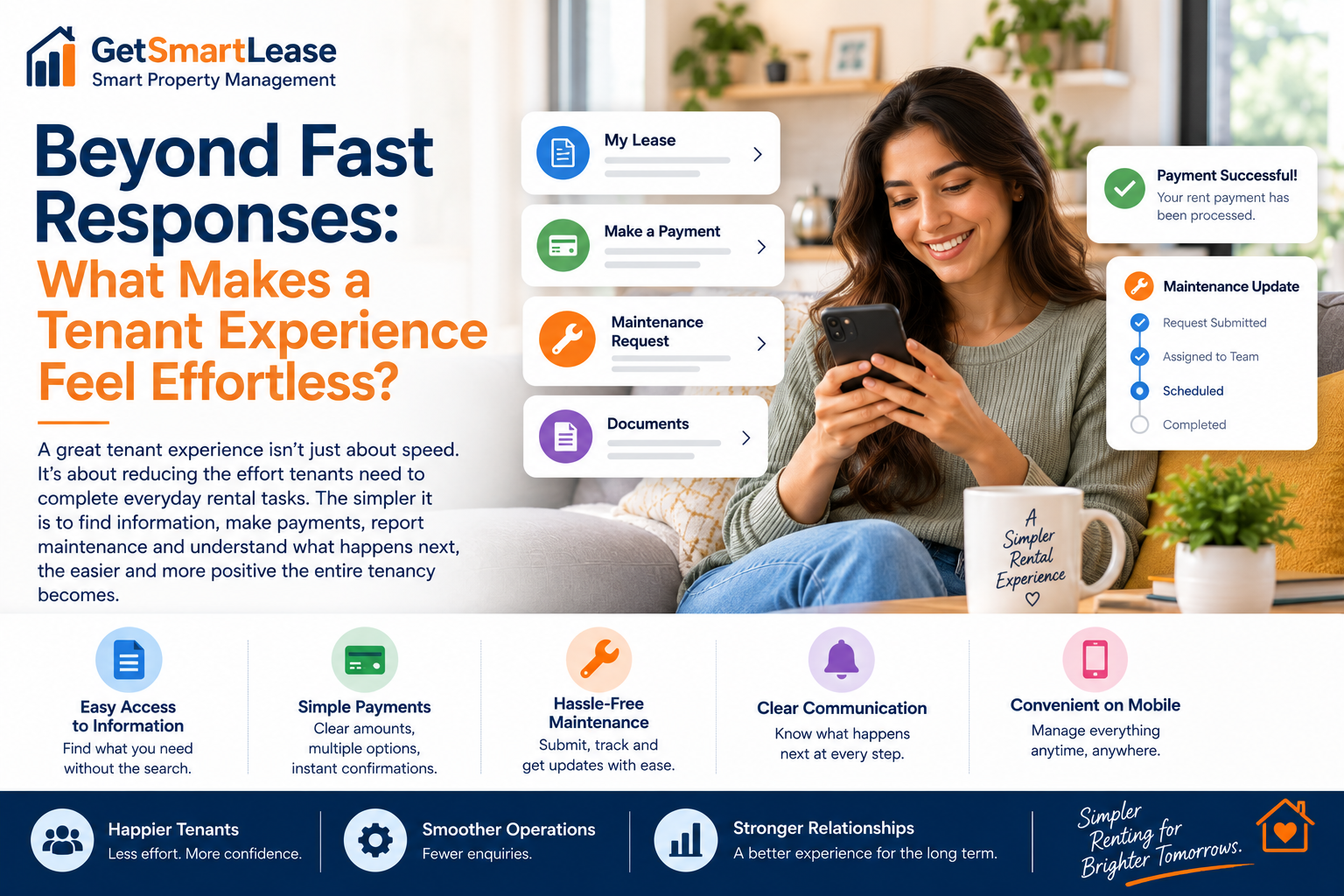
A Good Tenant Experience Shouldn't Feel Like Work
When property managers think about tenant experience, speed often comes first.
How quickly did we respond?
How quickly was the maintenance request assigned?
How quickly was the payment processed?
Speed certainly matters.
But there's another question that's just as important:
How much effort did the tenant have to make?
A tenant might receive a quick response but still have a frustrating experience if they had to search through old emails, contact several people, repeat the same information, or follow up multiple times.
The best tenant experiences often feel simple.
Tenants know where to go, what to do, and what happens next.
For property managers, creating that experience means looking for friction across everyday rental interactions—and removing it wherever possible.
1. Make Information Easy to Find
One of the most common sources of unnecessary effort is simply finding information.
Imagine a tenant wants to check their lease end date.
Should they search through their email?
Find the original PDF?
Contact their property manager?
Check a tenant portal?
When tenants aren't sure where information lives, even a simple question becomes another support request.
Property managers can reduce this friction by creating a clear, centralized place for important information such as:
- Lease details
- Payment information
- Documents
- Maintenance requests
- Property notices
- Contact information
- Renewal information
The easier information is to find, the less effort tenants need to spend looking for answers.
2. Reduce Repeated Information
Few things make a process feel more frustrating than having to explain the same situation repeatedly.
A tenant reports a maintenance issue.
Later, they speak to another team member and explain it again.
Then a contractor arrives without the full details, and the tenant repeats everything once more.
Each handoff adds effort.
Connected property management processes can help important information move with the request.
The maintenance team should understand what was reported.
The property manager should be able to see its status.
The tenant shouldn't have to become the person responsible for connecting everyone involved.
A smoother experience means:
Tell us once, and we'll take it from there.
3. Make Payments Predictable
Rent payments happen repeatedly throughout a tenancy.
That makes them an important opportunity to create a low-effort experience.
Tenants shouldn't need to wonder:
How much do I owe?
When is it due?
Did my payment go through?
Where can I find my receipt?
A clear digital payment experience can provide this information without requiring tenants to contact management.
Useful features may include:
- Clear amounts and due dates
- Convenient payment options
- Payment confirmations
- Transaction history
- Accessible invoices or receipts
- Appropriate reminders
When a recurring task becomes predictable, it becomes easier.
4. Make Maintenance Requests Simple From the Start
Reporting maintenance shouldn't require tenants to figure out who to contact.
A clear maintenance process can guide tenants through exactly what information is needed.
For example:
What's the problem?
Where is it happening?
How urgent is it?
Would a photo help explain the issue?
Collecting the right information upfront benefits everyone.
The tenant doesn't need multiple follow-up conversations.
The property manager gets better information.
And the maintenance team has more context before responding.
A simple request process can therefore improve both tenant experience and operational efficiency.
5. Tell Tenants What Happens Next
Uncertainty creates effort.
When tenants don't know what happens after completing an action, they often need to follow up.
Consider a maintenance request.
A tenant submits it and sees:
Request submitted.
That's useful—but incomplete.
What happens now?
A better experience could provide a simple progression:
Submitted → Reviewed → Assigned → Scheduled → Completed
The same principle applies elsewhere.
After making a payment, confirm it.
After submitting a document, acknowledge receipt.
After requesting renewal, explain the next step.
Good tenant experiences don't leave residents wondering what happens next.
6. Design Processes Around the Tenant, Not the Internal Team
Property management businesses naturally have internal processes.
Different departments may handle payments, maintenance, leases, documents, and support.
But tenants shouldn't need to understand the organization's internal structure just to get help.
From their perspective, they're dealing with one property management experience.
If a tenant contacts the wrong team, the solution shouldn't always be:
"You'll need to contact someone else."
Whenever possible, processes should guide the request to the right place without forcing the tenant to start over.
Internal complexity should remain internal.
7. Use Automation to Remove Routine Effort
Some tenant interactions happen so regularly that they shouldn't require manual intervention every time.
Automation can help with predictable events such as:
- Payment confirmations
- Upcoming payment reminders
- Maintenance acknowledgments
- Request status changes
- Document notifications
- Inspection reminders
- Lease expiration alerts
For tenants, these updates reduce the need to ask questions.
For property teams, they reduce repetitive administrative work.
But automation works best when it's useful.
Sending more notifications doesn't automatically create a better experience.
The right message should arrive at the right moment with information the tenant actually needs.
8. Make Mobile Experiences Simple
Many rental interactions happen away from a desk.
A tenant may notice a leaking tap while standing in the kitchen.
They may need to check a payment while travelling.
They might need a lease document while speaking with someone outside their home.
If common rental tasks only work comfortably on a desktop computer, unnecessary friction is introduced.
Mobile-friendly experiences should prioritize the tasks tenants use most frequently.
That means:
- Simple navigation
- Readable information
- Short forms
- Clear buttons
- Easy document access
- Straightforward payment flows
Convenience isn't just about offering digital services.
It's about making those services easy to use wherever tenants are.
9. Give Tenants Choices Without Creating Confusion
Convenience doesn't mean offering every possible option.
Too many channels can actually make an experience harder.
Should a maintenance request be submitted through email, WhatsApp, a phone call, a portal, or an app?
If every channel is treated differently, tenants may not know which one to use.
Property managers can provide flexibility while still establishing clear primary channels.
For example:
Maintenance requests → Tenant portal
Emergency issues → Emergency contact
General questions → Support channel
Clear choices reduce uncertainty.
10. Measure Effort, Not Just Satisfaction
Tenant satisfaction is important, but another useful question is:
"How easy was it to get this done?"
Consider asking this after important interactions.
After maintenance:
"How easy was it to report and track your request?"
After onboarding:
"How easy was it to find the information you needed?"
After a digital process:
"Were you able to complete this without additional help?"
These questions can reveal friction that traditional satisfaction ratings may miss.
A tenant may ultimately be satisfied because their problem was solved—but the process may still have been unnecessarily difficult.
That's an opportunity for improvement.
Small Friction Adds Up
One difficult interaction may not define an entire tenancy.
But repeated friction can.
Searching for documents.
Following up on maintenance.
Repeating information.
Wondering whether a payment was received.
Trying to determine who to contact.
None of these problems seems enormous individually.
Together, they can make property management feel difficult.
The opposite is also true.
When routine interactions are consistently simple, tenants spend less time thinking about property management at all.
And that's often a sign of a well-designed experience.
Make the Tenant Journey Easier With GetSmartLease
A better tenant experience isn't necessarily about adding more features.
Sometimes it's about removing unnecessary steps.
GetSmartLease helps bring important rental processes together so property managers and tenants have better visibility across applications, leases, documents, payments, and other property activities.
Connected workflows can reduce repeated tasks, improve access to information, and make it clearer what needs to happen next.
Technology should make renting feel simpler—not give tenants another complicated system to manage.
Because a great tenant experience isn't only fast.
It feels effortless.