
Modern property teams can track almost everything.
Lease dates. Payments. Applications. Maintenance requests. Tenant queries. Documents. Occupancy. Tasks.
Dashboards can bring all of this information together and give managers a useful overview of their portfolio.
But there's an important difference between seeing information and knowing what to do with it.
A dashboard might tell you that 12 leases are approaching expiration.
But which ones need attention today?
It might show seven outstanding payments.
But which tenants have already been contacted?
It might show 18 open maintenance requests.
But which requests are overdue, and who owns the next step?
This is where property operations need to move beyond visibility toward actionability.
1. Every Status Should Lead Somewhere
Statuses are essential for tracking operational processes.
But a status is most useful when it helps determine what happens next.
Consider a tenant application marked:
Documents Pending
That tells the property manager where the application currently stands.
A stronger operational workflow also answers:
- Which documents are missing?
- Who needs to provide them?
- Has the tenant already been contacted?
- When should the team follow up?
- What happens when the documents arrive?
The same principle applies across property operations.
A status shouldn't simply describe the past.
It should help guide the next action.
2. Prioritize Exceptions Instead of Reviewing Everything
Property managers shouldn't need to inspect every lease, payment, application, or maintenance request every day.
Most processes may be progressing normally.
What teams really need to see are the exceptions.
For example:
⚠️ A payment is overdue.
⚠️ A maintenance request has exceeded its expected resolution time.
⚠️ A required document hasn't been submitted.
⚠️ A lease is approaching renewal without a decision.
⚠️ A tenant query hasn't received a response.
By highlighting exceptions, operational systems can help teams focus their attention where intervention is actually required.
3. Make Deadlines Operational, Not Just Informational
Knowing a lease expires on a particular date is useful.
Knowing that the renewal process should begin 60 days before that date is operationally useful.
The same applies to other areas.
Instead of simply storing deadlines, workflows can use them to trigger actions.
For example:
Lease expiry approaching → Start renewal workflow
Payment due date approaching → Send reminder
Maintenance request unresolved → Escalate for review
Document deadline approaching → Request missing document
Dates become much more valuable when they actively drive the process.
4. Show Who Owns the Next Step
Operational visibility isn't complete without ownership.
A property manager may know that something is pending, but if nobody knows who should handle it, the task can remain pending indefinitely.
Every important workflow should make ownership clear:
Current status → Responsible person → Next action → Deadline
This creates accountability without requiring managers to constantly ask team members for updates.
It also makes handoffs between people easier.
5. Connect Communication With the Workflow
Communication is often treated as a separate activity.
But many tenant messages are directly connected to operational events.
A payment reminder exists because a payment is approaching or overdue.
A maintenance update exists because the request changed status.
A renewal email exists because the lease is approaching expiration.
A document request exists because something required is missing.
When communication is connected to these events, teams don't need to manually remember every message.
The workflow itself can help determine when communication should happen and why.
6. Turn Dashboards Into Daily Workspaces
Traditional dashboards are often designed primarily for reporting.
They answer:
What's happening?
Operational dashboards should go further.
They should also answer:
What needs my attention today?
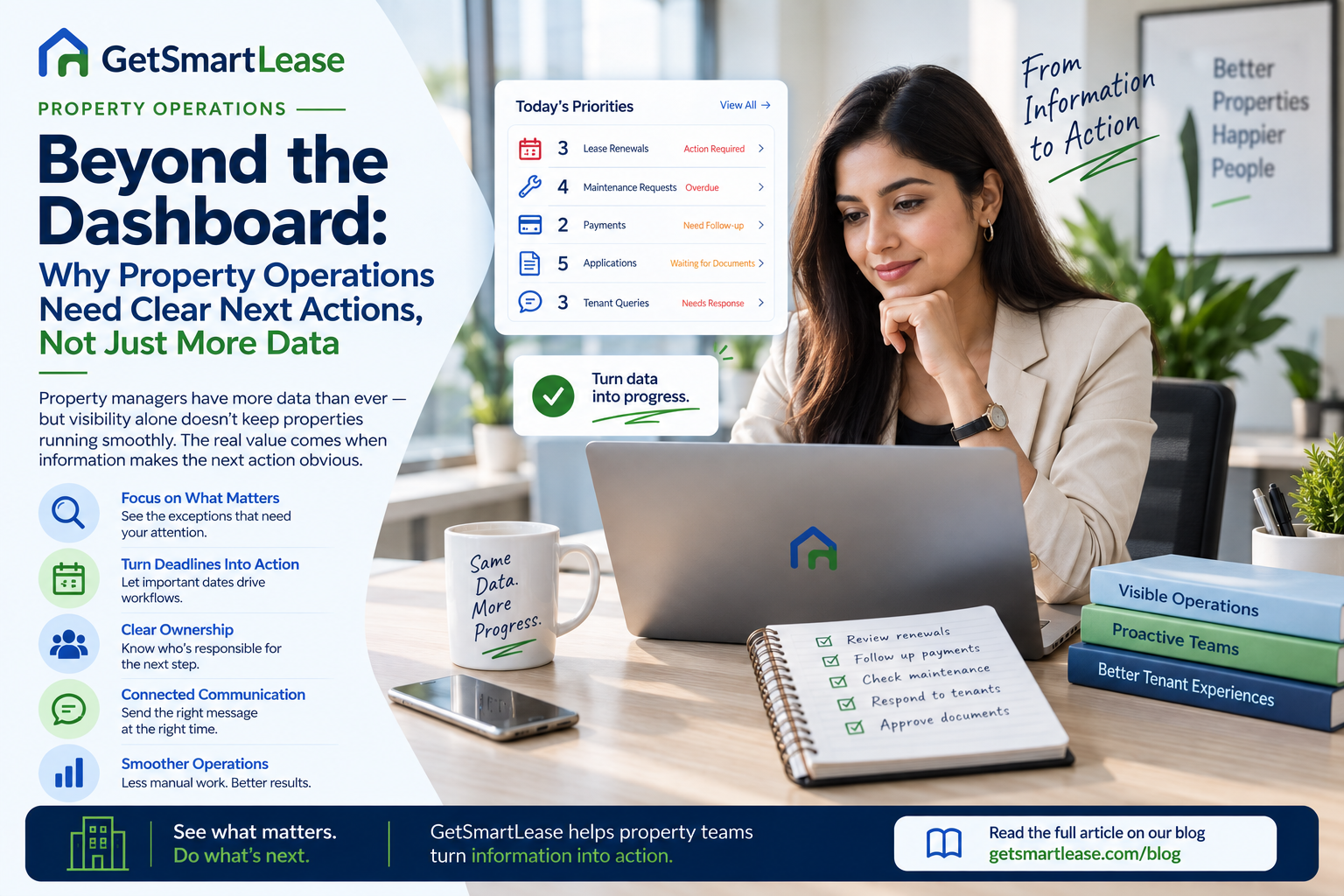
Imagine opening a property management dashboard and immediately seeing:
- 3 lease renewals requiring action
- 4 overdue maintenance requests
- 2 payments requiring follow-up
- 5 tenant applications waiting for documents
- 3 unresolved tenant queries
- 2 tasks requiring approval
Instead of searching across different areas of the system, the team starts the day with a prioritized operational view.
That's when a dashboard becomes more than a reporting tool.
It becomes a workspace.
7. Automation Should Move Work Forward
Automation is sometimes understood simply as sending emails or reminders.
But its potential in property operations is much broader.
Automation can help move workflows from one stage to another.
For example:
Tenant signs lease → Notify property manager
Property manager counter-signs → Update lease status
Payment confirmed → Update transaction status
Maintenance completed → Request tenant confirmation
Lease approaching expiration → Create renewal action
The goal isn't automation for its own sake.
The goal is reducing the number of routine transitions that depend entirely on someone remembering what happens next.
From Operational Visibility to Operational Clarity
Property teams don't necessarily need more dashboards.
They need clearer answers.
What requires attention?
Why does it require attention?
Who owns it?
When is it due?
What happens next?
When property management systems can answer those questions, teams spend less time searching for information and more time actually managing their properties.
The Future of Property Operations Is Actionable
As rental portfolios become increasingly digital, simply collecting more data won't be enough.
The next step is turning that data into workflows that help people make decisions and take action.
The strongest property operations platforms will connect information, deadlines, communication, ownership, and automation into one continuous process.
Because the goal isn't just to know what's happening across your portfolio.
It's to know exactly what needs to happen next.
Turning Visibility Into Action With GetSmartLease
GetSmartLease helps property teams bring important rental processes into connected digital workflows—from applications and leasing to documents, payments, tenant communication, and ongoing operations.
By creating clearer visibility into statuses and next steps, property teams can spend less time searching for answers and more time moving work forward.
See what matters. Know what's next. Keep property operations moving with GetSmartLease.