
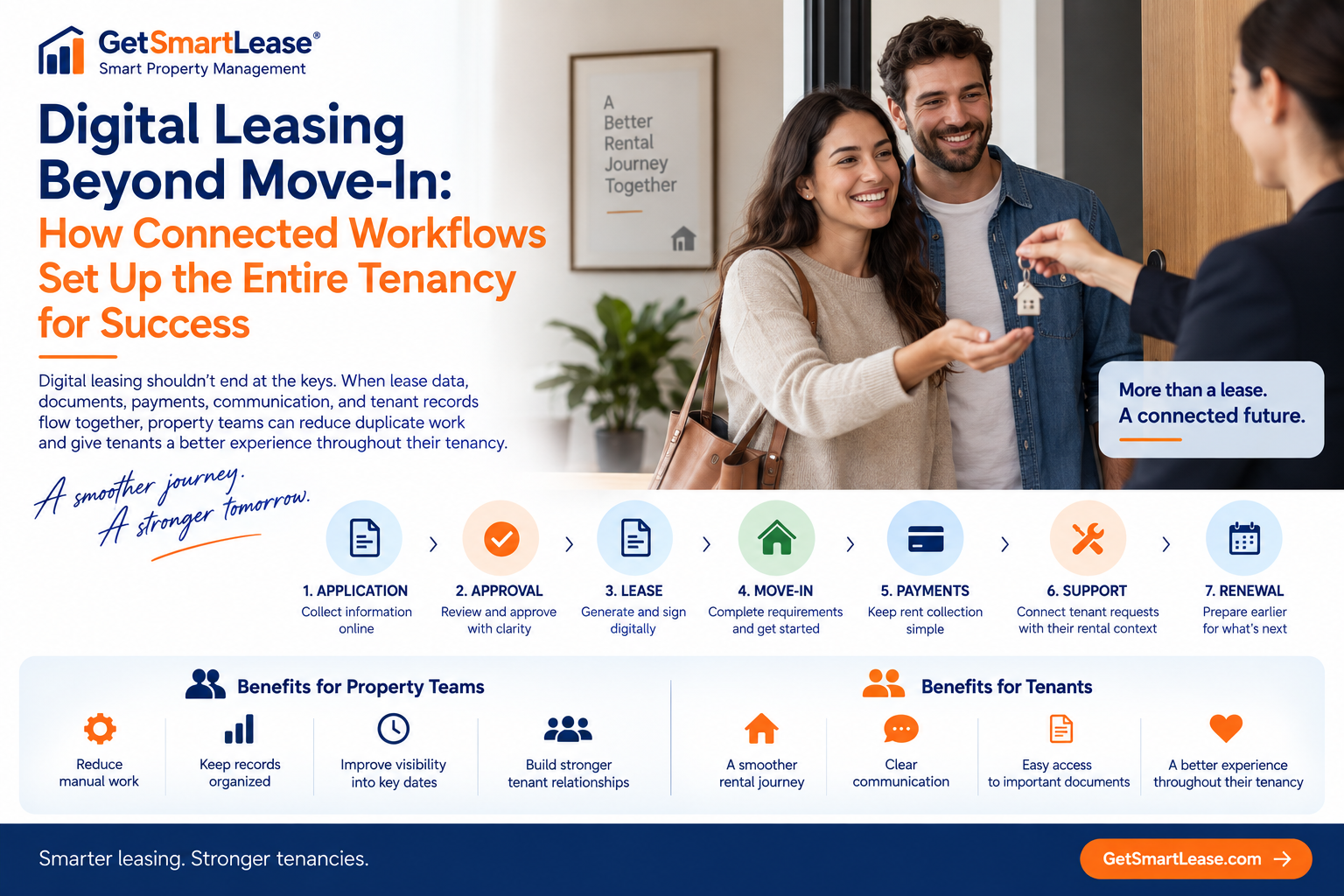
The Leasing Journey Doesn't Really End at Move-In
For many property teams, digital leasing focuses heavily on getting a prospective tenant from application to signed lease.
The application is submitted online. Documents are collected. Reviews and approvals are completed. The lease is generated and signed electronically. Initial payments are made, and the tenant moves in.
At that point, the leasing process appears complete.
But the information collected during leasing remains important for months—or even years—after move-in.
Lease dates determine renewals. Tenant contact details support communication. Payment information affects rent collection. Signed agreements may need to be referenced later. Property and unit information connects the tenant to ongoing operations.
When leasing and property management operate as separate processes, teams may find themselves entering the same information again or searching across different systems.
A connected digital workflow can make move-in a transition rather than a stopping point.
1. Turn Leasing Information Into Active Tenant Records
A significant amount of information is already collected during leasing.
This can include:
- Tenant details
- Property and unit information
- Lease start and end dates
- Rental amounts
- Deposits
- Signed documents
- Communication preferences
- Payment requirements
Once the lease becomes active, this information shouldn't have to be manually recreated elsewhere.
Connected workflows can allow relevant leasing information to become part of the tenant's ongoing rental record.
That reduces duplicate administrative work and helps maintain consistency.
2. Keep Important Lease Dates Visible
A signed lease contains several dates that can influence future property operations.
For example:
Lease start date
Lease end date
Payment due dates
Notice periods
Renewal timelines
When these dates remain buried inside a PDF, property teams have to remember to check them manually.
Digital leasing becomes much more useful when important lease information can support future workflows.
A lease end date, for example, can eventually help trigger renewal preparation rather than relying on someone to discover that the lease is approaching expiration.
3. Connect Leasing With Rent Payments
The transition from signing a lease to paying rent should feel natural.
If tenants complete the entire leasing process digitally but then receive separate or unclear payment instructions, the experience can quickly become fragmented.
A connected journey can clearly show:
Lease completed → Initial requirements completed → Rent schedule active
For tenants, this creates a clearer understanding of their financial responsibilities.
For property teams, connecting lease information with payment processes can make it easier to understand what is due, what has been received, and what may require attention.
4. Keep Documents Accessible After Signing
Lease documents don't stop being important after move-in.
Property managers and tenants may need to reference the agreement later to understand responsibilities, notice requirements, payment terms, or other conditions.
Additional documents may also become part of the tenancy over time.
Instead of treating signed documents as files that simply need to be archived, digital property management can keep them connected to the appropriate tenant, property, and lease.
That makes information easier to retrieve when it is actually needed.
5. Continue the Communication Journey
During leasing, tenants usually receive frequent updates.
Application received.
Documents required.
Application approved.
Lease ready.
Signature completed.
Move-in confirmed.
Then something interesting often happens after move-in: communication becomes much more reactive.
Tenants contact the property team when they need something, and teams respond.
Digital workflows create an opportunity to maintain more proactive communication throughout the tenancy.
This could include relevant reminders, payment information, maintenance updates, property notices, or renewal communication.
The communication journey doesn't need to restart simply because leasing has ended.
6. Connect Tenant Requests With Their Rental Context
Once a tenant moves in, maintenance and support become important parts of their experience.
A tenant reporting an issue shouldn't feel disconnected from everything the property team already knows about them.
The property, unit, tenant record, lease, and previous communication can provide useful context when handling a request.
Connected systems make it easier for teams to understand who is reporting the issue and which property or unit is affected without repeatedly asking for information that already exists.
This can make support interactions more efficient for both sides.
7. Prepare for Renewals Earlier
Renewals are another area where connected leasing information becomes valuable.
Without good visibility, renewal conversations can begin too close to the lease expiration date.
Teams then have to rush to review the tenancy, communicate with the tenant, prepare new terms, and complete documentation.
A connected digital process can make upcoming lease expirations easier to identify.
Instead of reacting at the last minute, property teams can begin renewal workflows earlier and give tenants more time to make decisions.
The rental lifecycle becomes:
Application → Lease → Move-In → Active Tenancy → Renewal
rather than a collection of separate processes.
Why Connected Workflows Matter
Imagine two scenarios.
In the first, a tenant completes a digital application and electronically signs a lease. After move-in, their information is manually transferred into other systems, documents are stored in folders, payment information is managed separately, and renewal dates are tracked through spreadsheets or calendars.
The leasing process was digital.
The rental lifecycle wasn't.
In the second scenario, information captured during leasing continues to support payments, documents, communication, tenant requests, and future renewals.
That's a much more connected approach.
Benefits for Property Teams
Extending digital workflows beyond move-in can help property teams:
- Reduce duplicate data entry
- Keep tenant and lease records organized
- Improve visibility into important dates
- Connect leasing and payment information
- Access documents more easily
- Manage communication more consistently
- Prepare earlier for renewals
- Reduce dependence on manual tracking
The goal isn't simply to automate everything.
It's to prevent information from becoming disconnected as the tenant moves from one stage to another.
Benefits for Tenants
Tenants can also benefit from greater continuity.
Instead of navigating completely different processes after move-in, they can experience a more consistent relationship with their property management team.
Information remains accessible.
Communication remains clear.
Payments and responsibilities are easier to understand.
Support requests have more context.
Renewal doesn't arrive unexpectedly.
Together, these improvements can create a rental experience that feels more organized from beginning to end.
Digital Leasing Is the Beginning of the Relationship
It's easy to think of leasing as a transaction:
Find tenant → Sign agreement → Move in.
But leasing is actually the beginning of an ongoing relationship between the tenant and the property management team.
The information collected during that process creates the foundation for everything that follows.
That's why the next opportunity in digital leasing isn't simply making applications or signatures faster.
It's ensuring that the work completed during leasing continues to create value throughout the tenancy.
From Digital Leasing to a Connected Rental Lifecycle
A truly modern rental experience doesn't need to restart every time the tenant reaches a new stage.
Applications can lead naturally into leases. Leases can connect with payments and documents. Tenant records can support communication and service. Lease dates can inform renewal workflows.
Each stage builds on the one before it.
For property teams, that means less duplication and better operational visibility.
For tenants, it means a more consistent and understandable experience.
The best digital leasing process doesn't end at move-in—it creates the foundation for everything that comes next.