
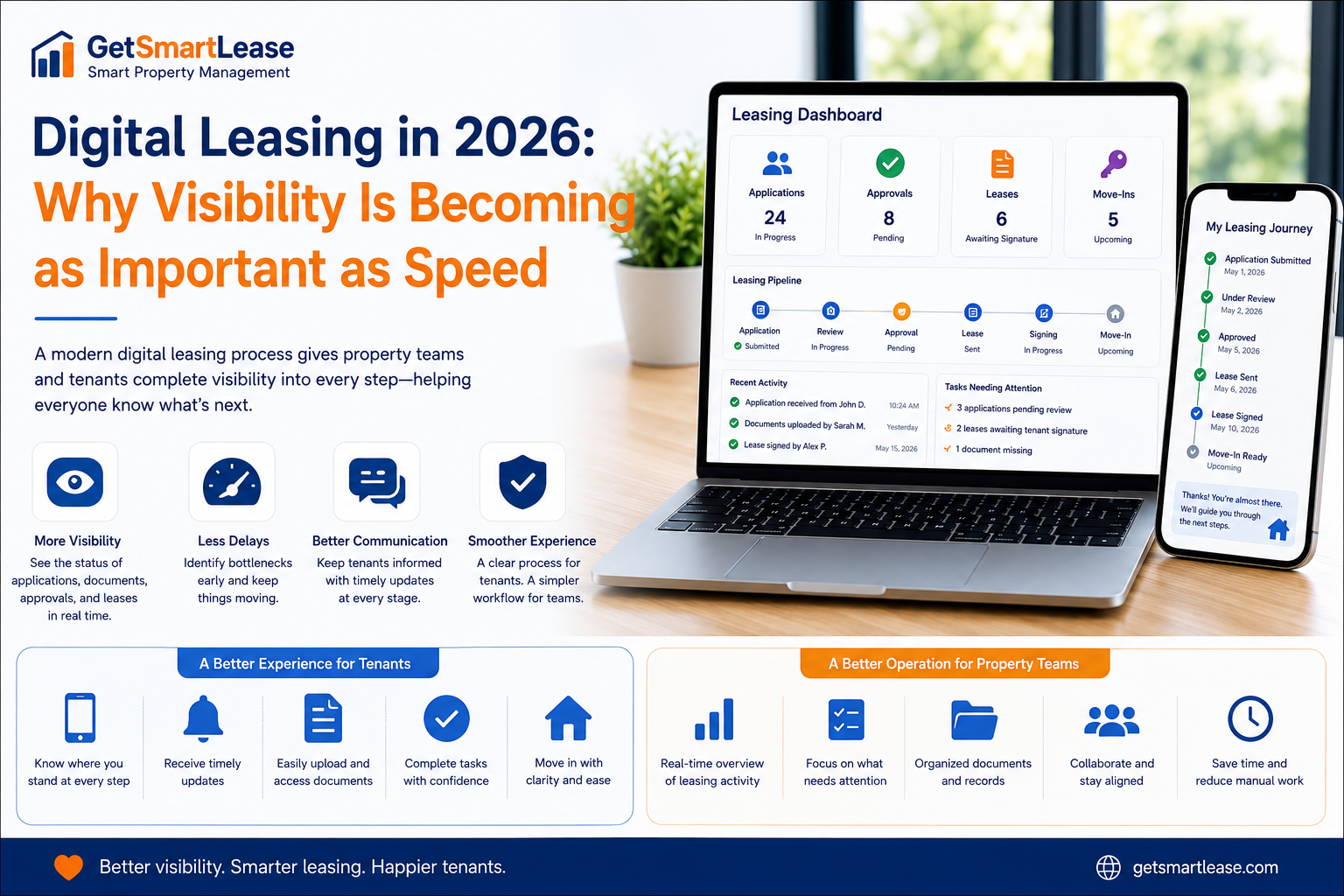
Digital Leasing Is Entering Its Next Stage
For years, the main promise of digital leasing was simple: make the rental process faster.
Online applications replaced paper forms. Electronic signatures reduced printing and scanning. Digital documents made it easier to send lease agreements without arranging in-person meetings.
These changes have made leasing significantly more convenient.
But as more of the rental journey becomes digital, another factor is becoming just as important as speed:
Visibility.
Property teams need to know which applications require attention, which documents are missing, which leases are waiting for signatures, and which tenants are ready for the next step.
Prospective tenants want similar clarity.
They want to know whether their application was received, what they still need to provide, when their lease will be ready, and what happens after they sign.
A strong digital leasing process should make these answers easier to find.
The Problem With a Fragmented Leasing Journey
A leasing process can technically be digital while still being difficult to manage.
Imagine an application is submitted through one system. Supporting documents arrive through email. Approval happens through internal messages. The lease is generated somewhere else, and payment instructions are sent separately.
Almost everything is digital.
But the overall process is still fragmented.
Property teams may need to jump between different tools to understand the status of a single applicant. Tenants may need to contact the team simply to ask what happens next.
The challenge isn't necessarily the individual tools.
It's the lack of visibility across the complete journey.
1. Make Application Status Easier to Understand
Once someone submits a rental application, uncertainty can quickly become frustrating.
Was the application received?
Is anything missing?
Is it being reviewed?
Has a decision been made?
Digital leasing workflows can provide clearer stages such as:
Application Submitted → Under Review → Approved → Lease Preparation → Signing → Move-In Ready
For property teams, clear statuses make it easier to identify where each application stands.
For applicants, better status communication reduces uncertainty and unnecessary follow-ups.
2. Bring Documents Into the Same Journey
Documents are a major part of leasing.
Applications may require identification, financial information, supporting documents, disclosures, lease agreements, addenda, and signed copies.
When those files are scattered across inboxes and folders, determining whether an application is complete can become unnecessarily difficult.
A connected digital process keeps documents associated with the correct applicant and leasing stage.
Property teams can more easily see what has been received and what is still outstanding.
Tenants can receive clearer instructions about what they need to provide.
3. Make Approvals Visible
Internal approvals can become an invisible bottleneck.
A tenant may believe everything is complete while the application is actually waiting for an internal review.
At the same time, another team member may not realize that action is required.
Digital workflows can create clearer ownership.
Instead of relying entirely on someone remembering to send another email or message, the process can show:
- What requires review
- Who needs to take action
- What has already been completed
- What happens after approval
This makes the process easier to coordinate without requiring constant manual checking.
4. Know Exactly Where the Lease Stands
Sending a lease is not the same as completing a lease.
After a document is prepared, property teams may still need to know:
Was it delivered?
Has the tenant reviewed it?
Has the tenant signed?
Does another party still need to sign?
Is the final agreement complete?
When lease progress is visible, teams can focus their attention on agreements that genuinely require action rather than manually checking every lease.
5. Connect Communication With Leasing Progress
Many tenant questions happen because people don't know what is happening behind the scenes.
A simple status update can often prevent an unnecessary phone call or email.
For example:
Your application has been received.
Your documents are currently being reviewed.
Your lease is ready for signature.
Your lease has been completed. Here are your next steps.
These updates may seem small, but together they create a much clearer tenant experience.
Automation can handle routine progress notifications while property teams remain available for conversations that actually require personal assistance.
6. Don't Lose Visibility After the Signature
Digital leasing shouldn't end when the tenant signs.
There may still be deposits, initial payments, documents, move-in requirements, inspections, access arrangements, and other tasks to complete.
If these steps become disconnected from the leasing workflow, uncertainty returns.
A better digital journey clearly transitions the tenant from:
Lease Signed → Requirements Completed → Move-In Ready
The tenant understands what needs to happen next, while the property team can see whether those requirements have been completed.
7. Give Property Teams a Clearer Operational View
Visibility isn't only valuable at the individual application level.
Property managers may be handling many applicants and properties simultaneously.
Instead of opening every application individually, a digital leasing dashboard can help teams quickly understand:
- Applications awaiting review
- Missing documents
- Pending approvals
- Leases awaiting signatures
- Outstanding leasing requirements
- Upcoming move-ins
This turns leasing information into something teams can act on.
Rather than constantly asking “What is happening?”, teams can focus on “What needs our attention next?”
Visibility Can Improve the Tenant Experience Too
From the tenant's perspective, renting a home is a significant process.
Even relatively short periods of uncertainty can feel long when someone is waiting to find out whether an application has progressed.
Providing greater visibility creates a sense of direction.
Tenants don't necessarily need access to every internal detail. They simply need clear information about their own journey:
Where am I now?
Is anything required from me?
What happens next?
Answering those three questions consistently can make the leasing experience feel significantly simpler.
Speed + Visibility = A Better Digital Leasing Experience
Speed will always matter in leasing.
Property teams don't want applications sitting unnecessarily, and prospective tenants don't want to wait longer than required.
But optimizing only for speed misses an important part of the experience.
A process that moves quickly but leaves everyone unsure about its status can still create frustration.
The stronger approach combines:
Speed — moving applications efficiently.
Visibility — making progress easy to understand.
Communication — keeping the right people informed.
Automation — reducing repetitive administrative work.
Connection — ensuring each stage naturally leads to the next.
The Future of Digital Leasing Is Clearer, Not Just Faster
The next evolution of digital leasing isn't simply another online form or another electronic signature tool.
It's creating a rental journey where property teams and tenants can understand what is happening without searching through emails, spreadsheets, folders, and disconnected systems.
From application to approval, signing, payments, and move-in, every stage should provide a clear path forward.
Because the best digital leasing experience isn't simply the one that moves fastest.
It's the one where everyone knows exactly what happens next.