
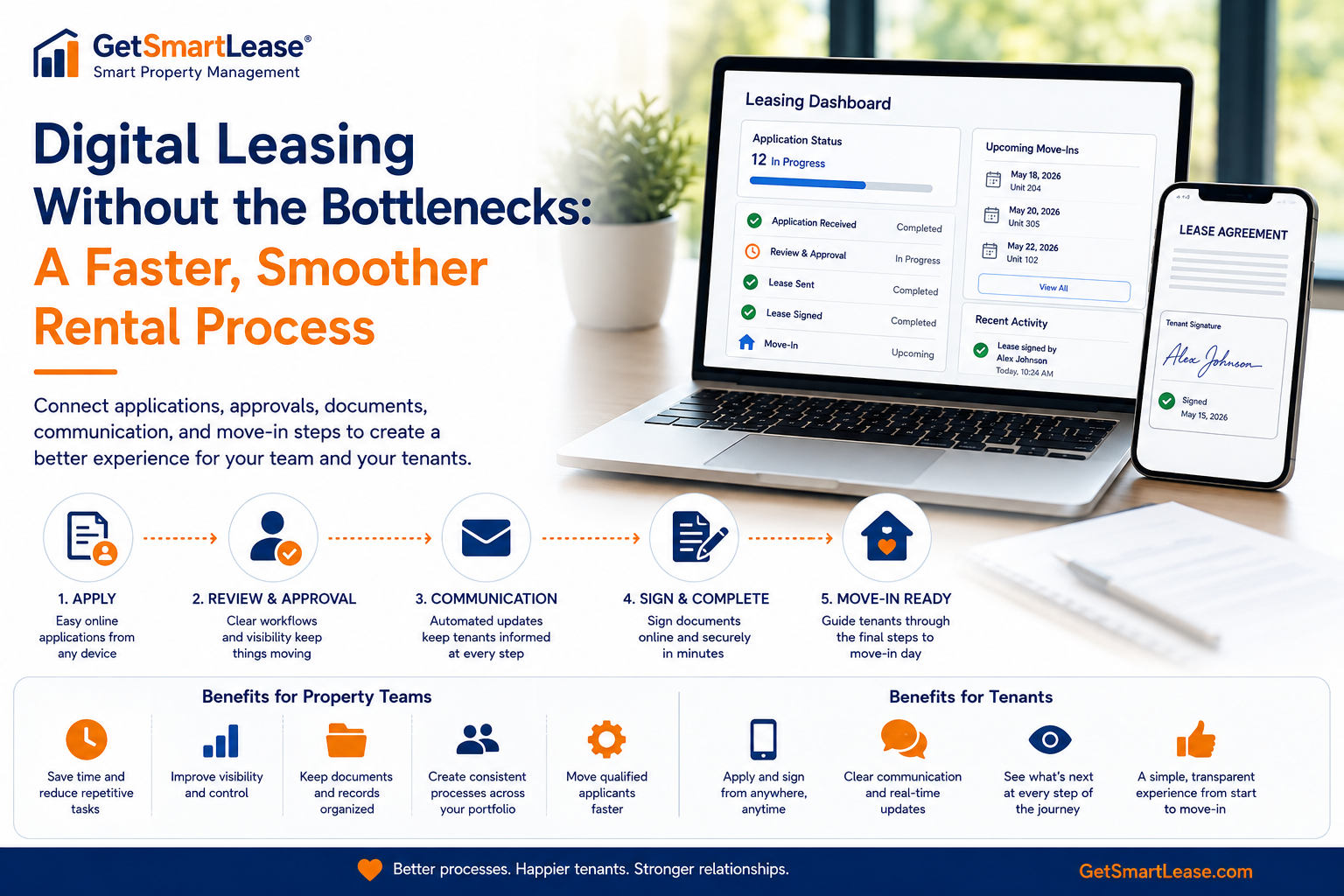
Digital Leasing Should Remove Friction
The rental journey has changed significantly.
Prospective tenants increasingly expect to search, apply, communicate, complete documents, and make payments digitally. For property management teams, this creates an opportunity to make leasing faster and more convenient.
But there is an important distinction between digitizing individual tasks and creating a connected digital leasing process.
A property team might accept online applications, send leases electronically, and communicate through email while still relying on spreadsheets, manual follow-ups, disconnected records, and repetitive data entry behind the scenes.
The result is technically digital—but not necessarily efficient.
A better digital leasing strategy focuses on removing the bottlenecks between each stage of the rental journey.
Where Leasing Bottlenecks Usually Begin
A prospective tenant rarely completes the entire leasing process in a single step.
The journey may include:
- Submitting an application
- Providing required information
- Completing screening
- Receiving approval
- Reviewing lease terms
- Signing documents
- Making required payments
- Receiving move-in instructions
When these activities happen across different systems or communication channels, small delays can quickly accumulate.
Someone may need to manually check whether an application is complete. Another team member may be waiting for an approval. A prospective tenant may not know whether additional information is required.
Digital leasing can help connect these stages so that everyone has greater visibility into what has happened and what comes next.
1. Make the Application Process Simple
The application is one of the first major interactions a prospective tenant has with a property.
Complicated forms, unclear requirements, or processes that work poorly on mobile devices can create unnecessary friction before the relationship has even begun.
A modern digital application process should make it easy for prospective tenants to understand what information is required and complete the process from their preferred device.
Clear instructions at this stage can also reduce incomplete applications and repetitive follow-ups for leasing teams.
2. Create Clear Paths for Reviews and Approvals
Applications often need to move through several internal steps before a leasing decision can be made.
When approvals rely heavily on emails, messages, or manual handoffs, applications can sit waiting even when only a simple action is required.
A connected digital workflow can make responsibilities clearer.
Team members can understand which applications require attention, which stages have been completed, and what action needs to happen next.
The goal isn't simply speed. It's creating a consistent process that is easier to manage.
3. Keep Documents Connected to the Leasing Journey
Digital leasing can involve applications, disclosures, lease agreements, addenda, policies, and other documents.
If these files are scattered across inboxes and folders, teams may spend unnecessary time finding the latest version or checking whether something has been completed.
Keeping documents associated with the appropriate applicant, property, and lease can create a more organized leasing record.
It also helps reduce the gap between document preparation, review, signing, and storage.
4. Automate Routine Communication
Many leasing questions are predictable:
Did you receive my application?
Has my application been approved?
When will I receive my lease?
Is there anything else I need to complete?
What happens before move-in?
Prospective tenants shouldn't have to repeatedly ask for basic status information.
Timely notifications, reminders, and updates can keep applicants informed while reducing repetitive communication for leasing teams.
Automation works best when it supports communication rather than replacing it. Property teams should still be available when a tenant needs personal assistance or has a more complicated question.
5. Reduce Repetitive Data Entry
One of the less visible leasing bottlenecks happens behind the scenes.
When information must be copied manually from applications into documents, spreadsheets, property records, or other systems, teams spend time repeating work that has already been completed.
Manual re-entry can also increase the possibility of inconsistent information.
Connected digital workflows can help information move through the leasing process more efficiently, reducing unnecessary administrative work and allowing teams to focus on activities that require human attention.
6. Make the Transition From Signing to Move-In Clear
Signing a lease may feel like the finish line, but for a new tenant, it is often the beginning of another important stage.
They may still need to:
- Complete payments
- Submit additional documentation
- Review property policies
- Arrange utilities
- Receive access information
- Confirm their move-in date
- Complete move-in requirements
A strong digital leasing process doesn't stop when the signature is collected.
It clearly guides the tenant toward the next steps so they know what needs to happen before move-in.
What Does a Smooth Digital Leasing Journey Look Like?
Imagine a prospective tenant finds a property and submits an application online.
They receive confirmation that their application was received and can clearly see whether anything else is required.
The property team reviews the application through an organized workflow. Once the appropriate steps are completed, the applicant receives an update and the necessary lease documents.
The tenant reviews and signs digitally.
Instead of wondering what happens next, they receive clear instructions about payments, documentation, and move-in preparation.
Throughout the journey, the property team can see the status of the process without constantly searching through emails or manually checking multiple records.
That's where digital leasing becomes valuable—not because every activity happens on a screen, but because the activities work together.
Benefits for Property Management Teams
Removing leasing bottlenecks can help property teams:
- Reduce repetitive administrative work
- Improve visibility into leasing progress
- Keep documents and records organized
- Reduce unnecessary follow-ups
- Create more consistent workflows
- Move qualified applicants through the process efficiently
For busy teams managing multiple properties or applications, even small improvements at each stage can make the overall operation easier to manage.
Benefits for Prospective Tenants
A connected leasing process can also create a better first impression.
Applicants benefit from greater convenience, clearer communication, easier document completion, and better visibility into what they need to do next.
This matters because the leasing process is often a tenant's first experience with a property management team.
A confusing process can introduce frustration before move-in. A simple and transparent process can start the relationship on a much stronger foundation.
Digital Doesn't Automatically Mean Better
Putting an application online doesn't automatically eliminate leasing friction.
Neither does sending a PDF instead of a paper document.
The real opportunity in digital leasing comes from looking at the entire journey and asking:
Where are applicants waiting?
Where are team members repeating work?
Where does information become disconnected?
Where are tenants unsure about what happens next?
Those are the places where digital leasing can have the greatest impact.
Build a Connected Leasing Experience
The future of leasing isn't simply about doing more tasks online.
It's about creating a connected journey where applications, approvals, documents, communication, signing, records, and move-in activities work together.
For property management teams, that can mean fewer administrative bottlenecks and better visibility.
For tenants, it can mean a rental journey that feels simpler, faster, and easier to understand.
Digital leasing works best when technology doesn't just replace manual steps—it removes the friction between them.