
Communication is at the center of property management.
Tenants ask questions about rent. They report maintenance problems. They request documents, enquire about renewals, update personal information, and follow up on applications.
For property managers, the challenge isn't simply receiving these messages.
It's making sure every message reaches the right person, receives the right response, and leads to the right action.
As portfolios grow, managing this manually becomes increasingly difficult.
AI and automation offer an opportunity to transform tenant communication from a busy inbox into a more structured and manageable workflow.
The Problem With Communication Overload
Tenant communication can arrive through many channels:
- Phone calls
- Property management portals
- Contact forms
- Support requests
- Messaging platforms
- Maintenance requests
When these conversations are handled separately, property teams can lose visibility.
One employee may respond to an email while another is unaware of it. A maintenance request may require follow-up but remain buried among other messages. A tenant may contact the team multiple times because they haven't received an update.
The problem isn't necessarily a lack of communication.
Sometimes, it's a lack of connected communication.
1. Understanding What the Tenant Needs
The first step in responding to a tenant is understanding why they're contacting the property team.
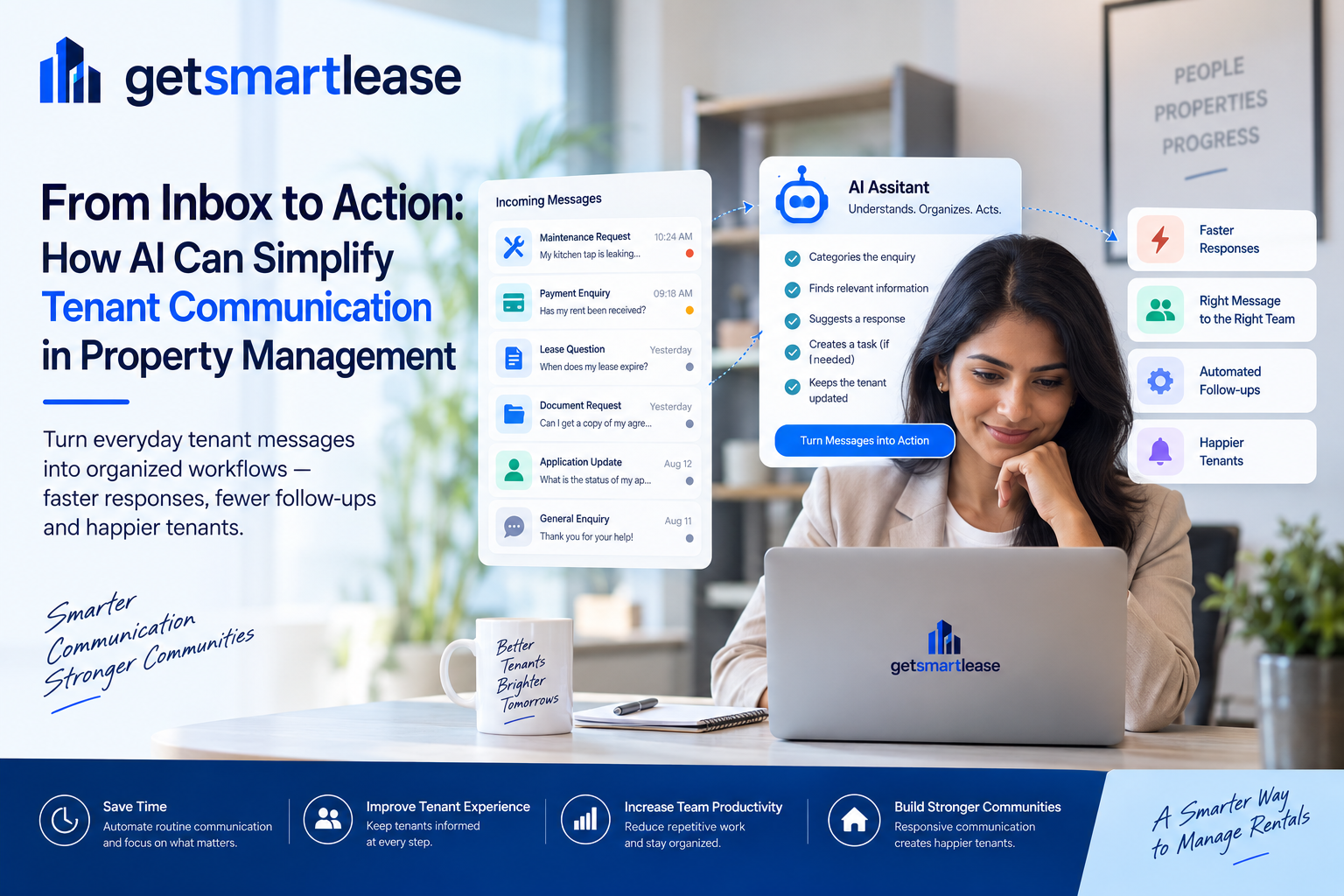
AI can help categorize incoming enquiries.
For example, messages could be grouped into areas such as:
Payments
“Has my rent payment been received?”
Maintenance
“My kitchen tap is leaking.”
Lease
“When does my current lease expire?”
Documents
“Can I get another copy of my agreement?”
Applications
“What is the status of my rental application?”
Automatically identifying the purpose of an enquiry can help route it to the correct workflow or team member.
Instead of manually sorting every message, property managers can focus on resolving the issue.
2. Answering Routine Questions Faster
Many tenant enquiries are repetitive.
Property managers may answer the same questions dozens of times each month.
AI-powered assistants can help respond to common questions using approved information from the property management system.
For example, tenants could quickly receive information about:
- Payment due dates
- Application requirements
- Lease dates
- Document availability
- Maintenance status
- Property procedures
This doesn't mean every conversation should be automated.
Simple questions can receive faster responses while complex or sensitive situations can still be directed to a person.
3. Turning Messages Into Tasks
A tenant message often requires more than a reply.
Consider this message:
“There's water leaking under my kitchen sink.”
Responding with “We've received your request” is only the beginning.
Someone may also need to:
- Create a maintenance request.
- Determine its priority.
- Assign it to the appropriate person.
- Arrange access.
- Track the repair.
- Update the tenant.
- Confirm completion.
AI and automation can help turn communication directly into workflow actions.
Instead of an employee manually copying information from an email into another system, the appropriate process can begin as soon as the request is received.
4. Prioritizing Urgent Requests
Not every tenant enquiry has the same urgency.
A request for a copy of a document is different from a report of flooding or an electrical problem.
AI can help identify language that may indicate an urgent issue and bring it to the team's attention.
The final decision about priority should still follow the property's established policies and procedures, but automated classification can help teams identify potentially important requests faster.
This becomes especially valuable when managing a large volume of communication.
5. Keeping Tenants Updated Automatically
One of the most common causes of repeated tenant enquiries is uncertainty.
A tenant submits a request but doesn't know what happens next.
Without updates, they may contact the property manager again.
Automation can help provide communication throughout a workflow.
For a maintenance request, for example:
Request received → Confirmation sent
Request assigned → Tenant updated
Work scheduled → Appointment information sent
Work completed → Completion notification sent
The tenant remains informed without requiring the property manager to manually send every update.
6. Bringing Communication Into One Tenant History
Property managers need context when speaking with tenants.
A conversation becomes much easier when staff can see relevant information in one place.
A connected system could bring together:
- Previous enquiries
- Maintenance requests
- Lease information
- Payment-related communication
- Documents
- Application activity
- Support requests
AI can help summarize this history so staff don't have to read through every previous conversation before responding.
For example, instead of reviewing ten messages, a property manager might see a concise summary of the tenant's recent issue and actions already taken.
7. Reducing Repetitive Follow-Ups
Communication often becomes repetitive because someone needs to remember to follow up.
A document was requested but hasn't been submitted.
A tenant was asked to confirm an appointment but hasn't responded.
A lease was sent but hasn't been signed.
Automation can track these situations and trigger appropriate reminders.
If the issue remains unresolved after a defined period, it can be escalated to the property team.
This creates a more consistent process without requiring employees to maintain separate reminder lists.
8. Using AI to Support Property Teams
AI can also assist employees while they communicate with tenants.
For example, it could help:
- Summarize long conversations
- Suggest responses
- Identify the tenant's main question
- Retrieve relevant account information
- Highlight previous unresolved issues
- Recommend the appropriate workflow
The employee can review the information and decide how to respond.
This keeps people involved while reducing the time required to gather context.
9. Knowing When Automation Should Stop
Automation works best when the situation is predictable.
But property management also involves conversations where empathy, negotiation, or judgment matters.
Examples might include:
- Tenant disputes
- Financial difficulties
- Complaints
- Lease negotiations
- Sensitive maintenance situations
- Complex application issues
These conversations shouldn't simply receive generic automated responses.
A well-designed system should recognize when human involvement is appropriate and make escalation easy.
The goal isn't:
Automate every conversation.
It's:
Automate the routine parts so people have more time for the conversations that matter.
From Communication to Connected Workflows
The biggest opportunity for AI isn't simply generating faster replies.
It's connecting communication with action.
A maintenance message can become a maintenance workflow.
A payment question can connect to payment information.
A lease enquiry can connect to the tenant's lease.
An application question can connect to application status.
When communication and operational workflows work together, tenants don't have to repeatedly explain their situation and property managers don't have to search across multiple systems.
Final Thoughts
Good tenant communication isn't measured only by how quickly someone replies.
It's measured by whether the tenant's issue actually moves toward resolution.
AI and automation can help property managers bridge the gap between receiving a message and completing the action behind it.
By categorizing enquiries, answering routine questions, triggering workflows, providing automatic updates, and helping employees understand communication history, AI can make tenant communication more organized and responsive.
The future of tenant communication isn't simply a smarter inbox.
It's an inbox connected directly to action.