
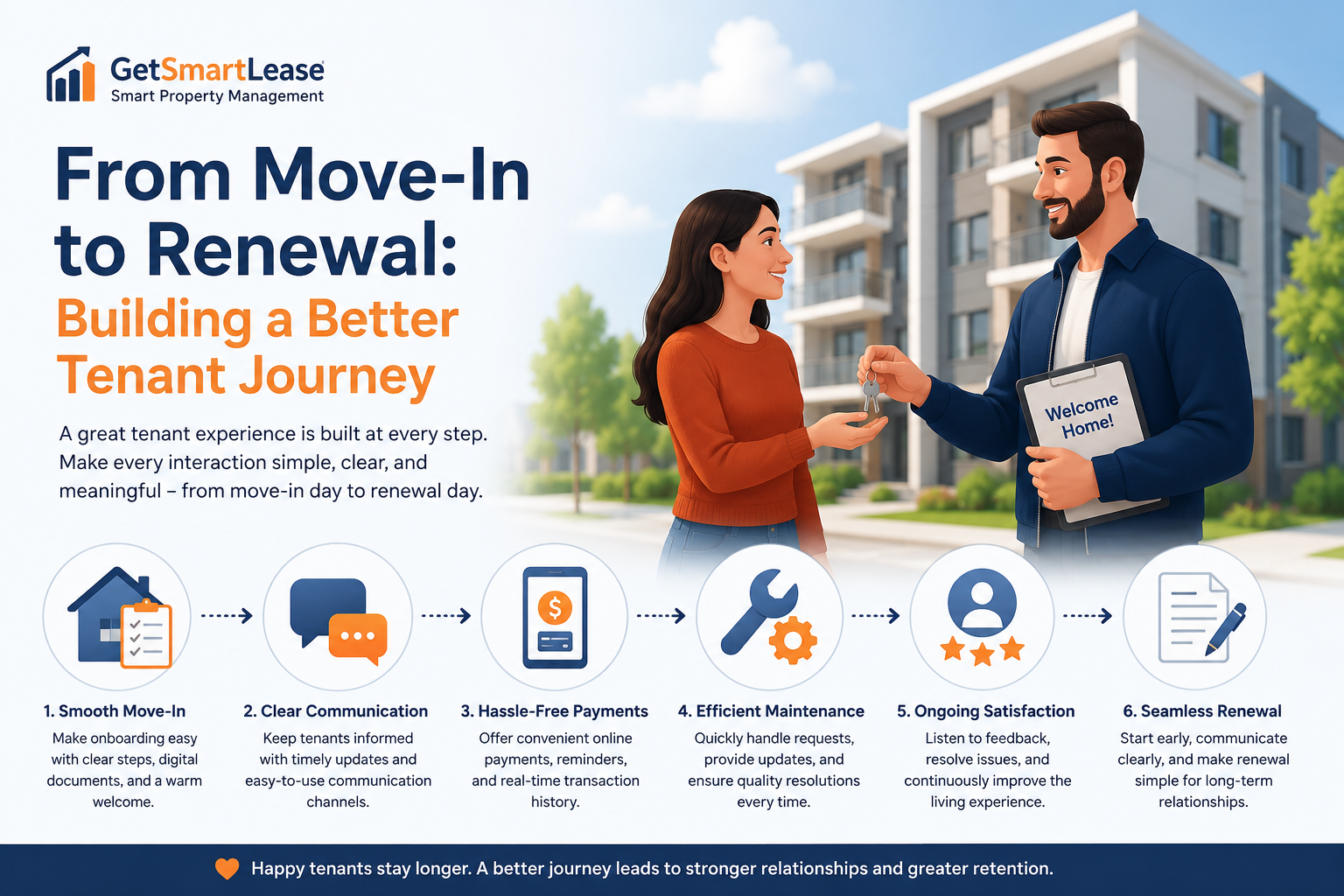
A Better Tenant Experience Starts With the Journey
For tenants, renting a home isn't a single transaction. It's a journey made up of many interactions with the property management team.
It begins with the application and move-in process. It continues through rent payments, maintenance requests, questions, notices, and everyday communication. Eventually, it reaches one of the most important moments in the relationship: lease renewal.
Every interaction contributes to how a tenant feels about their rental experience.
A smooth journey can build trust and confidence. A frustrating one can make even a good property feel difficult to live in.
For property managers, improving the tenant journey means looking beyond individual tasks and considering the entire experience from move-in to renewal.
Here's how property management teams can create a more connected and tenant-friendly journey.
1. Start Strong With a Smooth Move-In Experience
First impressions matter.
Moving into a new home is already a busy process for tenants. They may be coordinating movers, utilities, work schedules, deposits, documents, and dozens of other details.
Property management shouldn't add unnecessary complexity.
Before move-in day, tenants should clearly understand what they need to do, what documents are required, when payments are due, and how they can access their new home.
A well-organized move-in process can include:
- Clear lease documentation
- Digital lease signing where available
- Simple payment instructions
- Move-in dates and key collection details
- Property rules and important policies
- Emergency and management contact information
- Instructions for submitting maintenance requests
- Information about tenant services or portals
Instead of requiring tenants to search through multiple emails or contact the office for basic information, property managers can make essential details easy to find from the beginning.
A smooth move-in doesn't just save time. It sets expectations for the relationship ahead.
2. Establish Clear Communication Early
Once a tenant moves in, communication becomes one of the most important parts of their experience.
Tenants should know how to contact their property manager and what they can expect after reaching out.
For example, where should they report a maintenance issue? Who should they contact about a payment question? How will they receive important property notices?
When these processes aren't clear, tenants may send multiple emails, make repeated phone calls, or contact different team members looking for an answer.
Property managers can create a better experience by establishing clear communication channels from the beginning.
Communication should also be proactive whenever possible.
If maintenance is delayed, tell the tenant.
If an inspection is scheduled, provide clear information in advance.
If an important property service will be temporarily unavailable, communicate before tenants need to ask.
Tenants don't necessarily expect every issue to be resolved instantly. But they do expect to know what's happening.
3. Make Everyday Rent Payments Easier
Rent payment is one of the most frequent interactions in the tenant journey.
It should also be one of the simplest.
Complicated or heavily manual payment processes can create unnecessary work for both tenants and property managers.
Digital rent payment options can make it easier for tenants to:
- View balances
- Understand due dates
- Make payments online
- Receive payment confirmations
- Review previous transactions
Automated reminders can also help tenants stay informed about upcoming payment dates without requiring property teams to manually send the same messages every month.
Convenience matters because these interactions happen repeatedly throughout the lease.
When routine processes work smoothly, tenants have fewer reasons to contact management for administrative assistance, while property teams spend less time handling repetitive tasks.
4. Turn Maintenance Into a Better Tenant Experience
Maintenance is one of the moments when tenants depend most on their property management team.
When something goes wrong in their home, they want to know that the issue has been received, understood, and is being addressed.
Consider two maintenance experiences.
A tenant submits a request and receives no response. After a day or two, they contact the property manager again because they aren't sure whether anyone saw it.
Now consider another experience.
The tenant submits the same request and immediately receives confirmation. Later, they're informed that the request has been assigned and receive an update when its status changes.
The actual repair might take the same amount of time.
But the tenant experience is very different.
A better maintenance journey includes:
- Easy request submission
- Prompt acknowledgment
- Clear categorization of urgent issues
- Efficient assignment to the appropriate person
- Status updates
- Completion confirmation
- Maintenance history
The key is visibility.
Tenants shouldn't have to repeatedly ask for updates just to understand what's happening with their request.
5. Give Tenants More Self-Service Options
Not every tenant question requires a conversation with a property manager.
Sometimes a tenant simply wants to check a balance, review a document, look at a payment record, or see the status of a maintenance request.
Making this information easily accessible can improve the tenant experience while reducing administrative work.
Depending on the property's technology, self-service tools can give tenants access to:
- Lease information
- Payment history
- Outstanding balances
- Maintenance requests
- Important documents
- Property notices
- Contact information
Self-service doesn't mean removing personal support.
Instead, it gives tenants the flexibility to handle simple tasks independently while property management teams remain available when more complex assistance is needed.
6. Don't Wait for Problems to Communicate
A common mistake in tenant management is communicating only when something requires immediate attention.
Great tenant experiences are more proactive.
Think about the questions tenants frequently ask:
"When is the inspection?"
"What's happening with my maintenance request?"
"When does my lease expire?"
"What do I need to do to renew?"
Many of these questions can be answered before they're asked.
Property managers can proactively communicate about:
- Upcoming rent dates
- Scheduled inspections
- Planned maintenance
- Property announcements
- Service interruptions
- Lease expiration dates
- Renewal opportunities
Proactive communication reduces uncertainty for tenants and can also reduce repetitive inquiries for property management teams.
It changes the relationship from simply responding to problems to actively guiding tenants through their rental journey.
7. Listen Throughout the Lease
Property managers often receive feedback when something goes wrong.
But tenant feedback shouldn't only happen after a complaint.
Regular feedback can help property managers understand what's working and identify small problems before they become larger frustrations.
Feedback can be collected at important moments throughout the tenant journey.
For example:
After move-in: Was the process clear and easy?
After maintenance: Was the request handled effectively?
During the lease: Is there anything making the tenant experience unnecessarily difficult?
Before renewal: How satisfied is the tenant with their overall experience?
These questions don't require lengthy surveys.
Even short feedback opportunities can reveal valuable patterns.
If several tenants mention the same issue, property managers can investigate the underlying process instead of treating each complaint as an isolated problem.
8. Make Renewal Part of the Journey
Lease renewal shouldn't arrive as a surprise.
For both tenants and property managers, waiting until the last minute can create unnecessary uncertainty.
Property management teams should know which leases are approaching expiration and begin renewal conversations early enough for both sides to plan.
A structured renewal process can include:
- Identifying upcoming lease expirations
- Reviewing relevant tenant and lease information
- Preparing renewal terms
- Contacting tenants in advance
- Clearly communicating available options
- Completing renewal documentation efficiently
But renewal isn't just an administrative process.
It's also the result of everything that happened before it.
A tenant's renewal decision may be influenced by months of interactions: how quickly questions were answered, how maintenance was handled, how easy payments were, and whether communication felt reliable.
That's why tenant retention starts long before the renewal notice is sent.
Connecting Every Stage of the Tenant Journey
Property managers handle a large number of tenant interactions every day.
As portfolios grow, keeping those interactions organized becomes increasingly difficult.
Tenant information may be stored in one place, maintenance requests somewhere else, payments in another system, and important conversations across emails and messages.
Disconnected processes can create disconnected experiences.
A more centralized approach gives property teams greater visibility across the tenant lifecycle.
Instead of treating move-in, payments, maintenance, communication, and renewal as separate activities, teams can see them as connected stages of the same journey.
That visibility can help property managers respond more consistently and provide tenants with a smoother experience.
How Technology Supports a Better Tenant Journey
Technology can play an important role in making tenant experiences more consistent.
Property management platforms can help teams organize tenant information, track activities, manage communications, monitor maintenance requests, and stay ahead of important lease dates.
Automation can also support routine processes such as reminders, notifications, and status updates.
However, technology shouldn't replace human relationships.
Its value comes from reducing repetitive administrative work and giving property managers better information when tenants need their help.
The goal is simple:
Use technology to make everyday interactions easier, while keeping property management personal when it matters.
From Move-In to Renewal, Every Interaction Matters
A great tenant journey isn't created by one major feature or one perfect interaction.
It's built through many small experiences.
A move-in process that feels organized.
A payment that's easy to complete.
A maintenance request that's acknowledged quickly.
An update that arrives before the tenant has to ask.
A renewal conversation that starts at the right time.
When these interactions work together, tenants experience property management as more organized, responsive, and dependable.
And for property managers, a better tenant journey can mean fewer administrative frustrations, stronger tenant relationships, and greater opportunities for long-term retention.
GetSmartLease helps property management teams bring key processes together, improve visibility across tenant operations, and create more connected experiences throughout the tenant lifecycle.
Because a better renewal experience doesn't start when the lease is about to expire.
It starts on day one.