
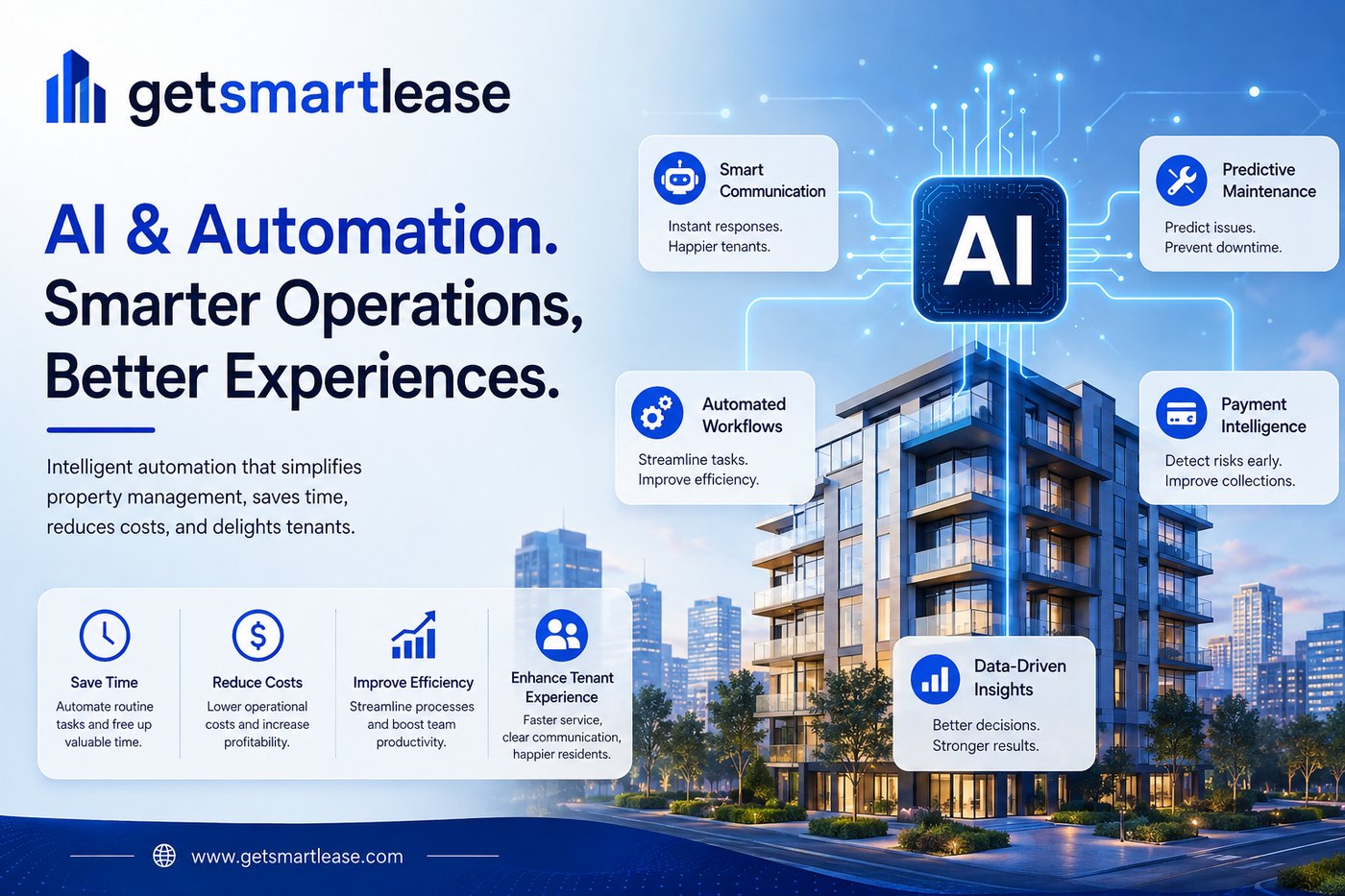
From Reactive Management to Predictive Operations
For years, property management has followed a familiar pattern: something happens, and the property team responds.
A tenant reports a maintenance problem. A payment becomes overdue. A lease approaches expiration. An occupancy issue appears.
This approach works, but it can create unnecessary delays and increase the workload for property teams.
AI introduces a different possibility: anticipating what may happen next.
By analyzing property, tenant, lease, maintenance, and payment data, AI-powered systems can identify patterns that help teams make earlier and better-informed decisions.
1. Predicting Maintenance Needs
Maintenance is one of the clearest opportunities for predictive property management.
Instead of relying entirely on tenants or staff to identify problems, AI-powered systems can analyze maintenance histories, equipment data, recurring issues, and other signals.
For example, if a particular type of equipment repeatedly requires repairs after a certain period, the system could flag it for inspection before another failure occurs.
This can help property managers:
- Reduce unexpected breakdowns
- Schedule maintenance more efficiently
- Minimize tenant disruption
- Extend the useful life of property assets
- Better plan maintenance budgets
The goal isn't to eliminate maintenance requests. It's to identify more problems before they become urgent.
2. Identifying Payment Risks Earlier
Late rent payments can create significant administrative work.
Traditionally, property teams identify the problem once a payment becomes overdue. With better automation and data analysis, teams can recognize payment patterns earlier.
AI could help identify trends such as repeated late payments or changes in payment behavior.
Property managers can then use automated workflows to send appropriate reminders and follow-ups.
Instead of manually checking accounts and contacting tenants individually, teams can focus their attention where it is most needed.
3. Making Lease Renewals More Proactive
Lease expiration dates are predictable, but renewal management can still become reactive.
When hundreds or thousands of leases are involved, teams may struggle to determine which renewals require immediate attention.
AI can help prioritize leases based on factors such as:
- Expiration dates
- Previous renewal behavior
- Communication history
- Occupancy trends
- Property-level data
Automation can then trigger renewal communications and internal tasks at appropriate stages.
The result is a more organized renewal process rather than a last-minute rush.
4. Improving Tenant Communication
Tenant communication often involves repetitive questions.
Residents may ask about rent due dates, maintenance updates, documents, policies, or lease information.
AI-powered assistants and automated communication tools can handle many routine requests instantly while directing more complicated situations to property staff.
Automation can also trigger communication based on events.
For example, when a maintenance request changes status, the tenant can automatically receive an update.
That means tenants receive information sooner while property teams spend less time sending repetitive messages.
5. Detecting Operational Patterns
One of AI's biggest advantages is its ability to analyze large amounts of information quickly.
Across a property portfolio, small problems can easily go unnoticed.
AI can help surface patterns such as:
- Increasing maintenance requests at a particular property
- Repeated payment delays
- Unusual vacancy changes
- Slower maintenance resolution times
- Lease renewal trends
- Frequently reported tenant issues
These insights give property managers an opportunity to investigate problems before they grow.
6. Automating the Next Step
Prediction becomes much more useful when it connects directly to automation.
Imagine a system that detects an upcoming lease expiration and automatically creates a renewal task, schedules communication, and alerts the appropriate team member.
Or a system that identifies an overdue payment and automatically begins the approved reminder workflow.
This combination of AI-driven insights + workflow automation can significantly reduce manual administrative work.
7. Giving Property Teams More Time for High-Value Work
AI isn't simply about replacing manual tasks.
Its greater value may come from helping teams spend their time differently.
When repetitive administrative processes are automated, property managers can dedicate more attention to tenant relationships, property performance, complex decisions, and long-term planning.
Technology handles more of the repetitive coordination while people remain responsible for decisions that require judgment, empathy, and experience.
What Predictive Property Management Looks Like
The transition won't happen overnight.
Property management companies will gradually move from:
Manual → Automated → Intelligent → Predictive
First, repetitive processes become digital.
Then workflows become automated.
Next, AI helps analyze the information generated by those workflows.
Finally, those insights can help teams anticipate what needs attention before problems occur.
Final Thoughts
The next generation of property management technology won't simply help teams work faster.
It will help them see what may happen next.
From maintenance and payments to renewals and tenant communication, AI and automation can transform property management from a reactive operation into a more proactive and predictive one.
For property managers, the competitive advantage will increasingly come from using technology not only to solve today's problems—but to identify tomorrow's problems before they happen.