
Tenant Feedback Is More Valuable Than a Rating
Property managers receive feedback every day, even when they aren't running surveys.
A maintenance complaint is feedback.
A repeated question about payments is feedback.
A tenant calling several times for an update is feedback.
A resident choosing not to renew can also be feedback—although by that point, the opportunity to improve their experience may already have passed.
The challenge is recognizing these signals early enough to act on them.
Tenant feedback shouldn't simply measure whether residents are happy. Used effectively, it can show property managers where friction exists in the tenant journey and what needs to improve.
The goal isn't to collect more surveys.
It's to listen at the right moments and turn what tenants say into better property operations.
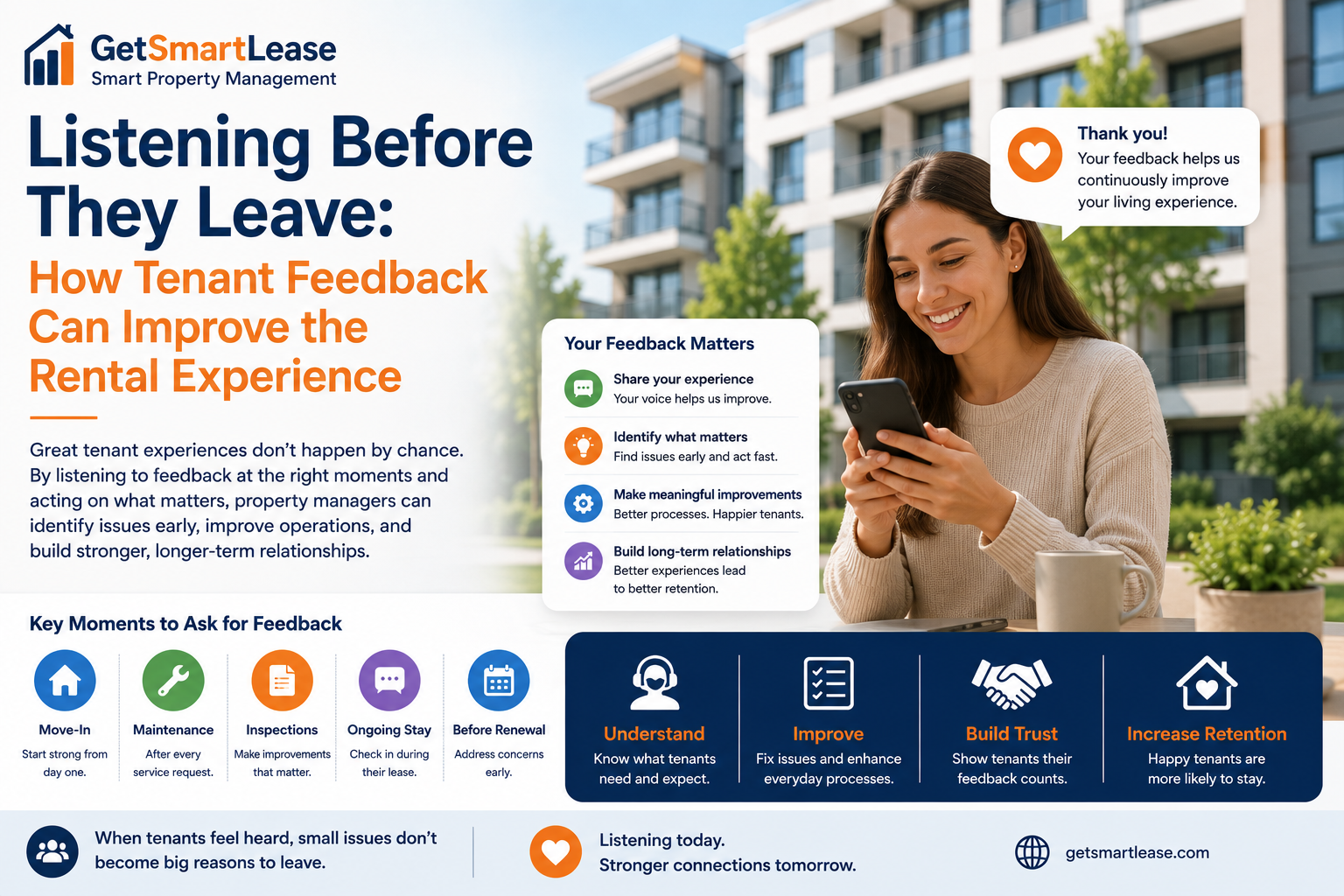
1. Don't Wait Until Renewal to Ask How Things Are Going
One of the biggest mistakes property teams can make is waiting until the end of a lease to understand the tenant's experience.
By then, months of small frustrations may have accumulated.
Instead, feedback can be collected throughout the tenancy.
Useful moments include:
- Shortly after move-in
- After maintenance requests
- Following inspections
- After resolving complaints
- Periodically during longer leases
- Before the renewal period
Each stage provides different insights.
A move-in survey might reveal that onboarding instructions are unclear.
Maintenance feedback might show that repairs are completed quickly but tenants aren't receiving enough updates.
Renewal feedback may reveal broader concerns about the overall experience.
Regular listening gives property managers more opportunities to improve.
2. Keep Feedback Simple
Tenants are unlikely to complete a long questionnaire every time they interact with property management.
Often, one or two focused questions are enough.
After maintenance, for example, you could ask:
Was your issue resolved satisfactorily?
Were you kept informed throughout the process?
After move-in:
Was the move-in process clear and easy to complete?
The easier it is to respond, the more useful feedback property teams may receive.
More questions don't necessarily create better insights.
Ask fewer questions—but make them relevant.
3. Look Beyond Individual Complaints
Every property manager deals with occasional complaints.
One complaint doesn't necessarily indicate a larger operational problem.
Patterns do.
Suppose several tenants say they don't receive maintenance updates.
The individual maintenance requests might all have been completed successfully, but the repeated feedback suggests a communication problem.
Or imagine tenants frequently contacting management because they can't find payment receipts.
The issue may not be the payment system itself. It may be that payment information isn't sufficiently visible.
Looking at feedback collectively helps property managers move from:
"How do we solve this tenant's problem?"
to:
"Why does this problem keep happening?"
That second question can lead to much more meaningful improvements.
4. Connect Feedback to Specific Tenant Touchpoints
General questions such as "Are you satisfied with your rental experience?" can be useful, but they don't always explain what needs improvement.
More actionable feedback is connected to specific interactions.
Move-In
Was documentation clear?
Were key dates communicated properly?
Did the tenant know what to do next?
Payments
Was it easy to understand the amount due?
Was payment confirmation available?
Could the tenant easily find their transaction history?
Maintenance
Was the request easy to submit?
Was it acknowledged?
Did the tenant receive updates?
Was the issue resolved?
Communication
Were messages clear?
Did tenants know who to contact?
Were important updates provided proactively?
Renewal
Were tenants contacted early enough?
Were the new terms easy to understand?
Was the renewal process straightforward?
Breaking feedback down by touchpoint makes it easier to identify where improvements are actually needed.
5. Respond to Negative Feedback Before It Becomes a Bigger Problem
Negative feedback isn't necessarily bad news.
It can be an early warning.
Suppose a tenant reports that they have contacted management several times about the same issue.
Ignoring that feedback could allow frustration to grow.
Responding quickly creates an opportunity to repair the relationship.
A useful response can include:
- Acknowledging the concern
- Reviewing what happened
- Explaining the next action
- Providing a realistic timeframe
- Following up after resolution
Tenants may understand that mistakes and delays happen.
What often matters is how the property management team responds afterward.
6. Close the Feedback Loop
Collecting feedback without acting on it can be worse than not asking at all.
If tenants repeatedly raise the same concern and nothing changes, they may stop believing their feedback matters.
Property managers should therefore create a simple feedback loop:
Listen → Identify → Act → Communicate → Measure
For example, tenants may report that maintenance status updates are insufficient.
The property team identifies the pattern.
A new process is introduced to send updates when requests change status.
Tenants are informed about the improvement.
Future feedback is then reviewed to see whether the problem has decreased.
This turns feedback into operational improvement rather than simply another piece of data.
7. Use Positive Feedback Too
Feedback isn't only about finding problems.
Positive responses can reveal what's working well.
Perhaps tenants consistently praise:
- Fast maintenance responses
- Helpful property managers
- Convenient digital payments
- Clear move-in instructions
- Easy access to documents
These insights are valuable because they show which processes should be maintained or expanded.
Positive feedback can also help teams recognize employees or service providers who consistently create good tenant experiences.
The objective should be to understand both sides:
What should we fix?
and
What should we continue doing?
8. Turn Feedback Into Team-Level Improvements
Feedback becomes more valuable when it reaches the people who can act on it.
Maintenance teams may need insights about repair quality.
Property managers may need feedback about communication.
Operations teams may need information about recurring process problems.
Management may need visibility into broader tenant satisfaction trends.
Instead of keeping feedback isolated, relevant insights can be shared across teams.
This helps everyone understand how their work contributes to the overall tenant experience.
9. Use Technology to Spot Patterns Earlier
Managing tenant feedback manually becomes harder as the number of properties and residents grows.
Comments may be scattered across emails, phone conversations, maintenance records, surveys, and support requests.
Centralized digital systems can help property teams organize tenant interactions and connect feedback with the activities that caused it.
Over time, this can make it easier to identify recurring issues.
For example:
Repeated maintenance complaints → investigate vendor or workflow performance
Payment questions → review payment visibility and instructions
Renewal concerns → improve renewal timing and communication
Move-in confusion → simplify onboarding
Technology doesn't decide what the tenant experience should be.
It gives property teams better visibility so they can make informed decisions.
10. Use Feedback Before the Renewal Decision
Renewal is one of the clearest indicators of the tenant relationship.
But tenant retention shouldn't become a priority only when the lease is about to expire.
If property managers regularly collect and respond to feedback throughout the lease, they have opportunities to address problems much earlier.
Think of retention as the result of many experiences:
Move-in + communication + payments + maintenance + support + trust = overall tenant experience
When these interactions consistently work well, renewal becomes a more natural continuation of the relationship.
From Tenant Feedback to Better Tenant Experiences
The most valuable tenant feedback doesn't simply tell property managers whether residents are satisfied.
It helps explain why.
Why are tenants repeatedly contacting the office?
Why are maintenance requests creating frustration?
Why are residents confused about payments?
Why are some tenants reluctant to renew?
Answering these questions gives property managers opportunities to improve processes—not just individual situations.
A strong feedback culture creates a continuous cycle:
Listen to tenants → identify friction → improve the process → measure the experience → keep improving.
Listen, Learn and Improve With GetSmartLease
Delivering a better tenant experience requires visibility throughout the rental lifecycle.
GetSmartLease helps property management teams bring important tenant and property processes together, making it easier to understand interactions across leases, payments, documents, communication, and other operational activities.
When property teams have better visibility, tenant feedback can become more than a comment or satisfaction score.
It can become an opportunity to improve the way properties are managed.
Because sometimes the most important question isn't:
"Why did this tenant leave?"
It's:
"What could we have learned while they were still here?"