
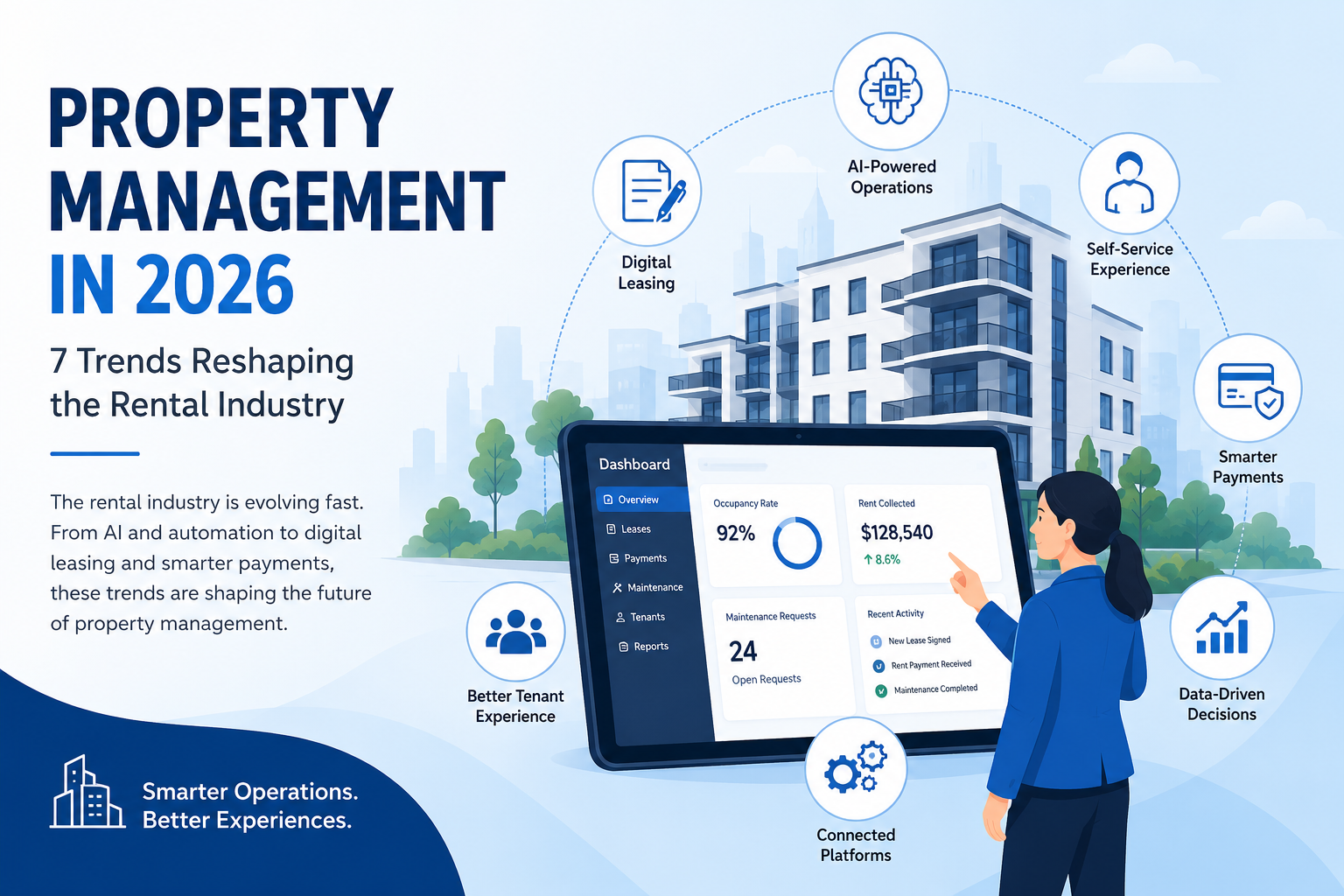
Property management has always involved balancing multiple responsibilities—leasing, tenant communication, payments, maintenance, documentation, and day-to-day operations.
What is changing is how those responsibilities are managed.
Renters increasingly expect convenient digital experiences, while property teams are looking for ways to reduce repetitive administrative work and operate more efficiently. At the same time, advances in automation, artificial intelligence, payments, and connected software are creating new possibilities.
Here are seven trends influencing the direction of property management in 2026.
1. AI Is Becoming Part of Everyday Property Operations
Artificial intelligence is moving beyond experimentation and into practical property management workflows.
Property teams can increasingly use AI to assist with tasks such as answering common tenant questions, organizing information, reviewing documents, generating communications, and identifying patterns within operational data.
The biggest opportunity isn't necessarily replacing human decision-making.
It's reducing the amount of time people spend on repetitive work so they can focus on situations that actually require their attention.
2. Leasing Is Becoming Fully Digital
Digital signatures were an important first step, but modern digital leasing goes much further.
The entire leasing journey can increasingly happen online—from applications and document collection to approvals, lease signing, payments, and record management.
Instead of moving information manually between emails, PDFs, spreadsheets, and separate systems, connected workflows can keep each stage of the process moving.
For renters, that means greater convenience.
For property teams, it can mean fewer administrative steps and better visibility into the leasing process.
3. Self-Service Is Becoming an Expectation
Consumers already manage banking, shopping, travel, and subscriptions online. Rental housing is increasingly following the same pattern.
Tenants may expect to be able to:
View lease information online
Make payments digitally
Submit requests
Access documents
Update relevant information
Communicate with property teams
Self-service doesn't eliminate the need for personal support. Instead, it gives residents the ability to handle simple tasks whenever it's convenient while allowing property teams to spend more time on complex issues.
4. Rental Payments Are Getting Smarter
Rent collection is another area experiencing rapid digital transformation.
Online payment options can make it easier for residents to pay while giving property teams better visibility into transactions and payment status.
The next stage is increasingly about connecting payments with the broader property management workflow.
When payment information, tenant records, leases, and communications work together, teams can spend less time manually reconciling information across different systems.
5. Data Is Driving More Property Decisions
Property managers generate significant amounts of operational data through leasing, payments, maintenance, occupancy, and tenant interactions.
Historically, much of that information has been scattered across different systems.
More connected technology can make it easier to turn that information into useful insights.
Instead of relying entirely on manual reports, teams can monitor important indicators and identify trends earlier.
The result is a gradual shift from simply recording what happened toward understanding what may require attention next.
6. Tenant Experience Is Becoming a Competitive Differentiator
Technology isn't only changing back-office operations. It's also changing renter expectations.
A tenant's experience now includes every interaction with the property—from the initial application to signing the lease, paying rent, requesting assistance, and eventually renewing or moving out.
Slow processes and fragmented communication can create unnecessary friction.
Simple, transparent, and accessible digital experiences can make the rental journey easier while helping property teams maintain stronger communication with residents.
7. Connected Platforms Are Replacing Fragmented Workflows
One of the most important industry shifts is happening behind the scenes.
Property teams have traditionally relied on combinations of spreadsheets, emails, documents, payment systems, communication tools, and specialized applications.
Each tool may solve an individual problem, but disconnected systems can create another problem: fragmented information.
The industry is increasingly moving toward connected property management ecosystems where leasing, payments, communication, documents, tenant information, and operational workflows can work together.
Integration may ultimately be just as important as individual features.
What This Means for Property Managers
The property management industry isn't simply becoming more digital.
It's becoming more connected.
AI can support automation. Digital leasing can connect applications with agreements. Smart payments can connect transactions with tenant records. Self-service tools can connect residents directly with property operations.
Together, these developments point toward a property management experience that requires less repetitive administration and provides better visibility for both teams and tenants.
Looking Ahead
Technology will continue to evolve, but the goal remains relatively simple: make property management easier for the people managing properties and more convenient for the people living in them.
The organizations that benefit most from these trends may not be those that adopt every new technology.
They will be the ones that use technology thoughtfully to simplify workflows, connect information, and create better experiences throughout the rental lifecycle.