
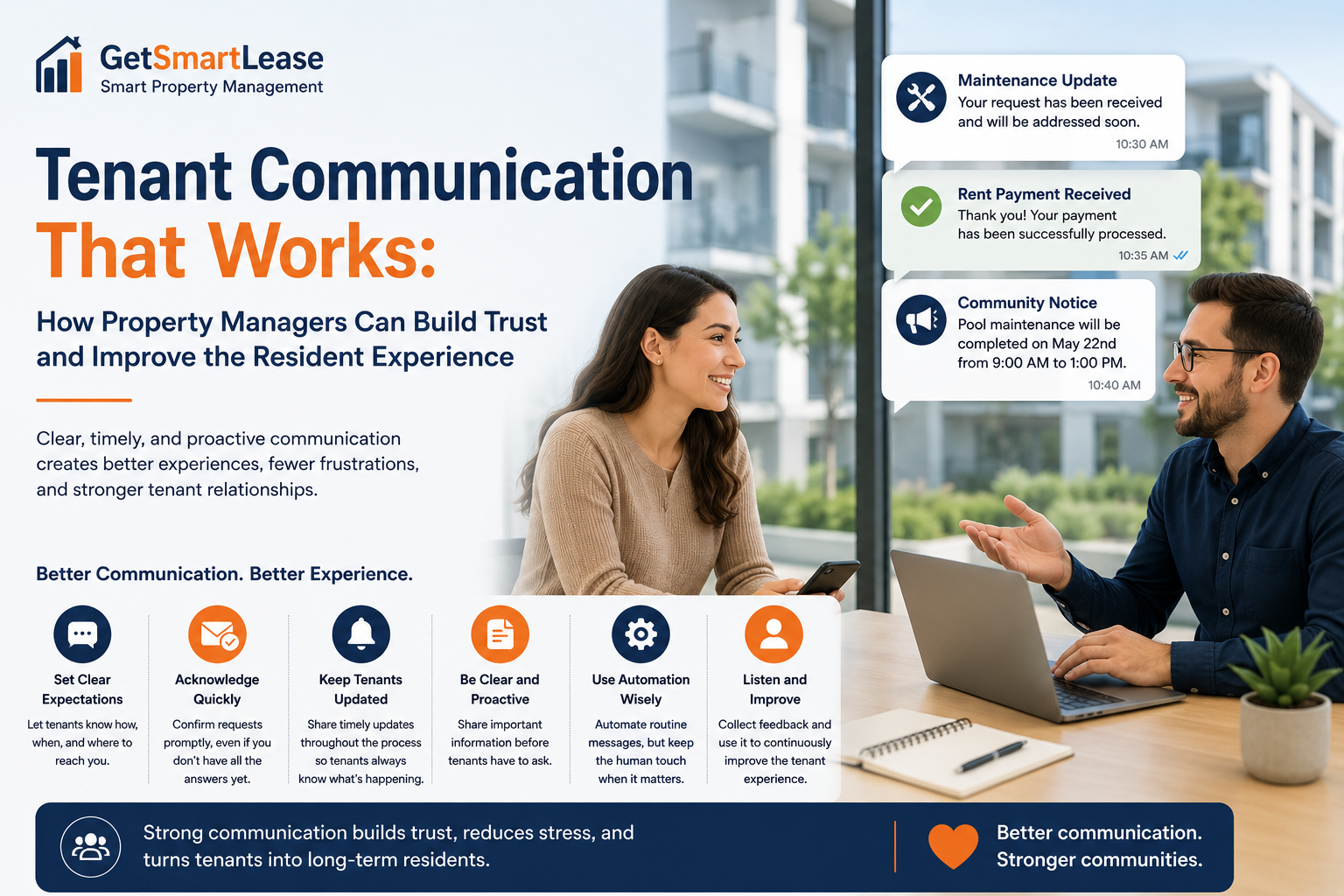
Good Tenant Experiences Start With Good Communication
A tenant submits a maintenance request.
The issue can't be fixed immediately, but the property manager acknowledges the request, explains what happens next, and provides an update when the schedule changes.
Now imagine the same situation with no response.
The repair may ultimately happen at exactly the same time, but the tenant's experience is completely different.
Why?
Communication.
For property managers, communication is more than answering emails or sending notices. It shapes how tenants perceive the service they receive throughout their lease.
When communication is clear and timely, tenants know what to expect. When it's inconsistent, even relatively small issues can become frustrating.
Improving tenant communication is therefore one of the simplest ways to create a better resident experience.
1. Set Communication Expectations From Day One
Good communication should begin before there is a problem.
During move-in, tenants should understand how and when to contact property management.
They should know:
- Where to submit maintenance requests
- How to ask questions about rent or payments
- Where important documents can be found
- How emergency situations should be reported
- How property notices will be delivered
- Who to contact for different types of questions
Setting these expectations early removes uncertainty later.
It also prevents a common problem: tenants sending the same request through emails, phone calls, text messages, and other channels because they aren't sure which one will receive a response.
A clear communication process benefits both tenants and property teams.
2. Acknowledge Requests Quickly—even When You Don't Have an Answer Yet
Property managers can't solve every issue immediately.
But they can acknowledge it.
Imagine a tenant reporting that their air conditioning isn't working.
If they hear nothing for hours or days, they may wonder:
Was my request received?
Do I need to submit it again?
Is anyone actually working on it?
That uncertainty can quickly turn into frustration.
A simple confirmation can change the experience:
"We've received your maintenance request and are reviewing it. We'll update you when it has been assigned."
The problem hasn't been solved yet, but the tenant knows someone is paying attention.
This distinction is important.
Fast communication doesn't always mean fast resolution.
Sometimes it simply means letting tenants know where things stand.
3. Keep Tenants Updated During Maintenance
Submitting a maintenance request is only the beginning of the experience.
Tenants also want visibility into what happens afterward.
For example, useful updates might include:
Request received → Request assigned → Visit scheduled → Work in progress → Request completed
Without these updates, tenants may repeatedly contact the property office just to find out what's happening.
That creates frustration for residents and additional work for property management teams.
Better maintenance communication can include:
- Confirmation when a request is received
- Scheduling information
- Technician or vendor updates when appropriate
- Notifications about delays
- Completion confirmation
- Follow-up when additional work is required
Even when repairs take longer than expected, transparency can help maintain tenant confidence.
4. Make Important Messages Easy to Understand
Property managers communicate about many subjects:
Rent.
Maintenance.
Inspections.
Policies.
Emergencies.
Renewals.
Property access.
Community updates.
These messages should be clear enough that tenants immediately understand what is happening and whether they need to take action.
For important notices, answer four questions:
What is happening?
When is it happening?
Does the tenant need to do anything?
Who should they contact if they have questions?
Avoid unnecessary jargon or overly complicated explanations.
For example, instead of sending a long message about scheduled maintenance, clearly state the date, expected time window, affected area, and whether tenant access is required.
Clarity reduces confusion—and confusion often creates additional communication.
5. Be Proactive, Not Just Reactive
Many tenant communications happen after something goes wrong.
But some of the best tenant experiences come from communication that happens before tenants need to ask.
Suppose an elevator will be unavailable for scheduled maintenance.
A reactive approach is to wait until tenants discover the issue and contact management.
A proactive approach is to notify residents beforehand, explain when the work will happen, and provide an expected completion timeframe.
The same approach can be applied to:
- Planned maintenance
- Property inspections
- Upcoming rent dates
- Service interruptions
- Community announcements
- Lease expirations
- Renewal opportunities
Proactive communication gives tenants time to prepare and can reduce incoming questions for property teams.
6. Use Automation Without Losing the Human Touch
As property portfolios grow, manually managing every routine communication becomes difficult.
This is where automation can help.
Automated communication can be useful for predictable events such as:
- Payment reminders
- Payment confirmations
- Maintenance acknowledgments
- Maintenance status changes
- Inspection reminders
- Lease expiration alerts
- Renewal reminders
Automation can make communication more consistent and reduce repetitive administrative work.
But not every conversation should be automated.
A frustrated tenant, complicated maintenance problem, dispute, or unusual situation may require direct human communication.
The goal isn't to automate every interaction.
The goal is to automate predictable communication so property teams have more time for conversations that genuinely require personal attention.
7. Keep Communication Organized
Tenant communication becomes difficult when information is spread across multiple systems.
One conversation may happen through email.
Another may happen over the phone.
A maintenance update may exist in a separate application.
Important details can become difficult to track.
Centralizing communication alongside tenant, property, lease, payment, and maintenance information can give property teams a clearer view of each situation.
When a tenant contacts management, the team can understand the context without asking the resident to repeat the entire story.
That creates a smoother experience for both sides.
8. Listen as Well as You Communicate
Effective communication isn't one-way.
Property managers also need ways to hear what tenants are experiencing.
Feedback can be especially useful after important interactions, such as:
- Move-in
- Maintenance completion
- Property inspections
- Service issues
- Lease renewal
A short question such as "Was your maintenance request handled satisfactorily?" can provide useful insight without creating a lengthy survey.
Over time, feedback can reveal patterns.
If multiple tenants say they aren't receiving enough maintenance updates, for example, the underlying problem may not be maintenance speed at all.
It may be communication.
Listening helps property managers identify these differences.
9. Start Renewal Conversations Early
Lease renewal is another area where timing matters.
Tenants shouldn't have to wonder when their lease expires or wait until the last minute to learn about renewal options.
Property managers can create a smoother experience by identifying upcoming expirations and beginning conversations early.
Clear renewal communication should explain:
- When the current lease ends
- Whether renewal is available
- Important dates or deadlines
- Updated terms when applicable
- What the tenant needs to do next
Early communication gives tenants time to make informed decisions and gives property managers better visibility into future occupancy.
More importantly, it demonstrates organization and professionalism at an important stage of the tenant relationship.
Better Communication Creates Better Tenant Experiences
Tenant experience isn't shaped only by how quickly a property manager solves problems.
It's also shaped by what happens between the problem and the solution.
Did the tenant know their request was received?
Did they understand what would happen next?
Were they informed about delays?
Could they easily find the information they needed?
Did management communicate before important events?
These small interactions can have a significant impact on how tenants perceive their property management experience.
Better communication creates clarity.
Clarity builds confidence.
And confidence can help create stronger tenant relationships.
Creating More Connected Tenant Communication With GetSmartLease
Managing communication becomes increasingly complex as properties, tenants, maintenance requests, payments, and leases grow.
GetSmartLease helps property management teams keep important information and workflows more connected, making it easier to stay organized throughout the tenant lifecycle.
With better visibility into tenant and property activities, teams can spend less time navigating disconnected processes and more time delivering timely, useful communication.
Because creating a great tenant experience doesn't always require communicating more.
It requires communicating better.