
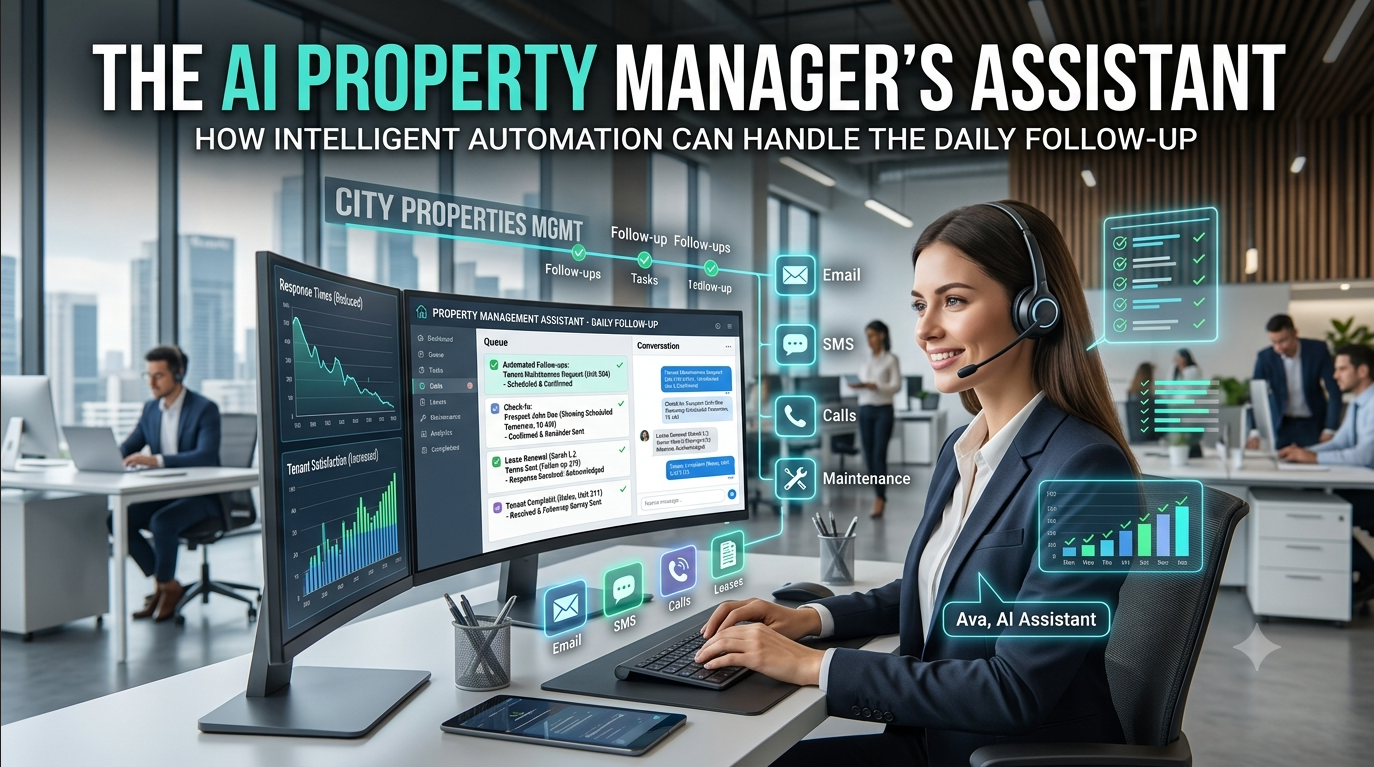
The AI Property Manager’s Assistant: How Intelligent Automation Can Handle the Daily Follow-Up
Property management rarely slows down because of one major task.
More often, time disappears into dozens of smaller ones.
A tenant hasn't submitted a document. A lease is waiting for a signature. A payment reminder needs to be sent. A maintenance request needs an update. An application has been sitting at the same stage for several days.
Each task seems manageable on its own.
The challenge is remembering what needs attention, when it needs attention, and who needs to act next.
This is an area where AI and intelligent automation can make a meaningful difference.
Instead of property managers constantly checking different systems and lists, an AI-powered assistant can help monitor workflows, identify unfinished actions, and bring the right tasks to their attention.
The Hidden Work of Property Management
A large part of property management is follow-up.
Consider a typical rental application.
The application may require:
- Applicant information
- Supporting documents
- Internal review
- Approval
- Lease preparation
- Tenant signature
- Property manager signature
- Payment
- Unit allocation
Moving from one stage to another often requires someone to check whether the previous action has been completed.
When this process is handled manually, property teams spend significant time asking questions such as:
Has the tenant uploaded the document?
Has the lease been signed?
Has the payment been received?
Did someone respond to the maintenance request?
Which applications are still waiting for action?
AI-assisted workflows can reduce this constant checking.
1. Identifying What Needs Attention
A traditional task list tells a property manager what tasks exist.
An intelligent assistant can go further by helping determine which tasks actually need attention now.
For example, imagine a property manager starting the morning with 150 active tenant and property activities.
Instead of reviewing every record, the system could highlight:
- 4 leases approaching expiry
- 3 overdue payments
- 2 applications waiting for documents
- 5 unresolved maintenance requests
- 1 lease awaiting signature
The property manager immediately knows where to focus.
This changes software from simply storing information into actively helping teams manage their workload.
2. Automating Routine Follow-Ups
Not every follow-up requires a person.
If a tenant hasn't uploaded a required document, an automated reminder could be sent.
If rent is approaching its due date, the system could send a scheduled notification.
If a lease has been sent but remains unsigned, a reminder could be triggered after an appropriate period.
Automation can handle these predictable actions consistently without requiring staff to remember every deadline.
Property managers can then become involved when a situation requires personal attention.
3. Keeping Applications Moving
Rental applications often slow down because one small action is incomplete.
Perhaps an applicant hasn't submitted a document.
Maybe an internal review hasn't been completed.
Or the lease is waiting for approval.
An AI-assisted workflow can monitor how long an application remains at each stage.
If an application stays inactive longer than expected, the system could flag it.
This gives property teams an opportunity to resolve bottlenecks before applicants become frustrated or opportunities are lost.
4. Making Lease Management More Organized
Lease management involves many dates and responsibilities.
There are lease start dates, expiry dates, renewal periods, notice periods, signatures, documents, and payments.
Instead of requiring property managers to manually track every milestone, automation can monitor these events continuously.
For example, the system could recognize that a lease will expire soon and automatically:
- Add it to the renewal queue.
- Notify the property manager.
- Prepare the appropriate workflow.
- Schedule tenant communication.
- Track whether action has been completed.
The property manager remains responsible for important decisions while the system manages much of the administrative coordination.
5. Following Maintenance Requests From Start to Finish
Receiving a maintenance request is only the beginning.
The issue needs to be reviewed, assigned, updated, completed, and communicated back to the tenant.
Without a structured workflow, requests can become stuck between these stages.
An intelligent system can monitor their progress.
If a maintenance request hasn't changed status within an expected period, it could be flagged for attention.
Tenants could also receive automated updates as the request progresses.
This reduces the need for tenants to repeatedly ask:
“What's happening with my maintenance request?”
6. Making Communication More Context-Aware
Basic automation sends the same message to everyone.
AI creates the opportunity for more context-aware communication.
For example, communication could vary depending on whether someone is:
- Completing a rental application
- Waiting for lease approval
- Approaching a payment deadline
- Requesting maintenance
- Preparing for lease renewal
Instead of generic notifications, messages can reflect the actual stage of the tenant journey.
However, automated communication should still follow approved business rules and allow human involvement when situations become sensitive or complex.
7. Turning Exceptions Into the Property Manager's To-Do List
One of the most useful applications of automation is exception management.
If everything is progressing correctly, staff shouldn't necessarily need to check it.
The system should bring attention to situations where something isn't progressing normally.
For example:
Normal: Payment received → record automatically updated.
Exception: Payment overdue → property manager alerted.
Normal: Application documents complete → application progresses.
Exception: Required document missing → reminder triggered.
Normal: Maintenance request progressing → tenant receives updates.
Exception: Request inactive too long → team alerted.
This allows property teams to manage by exception instead of manually supervising every transaction.
8. Creating a Smarter Daily Dashboard
Property management dashboards traditionally focus on numbers.
Occupancy rate.
Outstanding rent.
Open maintenance requests.
Active leases.
These metrics are valuable, but AI could make dashboards more actionable.
Instead of only saying:
“23 maintenance requests are open.”
A smarter dashboard could say:
“23 requests are open. Four have had no activity for more than three days and need attention.”
Instead of:
“18 leases expire soon.”
It could highlight:
“18 leases expire within 90 days. Six haven't started the renewal process.”
The difference is important.
Data tells teams what exists.
Intelligence helps them understand what to do next.
AI Should Assist, Not Make Every Decision
AI-powered assistants can help organize information, recommend actions, generate reminders, and automate repetitive workflows.
But important property management decisions still require human judgment.
Tenant disputes, lease negotiations, unusual payment circumstances, sensitive communications, and complex maintenance decisions shouldn't simply be handed over to automation.
The strongest approach combines both.
AI handles monitoring and routine coordination.
People handle judgment, relationships, and important decisions.
From Property Management Software to Property Management Assistant
Traditional property management software has largely been designed around one idea:
Store everything in one place.
The next stage could be different:
Help users understand what requires action.
That means software won't simply wait for a property manager to search for information.
It can monitor workflows in the background, surface exceptions, trigger routine actions, and help teams prioritize their day.
Final Thoughts
The future of AI in property management may not be about dramatic robots replacing property managers.
It may be much more practical.
A reminder sent automatically.
A missing document identified early.
An overdue task brought to someone's attention.
A maintenance request prevented from being forgotten.
A renewal started at the right time.
Individually, these improvements seem small. Across hundreds of tenants, properties, leases, payments, and requests, they can add up to significant operational improvements.
The most useful AI property management assistant may simply be the one that makes sure the right next step happens at the right time.