
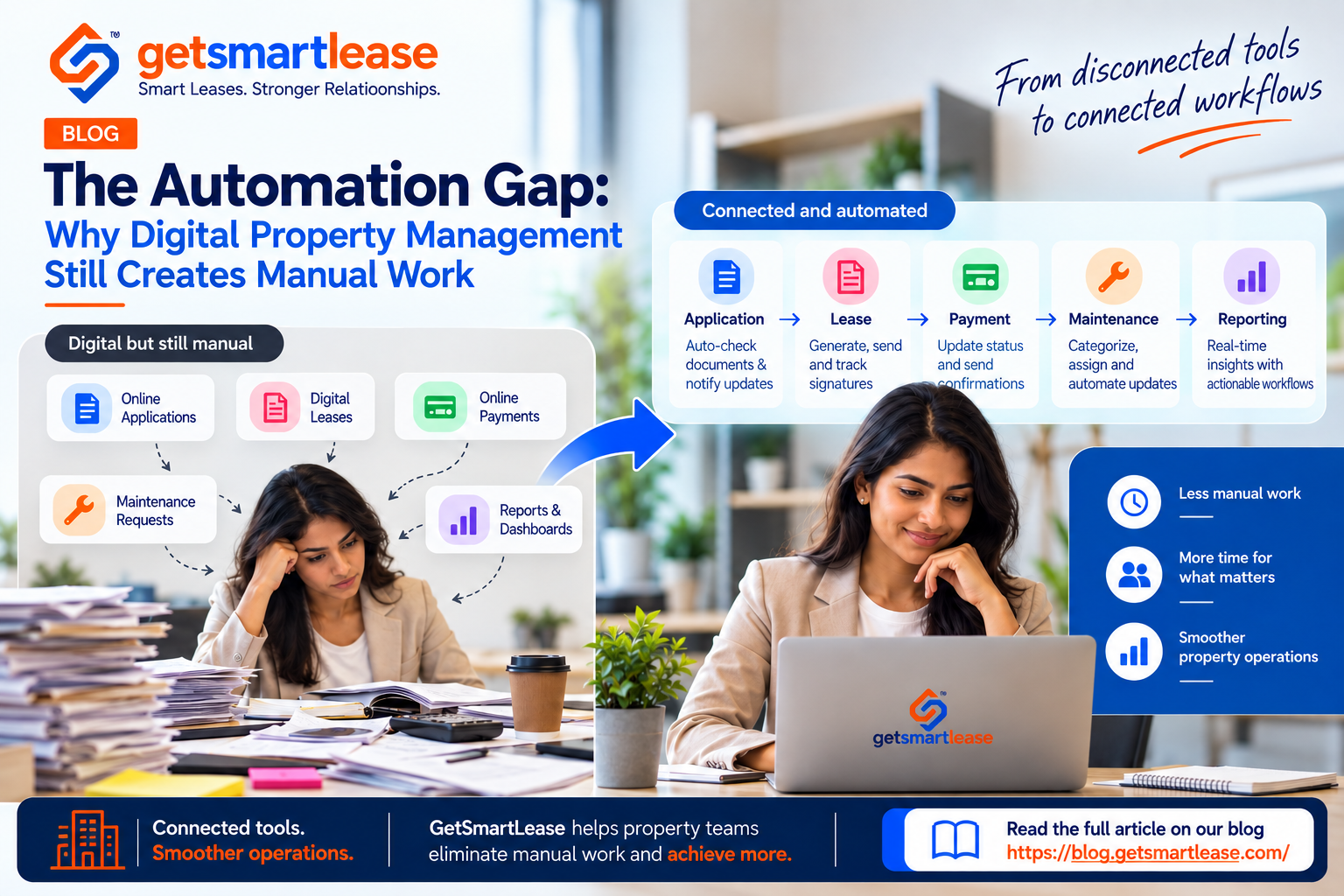
Property management has undergone a major digital transformation.
Paper applications have become online forms.
Physical lease agreements have become digital documents.
Rent can be paid online.
Maintenance requests can be submitted through portals.
Property managers have dashboards containing more information than ever before.
Yet many property teams still spend a surprising amount of time performing manual work.
Why?
Because digitizing a task isn't the same as automating a process.
A digital system may make individual tasks easier while still requiring people to connect those tasks manually.
This creates what we can call the automation gap.
What Is the Automation Gap?
The automation gap is the space between having digital tools and having those tools work together as a connected process.
Consider a rental application.
The applicant completes an online form.
That's digital.
But then someone may still need to:
Check whether all documents were submitted
Update the application status
Send a follow-up email
Prepare the lease
Request signatures
Confirm payment
Update another system
Notify the next person responsible
The application is digital, but the workflow surrounding it remains largely manual.
True automation begins when these individual steps become connected.
1. Too Many Systems, Too Many Handovers
Property management businesses often use different tools for different purposes.
One system may handle applications.
Another handles payments.
Documents may be stored somewhere else.
Maintenance may have its own platform.
Communication may happen through email.
Each system can work perfectly on its own while creating additional work between systems.
Employees become the connection layer.
They copy information, update statuses, send notifications, and check whether actions have been completed.
Automation should reduce these manual handovers.
When one action is completed, the next appropriate action should be able to begin automatically.
2. Digital Applications Still Need Manual Checking
Online rental applications are much more convenient than paper forms.
But simply putting an application online doesn't remove the administrative work behind it.
Property teams may still need to check:
Has the applicant completed every field?
Are all required documents available?
Has the application been reviewed?
What stage is the application currently in?
Automation can help monitor these requirements.
If something is missing, the applicant can receive a reminder.
If everything is complete, the application can move to the appropriate review stage.
Instead of employees repeatedly checking every application, they can focus on exceptions.
3. Digital Leases Can Still Have Manual Bottlenecks
Electronic signatures have significantly simplified leasing.
But signing is only one part of the lease lifecycle.
Before and after the signature, property managers may still coordinate:
Lease preparation
Internal approval
Tenant signature
Counter-signature
Payment requirements
Document storage
Move-in activities
If these steps aren't connected, staff must manually track where each lease stands.
A connected workflow can automatically move the process forward when each requirement is completed.
4. Online Payments Don't Automatically Mean Automated Collections
Offering online rent payments improves convenience.
But payment administration can still involve manual work.
Someone may need to:
Check whether payment was received
Update payment status
Send confirmation
Identify overdue accounts
Send reminders
Update reporting
A more automated process connects payment events directly to these actions.
When payment is received, the tenant's status can update automatically.
When payment becomes overdue, the appropriate reminder workflow can begin.
Property managers then focus primarily on cases that require intervention.
5. Maintenance Portals Can Still Create Follow-Up Work
Allowing tenants to submit maintenance requests online is useful.
But what happens after the request is submitted?
If property teams still need to manually review every request, notify people, update statuses, and send progress messages, much of the administrative workload remains.
Automation can connect the stages.
Request submitted → Categorized → Assigned → Updated → Completed
Communication can happen automatically as the request progresses.
Instead of simply digitizing the maintenance request, the entire maintenance workflow becomes connected.
6. Dashboards Can Show Problems Without Solving Them
Modern property management systems provide increasingly sophisticated dashboards.
They can show:
Outstanding payments
Open maintenance requests
Expiring leases
Occupancy levels
Pending applications
Document status
But information alone doesn't remove work.
A dashboard might tell a property manager:
12 leases are approaching expiration.
The next question is:
What happens now?
If someone still has to manually identify those leases, contact tenants, create tasks, and track responses, the process remains reactive.
Automation connects insights with action.
The system doesn't only show that something requires attention—it helps start the appropriate workflow.
7. Repetitive Data Entry Is a Sign of an Automation Gap
One of the easiest ways to identify an automation gap is to look for repeated data entry.
If employees regularly copy the same information between screens, spreadsheets, emails, and systems, there is probably an opportunity to improve the workflow.
For example, tenant information collected during an application shouldn't need to be manually entered again when creating a lease.
Property information already stored in the system shouldn't need to be repeatedly copied into documents.
Connected systems allow information to move with the workflow.
8. AI Can Help Connect the Missing Pieces
Traditional automation works particularly well when rules are clear.
For example:
If payment is received → mark invoice as paid.
If lease expires within 60 days → start renewal workflow.
If required document is missing → send reminder.
AI can add another layer by helping systems interpret information that isn't always perfectly structured.
It may assist with:
Categorizing tenant enquiries
Summarizing requests
Extracting information from documents
Identifying unusual workflow delays
Suggesting appropriate next actions
Prioritizing items requiring attention
Together, AI and workflow automation can reduce the manual coordination happening between digital processes.
How Property Managers Can Find Their Automation Gaps
Finding opportunities for automation doesn't require redesigning the entire business.
Start by observing everyday work.
Look for moments where employees repeatedly:
Copy information
Check statuses
Send the same reminders
Move information between systems
Search for documents
Update spreadsheets
Ask whether something has been completed
Notify another team member to continue a process
These are often signs that two digital steps aren't properly connected.
A useful question is:
“What happens immediately after this task is completed?”
If the answer is:
“Someone has to check and do the next thing,”
there may be an automation opportunity.
Digital Is the Foundation. Connected Is the Goal.
Digitization was an important first step for property management.
It moved applications, payments, documents, leases, and maintenance processes online.
The next stage is connecting those digital experiences.
Instead of:
Application → manual follow-up → lease → manual follow-up → payment → manual follow-up
the process becomes:
Application → Lease → Payment → Move-in
with automated workflows coordinating routine steps between each stage.
People remain involved where decisions, relationships, and judgment are required.
Technology manages more of the repetitive coordination.
Final Thoughts
The future of property management isn't simply about adopting more digital tools.
Most property businesses already have plenty of technology.
The bigger opportunity is making those tools and processes work together.
Every manual status check, repeated data entry, forgotten follow-up, and disconnected workflow represents a small automation gap.
Closing those gaps one by one can create a property management operation that is not only digital—but genuinely connected.
Because the real value of automation isn't completing one task faster.
It's making sure the next task doesn't have to be started manually.