
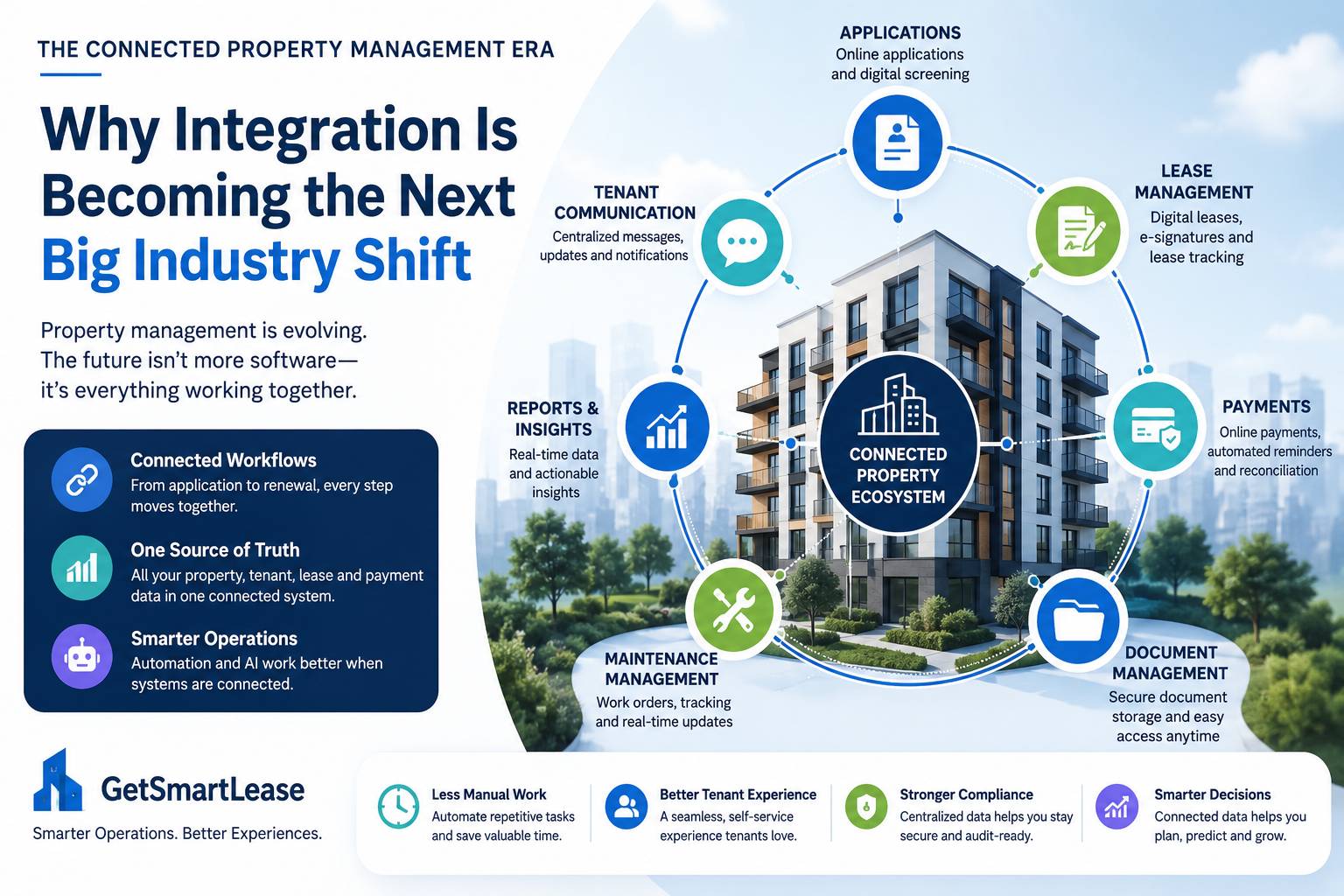
Over the past several years, property management has undergone significant digital transformation.
Paper applications became online forms. Physical lease agreements moved to digital signing. Rent payments became available online. Tenant communication expanded beyond phone calls and office visits.
But digitizing individual tasks created another challenge.
Many property teams now operate with multiple systems that don't always communicate with each other.
Leasing may happen in one platform, payments in another, documents somewhere else, and tenant communication across email, messaging tools, and spreadsheets.
The next major shift in property technology isn't simply about adding another tool.
It's about connecting the tools, information, and workflows that already exist.
1. More Technology Doesn't Always Mean Less Work
Introducing digital tools can improve individual processes, but having too many disconnected systems can create additional administrative work.
A property manager might receive a rental application digitally but still need to manually transfer information into another system.
A tenant might make an online payment, but the property team may still need to verify the transaction and update internal records.
A signed lease might be stored digitally but remain disconnected from the tenant's application, payment history, or property record.
Each process is digital, yet employees may still be responsible for connecting everything manually.
This is why the industry is increasingly focusing on workflow integration rather than simple digitization.
2. The Single Source of Truth Is Becoming More Important
Property management generates information throughout the entire rental lifecycle.
This includes:
- Property and unit information
- Tenant applications
- Lease agreements
- Payment records
- Documents
- Maintenance requests
- Communication history
- Renewal information
When this information exists across multiple systems, finding the latest or correct version can become difficult.
Connected platforms can create a more consistent source of information, helping teams understand what is happening across properties, tenants, leases, and payments without searching through multiple systems.
3. Leasing Is Becoming an End-to-End Workflow
Digital leasing used to mean putting a lease agreement online and allowing tenants to sign electronically.
Today, the expectation is much broader.
A connected leasing process can include:
Application → Review → Approval → Lease Creation → Digital Signature → Payment → Move-In
Instead of treating each stage as an independent task, property technology is increasingly connecting them into a continuous workflow.
When one stage is completed, the next step can begin without employees repeatedly entering the same information.
That can create a faster and more consistent leasing experience.
4. Payments Are Becoming Part of the Property Workflow
Online rent payments are already common, but the bigger industry shift is how payment information connects with other property operations.
For example, when payments are integrated with tenant and lease records, property teams can more easily understand:
- What payment is due
- Which lease it relates to
- Whether it has been paid
- When the transaction occurred
- What action may be required next
The goal isn't simply to process payments digitally.
It's to make payment information useful across the wider property management workflow.
5. Automation Works Better When Systems Are Connected
Automation is becoming one of the biggest themes in property technology.
But automation has limited value when information remains fragmented.
Connected systems make it possible for one event to trigger another.
For example:
Application approved → Prepare lease
Lease signed → Request required payment
Payment completed → Update tenant record
Lease approaching expiry → Begin renewal workflow
Instead of property managers manually monitoring every stage, workflows can help surface the next required action.
This allows automation to support employees rather than simply digitizing isolated tasks.
6. Tenant Experience Is Also Becoming More Connected
Fragmented systems don't only affect property teams.
Tenants experience them too.
Imagine having to use one process to submit an application, another to sign a lease, another to make payments, and email to request documents or ask questions.
A connected tenant experience can provide a more consistent journey from application through renewal.
Residents increasingly expect digital services to feel simple and accessible.
Property management technology is gradually moving toward meeting those expectations.
7. AI Will Make Integration Even More Valuable
Artificial intelligence is becoming increasingly relevant to property management.
AI can help summarize information, assist with communication, identify patterns, organize documents, and support operational decisions.
But AI becomes much more useful when it can work with connected and well-organized information.
If lease information, payment history, property records, and tenant interactions are fragmented, obtaining meaningful insights becomes more difficult.
As AI adoption grows, strong data integration may become an increasingly important foundation for intelligent property operations.
From Property Management Software to Property Ecosystems
The industry is gradually moving beyond individual property management applications.
The emerging model is a connected property ecosystem.
Instead of asking:
"Which software handles this task?"
Property teams may increasingly ask:
"How does this process connect with everything else?"
That change in thinking could influence how property technology develops over the coming years.
What This Means for Property Managers
Property managers don't necessarily need more technology.
They need technology that works better together.
When evaluating digital tools, teams can increasingly consider questions such as:
- Can information move between different workflows?
- Can repetitive tasks be automated?
- Can property and tenant information be viewed centrally?
- Can employees easily understand what action is required next?
- Can tenants complete important tasks without unnecessary friction?
The answers to these questions may become just as important as individual software features.
Looking Ahead
The first phase of property technology was about digitizing property management.
The next phase is about connecting it.
Leasing, payments, communication, documents, automation, and tenant services are becoming parts of a broader digital ecosystem.
As the rental industry continues to evolve, connected technology has the potential to reduce administrative complexity, improve visibility, and create smoother experiences for both property teams and residents.
The future of property management may not be defined by how many digital tools a company uses.
It may be defined by how well those tools work together.