
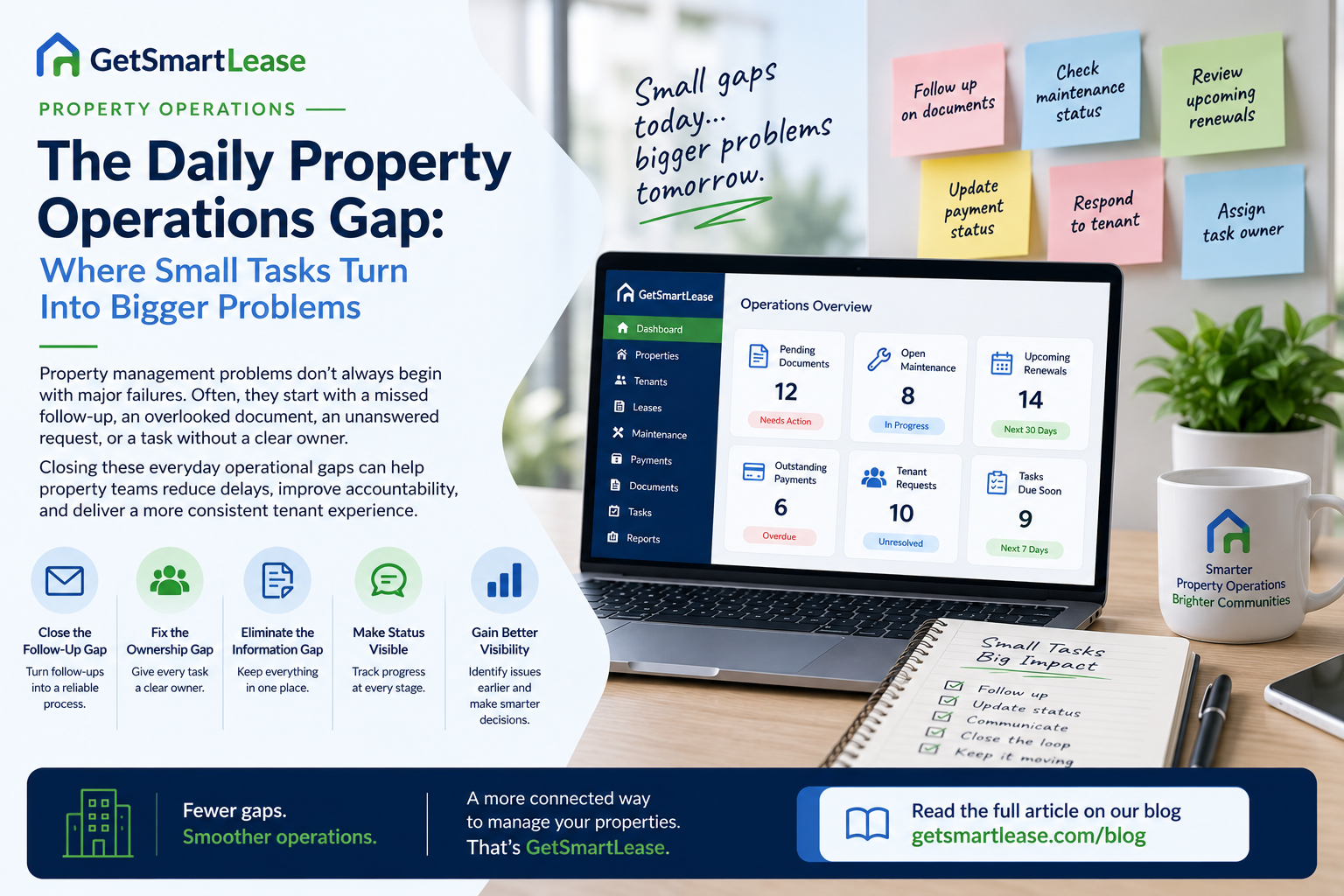
Small Gaps Can Create Big Operational Problems
Most property management teams don't struggle because they don't know what needs to be done.
The challenge is making sure everything actually gets done—at the right time, by the right person.
A tenant sends a document, but nobody updates its status.
A maintenance request is assigned, but the follow-up isn't recorded.
A lease is approaching renewal, but the conversation starts too late.
A payment requires attention, but the information sits in another system.
Individually, these may look like small issues. Across dozens or hundreds of properties, however, they can create delays, duplicated work, frustrated tenants, and unnecessary pressure on property teams.
This is the daily property operations gap: the space between knowing what needs to happen and ensuring it happens consistently.
1. The Follow-Up Gap
Property management involves constant follow-up.
Teams may need to follow up on:
- Missing tenant documents
- Outstanding payments
- Maintenance progress
- Lease signatures
- Application information
- Renewal decisions
- Internal approvals
When follow-ups depend on individual memory, calendars, or handwritten notes, they can easily be delayed or forgotten.
Structured workflows and reminders can help turn follow-up from a personal responsibility into a reliable operational process.
2. The Ownership Gap
One of the simplest questions in property operations is also one of the most important:
Who is responsible for this?
When responsibility isn't clear, tasks can remain untouched because everyone assumes someone else is handling them.
Each operational task should ideally have:
An owner → A status → A deadline → A next action
Clear ownership makes accountability easier and gives managers better visibility into where work is getting stuck.
3. The Information Gap
Property teams often work with information spread across multiple places.
Tenant details may exist in one system, lease documents in another, maintenance conversations in email, and payment information somewhere else.
The problem isn't necessarily that the information doesn't exist.
It's that employees may not have it when they need it.
Centralizing important operational information can reduce searching, duplicate data entry, and unnecessary back-and-forth between team members.
4. The Status Gap
Knowing that a task exists isn't enough.
Teams also need to know what stage it has reached.
Consider a maintenance request.
Has it been:
Submitted → Reviewed → Assigned → Scheduled → Completed → Confirmed?
Or a lease:
Prepared → Sent → Signed by tenant → Counter-signed → Activated?
Clear statuses make operational progress visible.
Without them, teams often rely on messages and conversations to determine what has already happened.
5. The Communication Gap
Operational delays often become tenant experience problems when communication is missing.
A maintenance repair might take several days, but a tenant may be far more understanding when they receive timely updates.
Likewise, tenants are less likely to become confused about payments, documents, or renewals when expectations and next steps are communicated clearly.
Good communication doesn't always mean sending more messages.
It means sending the right update at the right stage of the process.
6. The Handoff Gap
Many rental processes involve several people.
An application may move from a leasing team to a property manager. A maintenance issue may move from the tenant to the manager and then to a contractor. A lease may require actions from both the tenant and property team.
Every handoff creates an opportunity for information to be lost.
A connected workflow should make it clear:
- What has already been completed
- What information is available
- Who owns the next step
- What needs to happen next
Smooth handoffs can prevent teams from repeatedly asking for information that has already been provided.
7. The Visibility Gap
Managers can't improve operations they can't see.
If tasks, deadlines, requests, and exceptions are scattered across different systems, identifying operational bottlenecks becomes difficult.
A centralized operational view can highlight areas such as:
- Overdue tasks
- Outstanding tenant requests
- Upcoming lease expirations
- Pending applications
- Missing documents
- Unresolved maintenance issues
- Payment exceptions
This allows teams to prioritize attention rather than spending time searching for problems.
Fix the Process, Not Just the Problem
When something goes wrong, the immediate priority is usually to fix it.
But strong property operations go one step further.
They ask:
Why did this happen?
If a lease renewal was missed, perhaps the solution isn't simply remembering the next one. Maybe the renewal workflow needs an earlier reminder.
If tenants repeatedly ask about maintenance progress, perhaps automated status updates should be part of the process.
If documents frequently go missing, perhaps they need a centralized digital workflow.
Solving the underlying process can prevent the same problem from appearing again.
Better Operations Are Built in the Small Moments
Operational excellence isn't created only through major technology projects or dramatic process changes.
It's often created through hundreds of small improvements:
A reminder sent automatically.
A task assigned clearly.
A document stored correctly.
A status updated immediately.
A tenant informed at the right time.
A deadline identified early.
When these small moments work consistently, the entire property management operation becomes easier to manage.
Closing the Property Operations Gap With GetSmartLease
GetSmartLease helps property teams connect important rental workflows and improve visibility across day-to-day operations.
By bringing processes such as leasing, tenant management, documents, payments, and communication into a more structured digital environment, teams can reduce operational gaps and keep work moving from one stage to the next.
Because better property operations aren't only about managing more tasks.
They're about making sure fewer tasks fall through the gaps.