
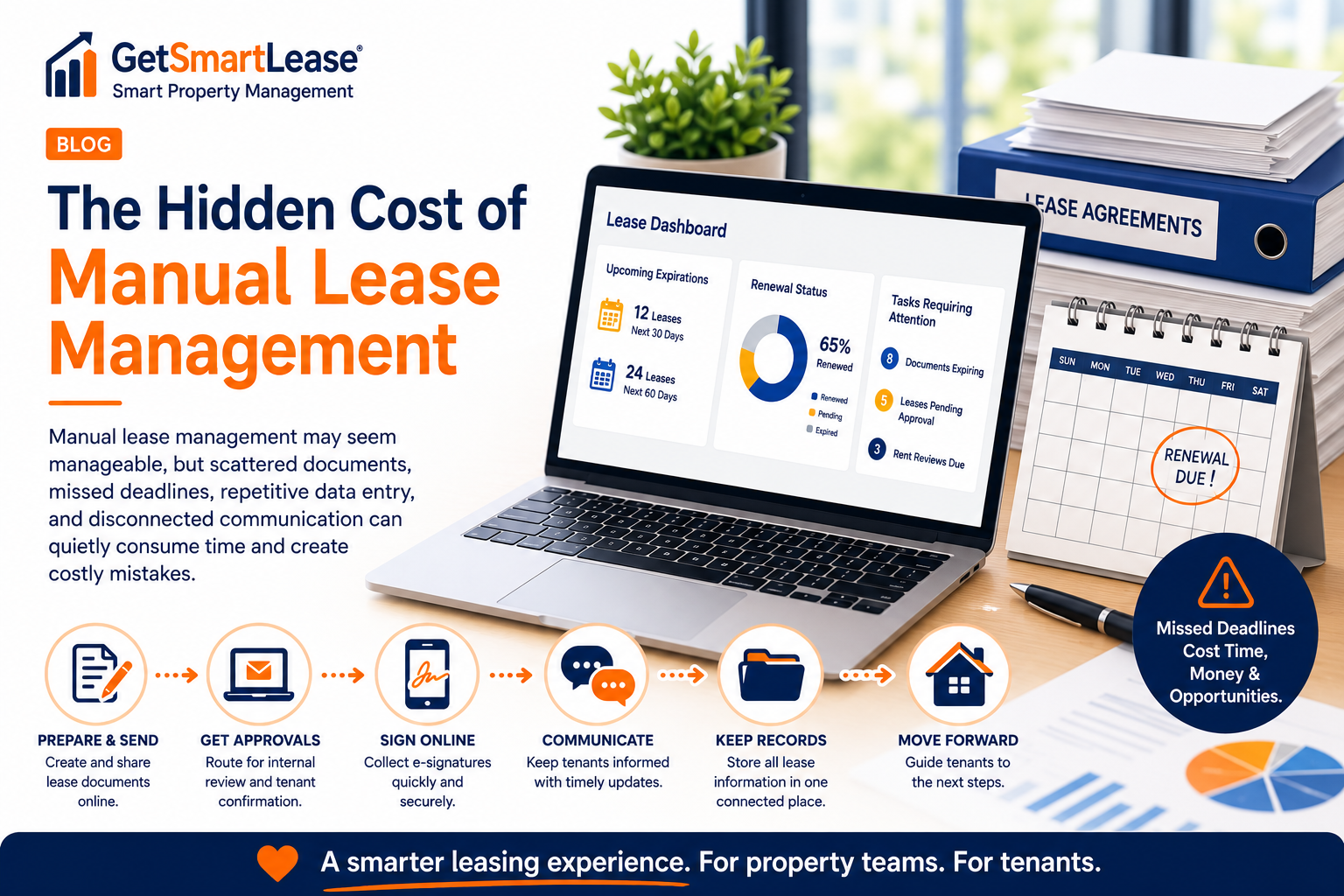
Managing leases is one of the most important responsibilities in property management. Every lease contains critical information—from rent amounts and payment terms to renewal dates, notice periods, tenant details, and important documents.
Yet many property teams still manage this information through spreadsheets, email threads, shared folders, calendars, and manual reminders.
At first, this approach may seem simple and inexpensive. But as the number of properties, units, tenants, and leases grows, manual lease management can create hidden costs that go far beyond administrative inconvenience.
Lost time, missed deadlines, inconsistent records, communication gaps, and limited visibility can all affect day-to-day operations.
Understanding these hidden costs is the first step toward building a more efficient lease management process.
1. Administrative Work Adds Up Quickly
Manual lease management often involves repetitive tasks.
Property teams may spend time entering lease information into spreadsheets, updating tenant records, organizing documents, checking expiration dates, sending reminders, and searching through emails for previous conversations.
Individually, these tasks may only take a few minutes. Across dozens or hundreds of leases, however, those minutes can turn into hours of administrative work.
The problem becomes even greater when the same information needs to be entered into multiple systems.
Instead of focusing on tenants, property operations, or strategic decisions, teams can find themselves spending significant time simply keeping records up to date.
A streamlined lease management process helps reduce this repetitive work and gives teams more time for higher-value activities.
2. Missed Lease Dates Can Become Expensive
Every lease has important dates.
These may include:
- Lease start dates
- Lease expiration dates
- Renewal windows
- Notice deadlines
- Rent increase dates
- Payment deadlines
- Inspection dates
Tracking all of these manually becomes increasingly difficult as a portfolio grows.
A spreadsheet may contain the correct expiration date, but someone still needs to regularly check it. A calendar reminder may help, but it can easily be overlooked, assigned to the wrong person, or lost when responsibilities change.
Missing a renewal or notice deadline can create unnecessary operational and financial consequences.
Effective lease management should make critical dates visible and help teams take action before deadlines arrive.
3. Searching for Documents Wastes Valuable Time
“Where is the latest lease agreement?”
It sounds like a simple question.
But when documents are stored across email inboxes, employee computers, shared drives, folders, and different software platforms, finding the correct version can become surprisingly difficult.
Teams may have to search through multiple locations just to confirm whether they have the latest signed document.
This creates another hidden cost: search time.
Centralizing lease documents makes it easier for authorized team members to locate the information they need without searching through disconnected systems.
It also helps reduce confusion around outdated or duplicate document versions.
4. Manual Data Entry Increases the Risk of Errors
Human error is unavoidable.
When lease information is entered manually, simple mistakes can happen:
- An incorrect lease expiration date
- A missing digit in a rent amount
- An outdated tenant contact
- A renewal status that was never updated
- A document saved under the wrong property
- An important note recorded in one system but not another
A single mistake may appear minor, but incorrect lease data can influence communication, reporting, renewals, and operational decisions.
The more times information is copied between systems, the greater the opportunity for inconsistencies.
A more connected lease management process can reduce duplicate data entry and help teams maintain more reliable records.
5. Scattered Communication Creates Information Gaps
Lease management isn't only about documents and dates.
Communication is equally important.
Property managers may need to communicate with tenants about renewals, lease documents, approvals, payments, move-in requirements, policy updates, and other lease-related matters.
When these conversations happen across different email accounts, phone calls, text messages, and internal notes, maintaining a complete history can become difficult.
One team member may know about a tenant conversation that another team member cannot see.
If an employee is unavailable or leaves the organization, important context can also disappear.
Keeping lease-related communication connected to the appropriate records gives teams better continuity and makes it easier to understand what has already happened and what needs to happen next.
6. Manual Processes Make Scaling Harder
A manual process that works for 20 leases may not work nearly as well for 200.
As a property portfolio expands, the number of documents, deadlines, tenant interactions, renewals, and internal tasks grows with it.
Without standardized workflows, growing teams may respond by creating more spreadsheets, adding more folders, or introducing additional manual checklists.
That can increase complexity rather than solve it.
Scalable lease management requires processes that remain organized as the volume of leases increases.
Standardized workflows, centralized information, and automated reminders can help property teams grow without increasing administrative complexity at the same rate.
7. Limited Visibility Makes Decision-Making Harder
Property teams often need quick answers to questions such as:
- Which leases expire in the next 90 days?
- Which tenants are approaching renewal?
- Which documents are still outstanding?
- Which leases require action this month?
- What is the current status of a particular lease?
When lease information is scattered across spreadsheets and folders, answering these questions may require manually reviewing multiple records.
That slows decision-making.
Centralized lease management gives teams a clearer view of their portfolio and makes important information easier to access.
Instead of searching for answers, teams can spend more time acting on them.
8. Inconsistent Processes Can Affect the Tenant Experience
Manual lease management can also affect tenants.
For example, a tenant might receive a renewal notice later than expected because a deadline was missed. Another tenant might be asked to submit a document they already provided because the original file cannot be located.
Small operational problems like these can create unnecessary friction.
A well-organized lease process helps property teams communicate consistently, respond faster, and provide tenants with clearer next steps.
Better internal organization can therefore contribute directly to a smoother tenant experience.
What Does Better Lease Management Look Like?
Improving lease management doesn't simply mean replacing paper documents with digital files.
A modern approach should connect the different parts of the lease lifecycle.
That can include:
- Centralized lease and tenant records
- Organized document storage
- Critical-date tracking
- Automated reminders
- Renewal workflows
- Clear lease status tracking
- Accessible communication history
- Standardized processes across properties
The goal is not automation for the sake of automation.
The goal is to reduce unnecessary administrative work while making important lease information easier to find, understand, and act on.
Moving From Manual to Modern Lease Management
Property teams don't have to change everything at once.
A good starting point is identifying where the most time is currently being lost.
Are employees constantly searching for documents?
Are renewal dates being tracked manually?
Is the same tenant information entered in multiple places?
Are important conversations difficult to locate later?
Once these bottlenecks are identified, teams can begin replacing disconnected manual steps with more organized digital workflows.
Even small improvements can create meaningful efficiencies when repeated across an entire portfolio.
Final Thoughts
The real cost of manual lease management isn't always visible on a balance sheet.
It appears in the hours spent searching for information, repetitive administrative tasks, missed deadlines, inconsistent records, communication gaps, and processes that become increasingly difficult to manage as a portfolio grows.
Modern lease management brings information, documents, deadlines, communication, and workflows together so property teams can operate more efficiently.
For property managers looking to simplify leasing operations, the question isn't only how much a new system costs.
It's also worth asking:
How much is the current manual process already costing you?
Simplify Lease Management with GetSmartLease
GetSmartLease helps property teams create a more connected digital leasing experience by simplifying workflows, improving organization, and reducing the administrative burden surrounding lease management.
Ready to make lease management simpler? Explore GetSmartLease and discover a smarter way to manage the leasing journey.