
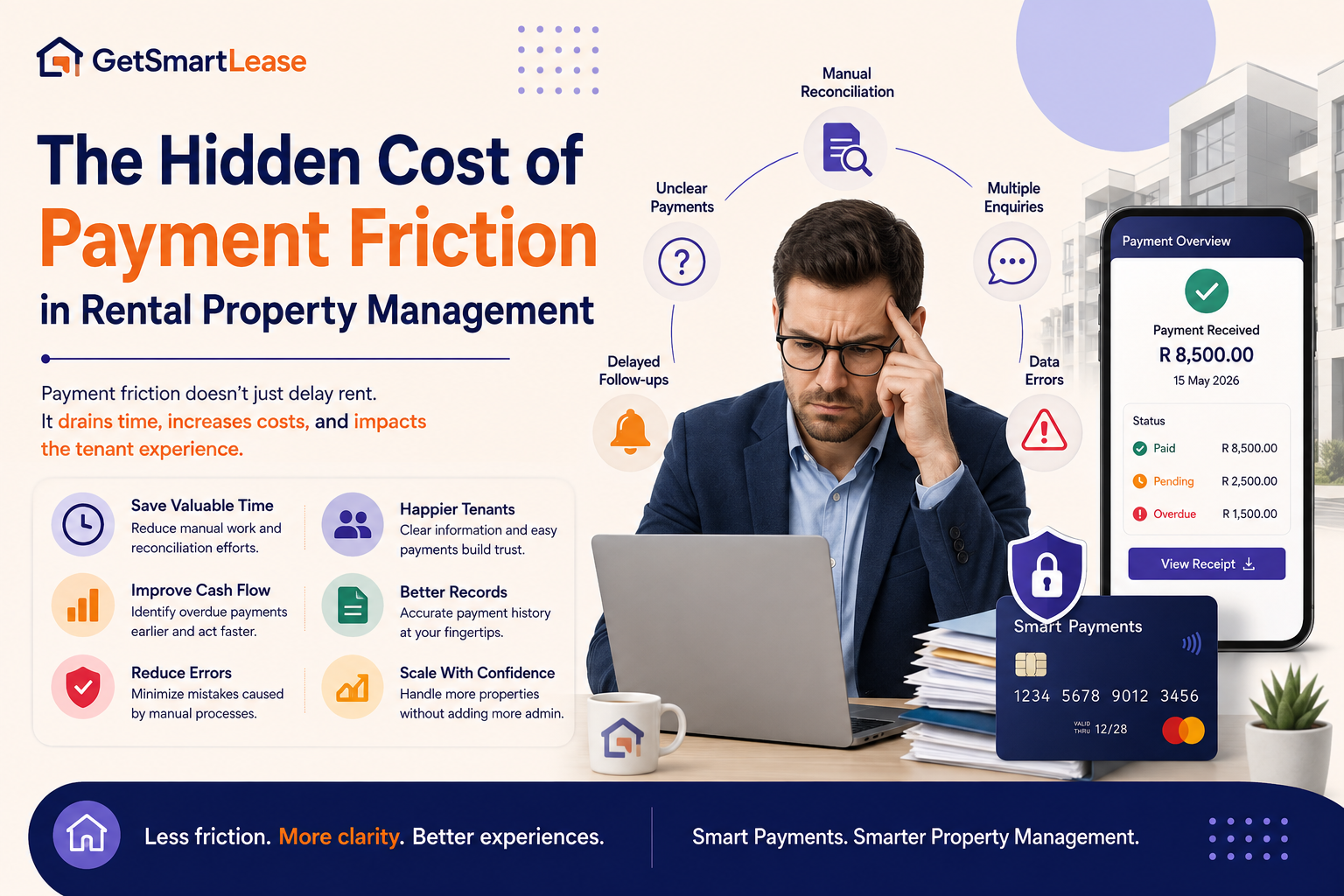
A rent payment may seem like a simple transaction: a tenant owes an amount, makes a payment, and the property manager records it.
In reality, there can be many points of friction between the due date and a successfully recorded payment.
A tenant may be unsure about the amount due. A payment may arrive without a clear reference. A property manager may need to manually match a transaction to a tenant. A receipt may need to be created and sent separately. An overdue payment may only be noticed after someone checks a spreadsheet.
Individually, these issues may appear small.
Across dozens, hundreds, or thousands of rental units, however, they can create a significant operational burden.
This is the hidden cost of payment friction.
What Is Payment Friction?
Payment friction is anything that makes paying, receiving, tracking, or confirming rent more difficult than it needs to be.
It can appear at different stages of the payment process.
For tenants, friction might mean unclear payment instructions, uncertainty about balances, limited payment visibility, or difficulty finding confirmation that a payment was received.
For property teams, it can mean manual reconciliation, repeated tenant follow-ups, disconnected records, and time spent investigating payment questions.
The problem isn't always the payment itself.
Often, it's everything happening around the payment.
1. Small Payment Questions Create Large Administrative Workloads
Consider some common tenant questions:
"How much do I need to pay?"
"Has my payment been received?"
"Can you send me my receipt?"
"Why does my account still show an outstanding balance?"
One question may take only a few minutes to resolve.
But when the same questions arrive from many tenants every month, those minutes quickly become hours of administrative work.
A clearer digital payment experience can reduce these routine enquiries by giving tenants better access to payment information and records.
2. Manual Reconciliation Consumes Valuable Time
Receiving money is only one part of rent collection.
The payment also needs to be correctly identified and recorded.
When payment information isn't connected with tenant, property, and lease records, employees may need to manually determine who made each payment and what the payment relates to.
That can involve comparing:
- Bank transactions
- Tenant names
- Payment references
- Property information
- Lease records
- Spreadsheets
- Invoices
The larger the rental portfolio becomes, the harder this process can be to manage efficiently.
Reducing reconciliation friction can save property teams significant administrative effort.
3. Poor Visibility Can Delay Follow-Ups
If payment information isn't easy to access, overdue payments can remain unnoticed longer than necessary.
Property managers may have to manually review records before determining which tenants have paid and which haven't.
That delays action.
A clearer payment workflow should make important statuses immediately visible:
Paid | Pending | Overdue
When teams can quickly identify exceptions, they can focus their attention on the accounts that actually require follow-up.
4. Confusing Payment Experiences Can Affect Tenants
Payment friction isn't only an internal operational problem.
It directly affects the tenant experience.
Imagine paying rent and then being unsure whether the payment was successfully recorded.
Or receiving a reminder for rent you've already paid.
Or having to contact the property manager simply to obtain a receipt.
These experiences can create unnecessary frustration.
Tenants increasingly expect the same level of digital convenience they experience with banking, shopping, subscriptions, and other everyday services.
Rent payments shouldn't feel disconnected from those expectations.
5. Disconnected Systems Create Duplicate Work
Another hidden source of payment friction is disconnected technology.
For example, a payment may be processed through one system while tenant information is stored in another and lease details are maintained somewhere else.
Employees then become responsible for connecting the information manually.
They may need to copy transaction details, update payment statuses, create records, and communicate confirmations separately.
Every additional manual handoff creates another opportunity for delay or error.
Smart payment workflows reduce this friction by connecting payment activity with the broader property management process.
6. Payment Errors Can Become Expensive to Resolve
A small recording error can create a surprisingly complicated chain of work.
Suppose a tenant pays rent but the transaction is incorrectly matched or isn't updated in the property management records.
The tenant may receive an overdue notice.
They contact the property manager.
A staff member investigates.
Bank records are checked.
The payment is identified.
The account is corrected.
The tenant is contacted again.
The original payment wasn't necessarily the problem.
The process surrounding it was.
Reducing manual handling can help prevent these situations before they happen.
7. Payment Friction Makes Growth Harder
Manual payment processes may seem manageable when a property business has a small portfolio.
But what happens when the number of tenants doubles?
If every new tenant creates additional manual reconciliation, reminders, receipts, and payment enquiries, administrative workload can grow almost as quickly as the portfolio itself.
That makes scaling expensive.
A better approach is to build payment processes that can support growth without requiring the same increase in repetitive administrative work.
8. Better Payment Transparency Builds Trust
Financial transactions require trust.
Tenants should be able to clearly understand what they owe, what they've paid, and whether a transaction has been successfully recorded.
Property managers need equally clear information.
A transparent payment experience can provide access to:
- Amount due
- Due date
- Current payment status
- Previous transactions
- Digital invoices
- Payment confirmations
- Receipts
When both sides have access to clearer information, there is less room for confusion and unnecessary disputes.
9. Smart Payments Can Remove Friction Across the Journey
The real value of Smart Payments isn't simply offering another way to pay.
It's simplifying the entire payment journey.
A connected process might look like:
Rent Due → Tenant Notified → Payment Made → Transaction Recorded → Status Updated → Receipt Available
If payment isn't received:
Rent Due → Payment Pending → Reminder Sent → Overdue Identified → Follow-Up Required
Instead of employees manually managing every stage, the system helps information move through the workflow.
Property teams can then focus on situations that genuinely need human attention.
10. Measure the Cost of Friction, Not Just the Cost of Technology
When evaluating payment technology, businesses often focus on transaction costs or software fees.
But there's another question worth asking:
What is the current payment process costing the business?
Consider the time spent:
- Checking whether payments arrived
- Matching transactions to tenants
- Updating spreadsheets
- Sending reminders
- Producing receipts
- Answering payment enquiries
- Correcting payment records
- Investigating discrepancies
Those activities have a cost too.
Reducing payment friction can therefore create value beyond simply making payments faster.
A Better Payment Experience Benefits Everyone
For property managers, reducing payment friction can mean:
- Less repetitive administration
- Faster reconciliation
- Better payment visibility
- Fewer avoidable errors
- Easier portfolio growth
For tenants, it can mean:
- Clearer payment information
- Easier access to records
- Faster confirmation
- Fewer unnecessary payment disputes
- A more convenient rental experience
The result is a payment process that works better on both sides.
Final Thoughts
The biggest problems in rent collection aren't always dramatic.
Often, they're dozens of small inefficiencies repeated every month.
One manual lookup.
One missing reference.
One unnecessary reminder.
One spreadsheet update.
One tenant asking whether their payment was received.
Individually, they seem insignificant. At scale, they become expensive.
That's why the future of Smart Payments isn't simply about moving money digitally.
It's about removing the friction surrounding every transaction.
Because the smartest payment process isn't just easier to pay through—it should be easier to manage from beginning to end.