
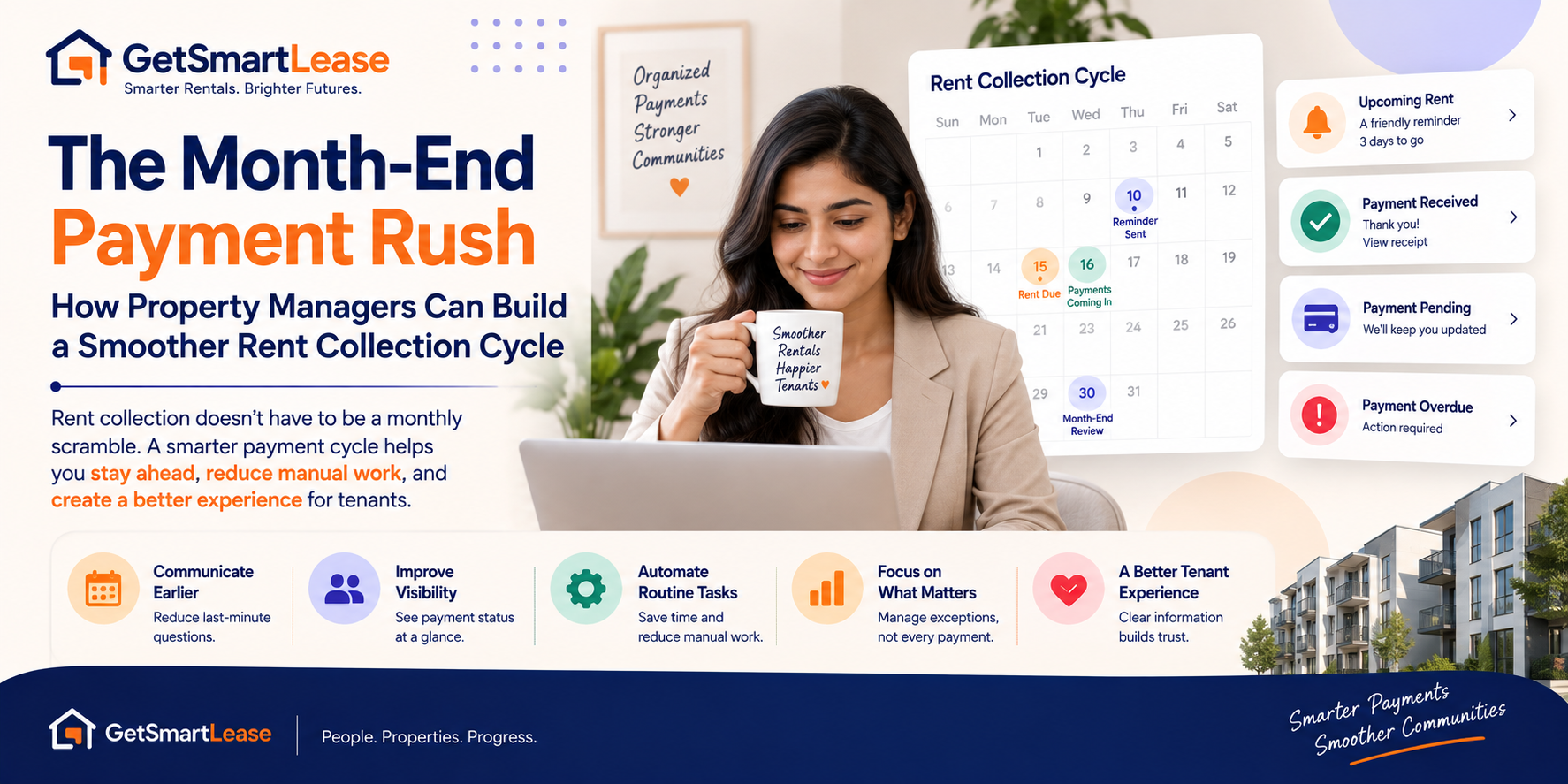
Introduction
For many property managers, rent collection follows a familiar pattern.
The due date approaches.
Payment activity increases.
Tenant questions arrive.
Teams begin checking transactions.
Reminders need to be sent.
Outstanding balances need attention.
Then comes the work of confirming payments, updating records, and identifying anything that still requires follow-up.
The problem isn't necessarily that tenants are paying digitally or manually.
It's that too much operational activity can become concentrated around the same period.
As a rental portfolio grows, this month-end payment rush can become increasingly difficult to manage.
Smart Payments can help property teams rethink rent collection as a continuous cycle rather than a single due-date event.
1. Rent Collection Starts Before the Due Date
A smooth payment cycle shouldn't begin on the day rent is due.
Preparation can start earlier.
Tenants should have clear visibility into:
- The amount due
- The payment due date
- Available payment methods
- Any outstanding balance
- Where to find payment information
Providing this information in advance gives tenants time to prepare and reduces last-minute questions.
Instead of waiting for problems to appear, property teams can create a more predictable payment journey.
2. Use Pre-Due Reminders Strategically
A reminder doesn't need to mean that a tenant is late.
A simple notification before the due date can help tenants remember an upcoming payment.
For example:
Rent Due Soon → Friendly Reminder
Rent Due Today → Payment Notification
Payment Received → Confirmation
This keeps tenants informed without requiring property managers to manually contact everyone.
The important part is timing.
Too many notifications can become noise, while too little communication can lead to avoidable missed payments.
3. Give Tenants a Clear View of What They Owe
Payment confusion often creates unnecessary communication.
If tenants aren't sure about the amount due, previous payments, or outstanding balances, they're more likely to contact the property team for clarification.
A self-service payment view can make key information easy to understand.
Tenants should be able to quickly answer:
How much do I owe?
When is it due?
Have I already paid?
Where is my receipt?
When tenants can find these answers themselves, property teams receive fewer routine enquiries during busy collection periods.
4. Separate Successful Payments From Exceptions
One of the biggest advantages of a smart payment workflow is the ability to distinguish between transactions that require attention and those that don't.
If a tenant has already paid successfully, the property team shouldn't need to spend time reviewing that account.
Instead, teams can focus on exceptions such as:
- Pending payments
- Failed transactions
- Overdue balances
- Unmatched payments
- Payment discrepancies
This creates an exception-based workflow.
Rather than manually checking every payment, employees concentrate on the smaller number of transactions that genuinely require action.
5. Keep Payment Status Updated
Payment visibility is only useful when the information is current.
A payment dashboard should clearly show the status of each transaction.
For example:
Upcoming → Due → Pending → Paid
And where necessary:
Failed → Retry Required
or
Overdue → Follow-Up Required
Clear statuses help property managers understand the collection position without switching between multiple systems or manually comparing records.
6. Automate Routine Confirmations
A successful payment shouldn't create another manual task.
Once a payment has been received and recorded, tenants can automatically receive confirmation.
That confirmation might include:
- Amount paid
- Payment date
- Transaction reference
- Property or lease reference
- Receipt availability
This gives tenants confidence that the payment was recorded while reducing requests for manual confirmation.
7. Make Receipts Easy to Find
Receipts can become another source of administrative work when tenants need to request them individually.
Instead, digital receipts can become part of the payment history.
A tenant should be able to complete a payment and later access the associated record without contacting the property manager.
This creates a simpler experience while maintaining clearer documentation.
8. Prioritize Overdue Accounts
Once the due date passes, not every tenant account should receive the same attention.
A smart workflow can help property managers identify which accounts remain outstanding and prioritize follow-up.
Instead of searching through transaction lists, teams can work from a focused view:
Overdue Payments
Failed Payments
Follow-Up Required
Recovery in Progress
This makes the next action clearer.
9. Avoid Duplicate Follow-Ups
Imagine a tenant receives an overdue reminder, immediately pays, and then receives another overdue message later that day.
The payment was resolved, but the communication workflow didn't know it.
Connecting payment status with notifications helps prevent this.
Once payment is confirmed:
Outstanding → Paid
The associated reminder process should stop.
This small improvement can make the payment experience feel much more coordinated.
10. Make Month-End Reconciliation Easier
When payments are recorded consistently throughout the collection cycle, month-end reconciliation becomes easier.
Instead of reconstructing activity from bank statements, emails, spreadsheets, and individual tenant records, teams have a clearer transaction history.
Property managers can review:
- Expected rent
- Collected rent
- Outstanding balances
- Failed transactions
- Payment adjustments
- Completed payments
Better records throughout the month can reduce the amount of cleanup required at the end.
11. Learn From Each Payment Cycle
Every rent collection period generates useful operational information.
Property teams can look at patterns such as:
- When most tenants pay
- How many payments arrive before the due date
- How many require reminders
- How many fail
- How quickly overdue payments are resolved
- Which parts of the process generate the most enquiries
These insights can help teams improve future payment cycles.
Smart Payments therefore becomes more than transaction processing.
It becomes a way to continuously improve rent collection operations.
12. Build a Payment Cycle That Can Scale
A payment process that works for 20 tenants may become difficult to manage with 200 or 2,000.
If every additional tenant requires more manual checking, reminders, confirmations, and reconciliation, growth creates additional administrative pressure.
A scalable payment cycle should allow routine transactions to move through the system with minimal intervention.
Property teams can then spend their time managing exceptions and supporting tenants who genuinely need assistance.
From Monthly Rush to Continuous Workflow
Traditional rent collection can feel like a monthly deadline.
A smarter approach turns it into a connected cycle:
Upcoming Rent
↓
Pre-Due Reminder
↓
Payment Due
↓
Payment Received
↓
Automatic Confirmation
↓
Receipt & Record Updated
For exceptions:
Payment Missing or Failed
↓
Issue Identified
↓
Targeted Follow-Up
↓
Resolution
↓
Records Updated
This creates a clearer process for both tenants and property teams.
Final Thoughts
Rent will always have a due date.
But property management teams don't need to treat every due date like an operational emergency.
By communicating earlier, improving tenant self-service, automating routine confirmations, separating successful payments from exceptions, and maintaining accurate payment visibility, property managers can create a smoother collection cycle.
The goal of Smart Payments isn't simply to collect rent digitally.
It's to make the entire period around rent collection easier to manage.
Less month-end rush. More visibility. A smoother payment cycle for everyone.