
Automation in property management isn't new.
For years, property teams have used technology to send rent reminders, schedule emails, generate notifications, and reduce repetitive administrative work.
But automation is entering a new phase.
Instead of automating individual tasks, modern property technology is increasingly focused on automating entire workflows.
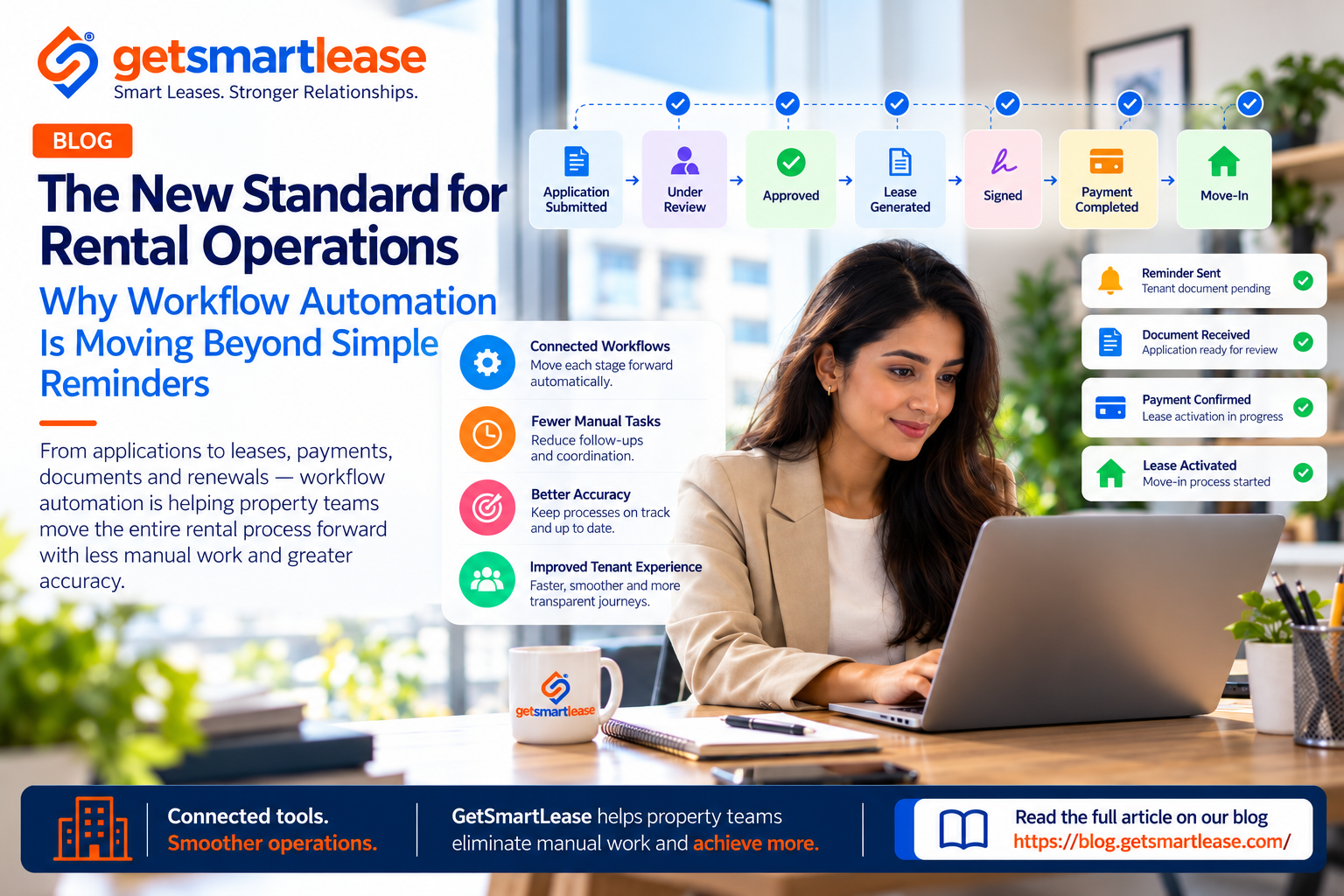
An application can move to review when documents are received. An approved applicant can progress to lease preparation. A signed lease can trigger the next payment step. An approaching lease expiration can initiate a renewal process.
The difference is significant.
Property management is moving from automated tasks toward connected automated journeys.
1. Traditional Automation Focused on Individual Tasks
Early property management automation was relatively straightforward.
A system might automatically:
- Send a payment reminder
- Confirm that a form was submitted
- Notify a tenant about an upcoming deadline
- Generate a recurring report
- Send an email after a particular event
These automations remain useful.
But they often operate independently.
The employee still needs to understand what happened, determine the next step, update another system, and continue the process manually.
The next generation of automation aims to connect those steps.
2. Workflows Are Becoming Event-Driven
Modern rental operations contain many events that naturally lead to another action.
For example:
Application submitted → Begin review
Application approved → Prepare lease
Lease sent → Await tenant signature
Lease signed → Request payment
Payment completed → Prepare move-in
Instead of relying on someone to manually monitor every transition, software can help move the workflow forward when specific conditions are met.
This is known as event-driven automation.
The event tells the system that something has changed, and the workflow determines what should happen next.
3. Application Processing Can Become More Structured
Rental applications often involve multiple documents, approvals, communications, and status changes.
Without a structured workflow, employees may need to repeatedly check whether an applicant has completed every requirement.
Workflow automation can help organize this process.
For example, the system can recognize when required documents have been submitted and make the application ready for review.
If something is missing, the appropriate follow-up can be triggered.
Once the application is approved, the leasing process can begin.
This creates a more predictable journey for both the applicant and the property team.
4. Lease Management Is Moving Beyond Digital Signatures
Digital signatures transformed lease management by reducing the need for physical paperwork.
But signing is only one part of the lease lifecycle.
Modern lease workflows can include:
Draft → Review → Send → Tenant Signature → Counter-Signature → Activation → Renewal
Each stage has its own requirements.
Connected automation can help ensure that the right action happens at the right stage without property teams manually coordinating every transition.
This can be especially valuable when teams manage many leases simultaneously.
5. Payments Can Trigger Operational Actions
Payments are another area where workflow automation can extend beyond reminders.
Consider what happens after a tenant completes a required payment.
In a disconnected process, an employee might need to verify the payment, update the tenant record, notify another team, and move the application or lease forward.
In a connected workflow, payment confirmation can become an operational event.
For example:
Payment received → Update status → Record transaction → Unlock next step
This reduces the number of manual handoffs between financial and operational processes.
6. Documents Can Become Part of the Workflow
Documents are essential throughout the rental lifecycle.
Applications, identification documents, bank statements, lease agreements, invoices, inspection reports, and other records may all be required at different stages.
Traditional document management focuses primarily on storing and retrieving files.
Workflow-based document management goes further.
The system can understand which document is required, when it is required, and whether it has been provided.
That makes documents an active part of the rental workflow rather than simply files stored in a folder.
7. Exception-Based Management Is Emerging
One of the most interesting effects of workflow automation is a change in what employees need to monitor.
Traditionally, property managers may need to check every application, payment, lease, or request to ensure everything is progressing correctly.
Automation creates the possibility of exception-based management.
Instead of reviewing everything, teams can focus on situations where something is unusual.
For example:
- An application has remained incomplete for too long
- A required document is missing
- A payment failed
- A lease hasn't been signed
- A workflow hasn't progressed as expected
Routine processes can continue while employees focus their attention on exceptions.
8. Human Decisions Still Matter
More automation doesn't mean removing people from property management.
Many decisions still require human judgment.
Property managers may need to evaluate applications, negotiate lease terms, handle sensitive tenant situations, review unusual payment circumstances, or resolve disputes.
The purpose of workflow automation is not to automate every decision.
It is to reduce the administrative work surrounding those decisions.
Technology can manage routine transitions while people remain responsible for situations requiring context, communication, and judgment.
9. AI Could Make Workflows More Adaptive
Traditional automation usually follows predefined rules.
If X happens, perform Y.
Artificial intelligence could make these workflows more flexible.
AI-assisted systems may help summarize cases, categorize requests, identify unusual activity, recommend next actions, or prioritize items requiring human attention.
This could gradually shift property automation from rigid workflows toward more adaptive operational assistance.
The combination of automation + connected data + AI could become an important direction for property technology.
From Task Automation to Journey Automation
The evolution of property management automation can be viewed as several stages:
Manual Tasks → Automated Tasks → Connected Workflows → Exception Management → Intelligent Assistance
Each stage reduces the amount of manual coordination required to keep rental operations moving.
The biggest change isn't necessarily that individual tasks become faster.
It's that the entire process becomes easier to manage.
What This Means for Property Teams
When evaluating automation, property teams can look beyond simple questions such as:
“Can this system send reminders automatically?”
They can also ask:
- Can one completed action trigger the next workflow stage?
- Can applications progress based on their status?
- Can payments connect directly with lease processes?
- Can required documents be tracked automatically?
- Can employees easily see which workflows have stalled?
- Can routine processes continue without constant manual monitoring?
These questions focus on the operational value of automation rather than automation for its own sake.
Looking Ahead
Property management automation is becoming less about saving a few clicks and more about orchestrating complete rental workflows.
Applications, documents, leases, payments, communication, and renewals don't exist independently.
They are parts of the same rental journey.
As property technology continues to evolve, the platforms that successfully connect these stages can help property teams reduce repetitive coordination, maintain clearer processes, and create smoother experiences for tenants.
The next chapter of automation isn't simply:
“Do this task automatically.”
It's:
“Help the entire process move forward.”