
Property Operations Are the Engine Behind the Tenant Experience
For tenants, property management may look simple from the outside: pay rent, submit a maintenance request, renew a lease, and contact the property manager when help is needed.
Behind the scenes, however, property teams are coordinating dozens of moving parts.
Lease dates need to be tracked. Payments need to be monitored. Maintenance requests must reach the right people. Documents need to be stored. Tenant questions need responses. Renewals require follow-up. Owners need updates.
When these processes depend heavily on spreadsheets, inboxes, phone calls, and individual memory, small inefficiencies can quickly become larger operational problems.
Modern property operations require something different: connected workflows that help teams move from one task to the next without losing information along the way.
1. Build Repeatable Processes for Everyday Work
Many operational problems start with inconsistency.
One team member may handle move-ins one way while another follows a completely different process. Important steps can be missed simply because there is no standard workflow.
Property managers can reduce this risk by creating repeatable processes for activities such as:
- New tenant onboarding
- Lease approvals and signing
- Rent collection and payment follow-up
- Maintenance coordination
- Property inspections
- Lease renewals
- Move-outs and security deposit processing
Clear workflows make responsibilities easier to understand and help teams maintain consistency as portfolios grow.
2. Reduce Manual Data Entry
Entering the same tenant, property, lease, or payment information into multiple systems wastes time and increases the possibility of errors.
A better operational model allows information to move between connected processes.
For example, once a lease is finalized, the relevant tenant and lease information should be available for future workflows rather than requiring staff to manually enter it again.
Reducing duplicate work gives property teams more time to focus on exceptions, tenant needs, and higher-value decisions.
3. Give Teams One Place to Find Information
Operational efficiency suffers when information is scattered across email threads, spreadsheets, shared drives, messaging apps, and paper documents.
Even a simple question—such as when a tenant's lease expires—can require searching through several systems.
Centralizing property, tenant, lease, payment, and communication information creates a more reliable source of truth.
Instead of asking, “Where is that information?”, teams can focus on “What action do we need to take?”
4. Turn Maintenance Into a Trackable Workflow
Maintenance is one of the most visible parts of property operations.
When requests are handled through phone calls, texts, and informal conversations, it becomes difficult to know what has been reported, assigned, completed, or delayed.
A structured maintenance workflow should make it easy to track:
Request → Priority → Assignment → Progress → Completion → Tenant Update
This creates accountability for the property team while giving tenants better visibility into what is happening.
5. Automate Routine Communication
Property managers repeatedly send similar messages throughout the tenant lifecycle.
Payment reminders, lease renewal notices, maintenance updates, document requests, and move-in instructions are all examples.
Automation can handle many of these predictable touchpoints while keeping staff involved when personal attention is necessary.
The goal isn't to remove human communication. It's to prevent routine communication from depending entirely on someone remembering to send it.
6. Manage Renewals Before They Become Urgent
Lease expiration dates should never surprise a property team.
A strong operational system identifies upcoming expirations early and creates a clear renewal workflow.
Teams can then review the tenant's history, determine renewal terms, communicate options, collect approvals, and complete documentation before the deadline becomes urgent.
Earlier action can reduce last-minute administrative pressure and give both managers and tenants more time to make informed decisions.
7. Use Operational Data to Find Bottlenecks
Property operations generate valuable data every day.
Managers can use it to understand questions such as:
- How long does it take to resolve maintenance requests?
- How many leases are approaching expiration?
- Where are payment delays occurring?
- Which tasks repeatedly require manual intervention?
- How quickly are tenant inquiries being addressed?
These insights turn operational management from reactive problem-solving into continuous improvement.
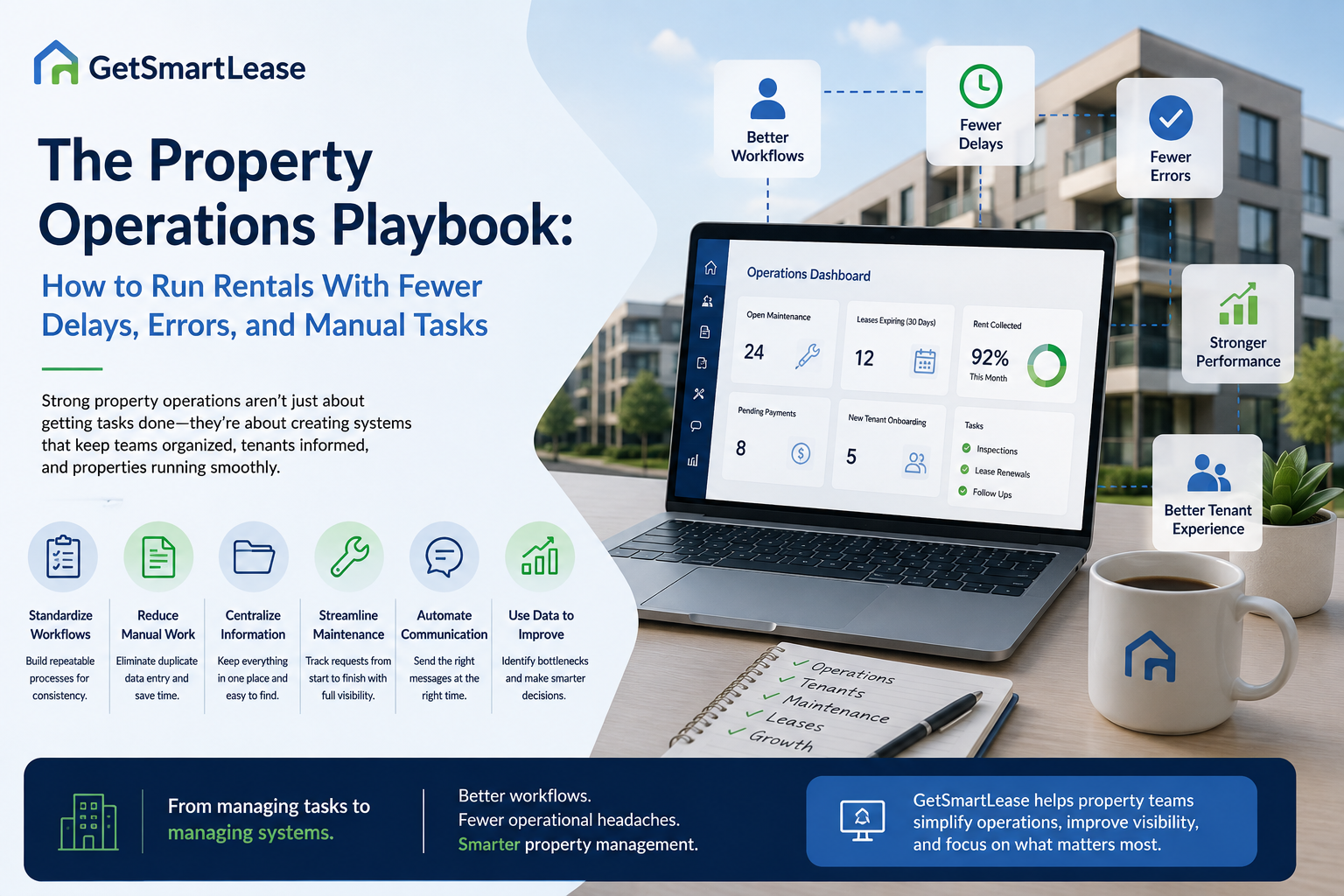
From Managing Tasks to Managing Systems
Efficient property operations aren't created by asking teams to work faster.
They're created by designing better systems.
When workflows are standardized, information is centralized, routine work is automated, and teams have visibility into what needs attention, property managers can operate more efficiently without sacrificing the tenant experience.
That becomes increasingly important as portfolios grow.
The future of property operations isn't about adding more administrative work. It's about connecting the work that already exists—and making every step easier to manage.
How GetSmartLease Supports Smarter Property Operations
GetSmartLease helps property teams bring important leasing and property management workflows into a more connected digital experience.
By reducing repetitive administrative work and improving visibility across day-to-day processes, property managers can spend less time managing disconnected tasks and more time focusing on properties, tenants, and growth.
Better workflows. Fewer operational headaches. Smarter property management.