
Introduction
For decades, much of property management has been built around responding to events.
A tenant reports an issue.
A payment becomes overdue.
A lease expires.
A document is missing.
An application gets delayed.
Then someone takes action.
While this approach can keep operations moving, it also creates a constant cycle of follow-ups, urgent tasks, and avoidable delays.
That model is beginning to change.
As property management becomes more digital and connected, teams are gaining better visibility into what is happening across their rental operations.
The result is an important industry shift:
Property management is moving from reacting to problems toward anticipating what needs attention next.
1. Reactive Property Management Creates Hidden Work
Many operational problems begin as small tasks.
A tenant hasn't completed a document.
A lease is waiting for a signature.
A payment hasn't arrived.
A renewal date is approaching.
None of these situations may initially seem urgent.
But when they're discovered late, they can quickly become bigger operational problems.
Property teams then spend additional time sending reminders, searching for information, contacting tenants, and coordinating internally.
Proactive property management aims to identify these situations earlier.
2. Automation Is Changing Follow-Up
Follow-up is one of the most repetitive parts of property management.
Teams regularly need to remind tenants about:
- Outstanding documents
- Lease signatures
- Upcoming payments
- Incomplete applications
- Renewals
- Required actions
Traditionally, employees have tracked many of these tasks manually.
Automation can increasingly help recognize when something is still incomplete and trigger an appropriate reminder or workflow.
That doesn't mean removing human communication.
Instead, automation can handle routine follow-up while property managers focus on situations that require judgment or personal attention.
3. Lease Renewals Are Becoming More Proactive
Lease renewal is a good example of where proactive management can make a significant difference.
If a property manager only notices an approaching expiration shortly before the lease ends, both the tenant and the property team have limited time to make decisions.
Earlier visibility creates more options.
Teams can identify upcoming expirations, begin conversations sooner, prepare renewal terms, and understand potential vacancies before they happen.
The workflow shifts from:
“This lease is about to expire.”
to:
“This lease will require attention soon.”
That small difference can have a major operational impact.
4. Payment Management Is Moving Beyond Collections
Payment technology is also becoming more proactive.
Traditional rent collection often focuses on what happens after a payment becomes overdue.
Modern systems can provide better visibility before that point.
Property teams can monitor upcoming payments, payment status, outstanding balances, and transaction activity.
Automated reminders can also help tenants stay aware of upcoming obligations.
Instead of beginning the process after a payment is missed, property teams can create workflows designed to reduce the likelihood of missed payments in the first place.
5. Application Bottlenecks Can Be Identified Earlier
Rental applications often involve multiple stages.
Application → Documents → Review → Approval → Lease → Signature → Payment → Move-In
A delay at any stage can slow the entire process.
When applications are tracked manually, stalled applications may not become obvious until someone checks them.
Digital workflows can make these bottlenecks easier to identify.
Property teams can see which applications are progressing normally and which ones have been waiting at a particular stage for too long.
That allows teams to intervene earlier.
6. Data Is Becoming an Early-Warning System
Property management platforms generate increasing amounts of operational data.
The important question is no longer simply:
“How much data do we have?”
It is:
“Can that data tell us where attention is needed?”
Operational information can potentially highlight patterns such as:
- Repeated payment delays
- Applications remaining in one stage too long
- Increasing tenant requests
- Upcoming lease expirations
- Missing documentation
- Changes in occupancy
This transforms data from a reporting tool into an operational early-warning system.
7. AI Could Push Proactive Management Further
Artificial intelligence could accelerate this transition.
Instead of requiring property managers to review every dashboard, report, and workflow manually, AI-assisted systems can potentially help identify unusual situations and prioritize information.
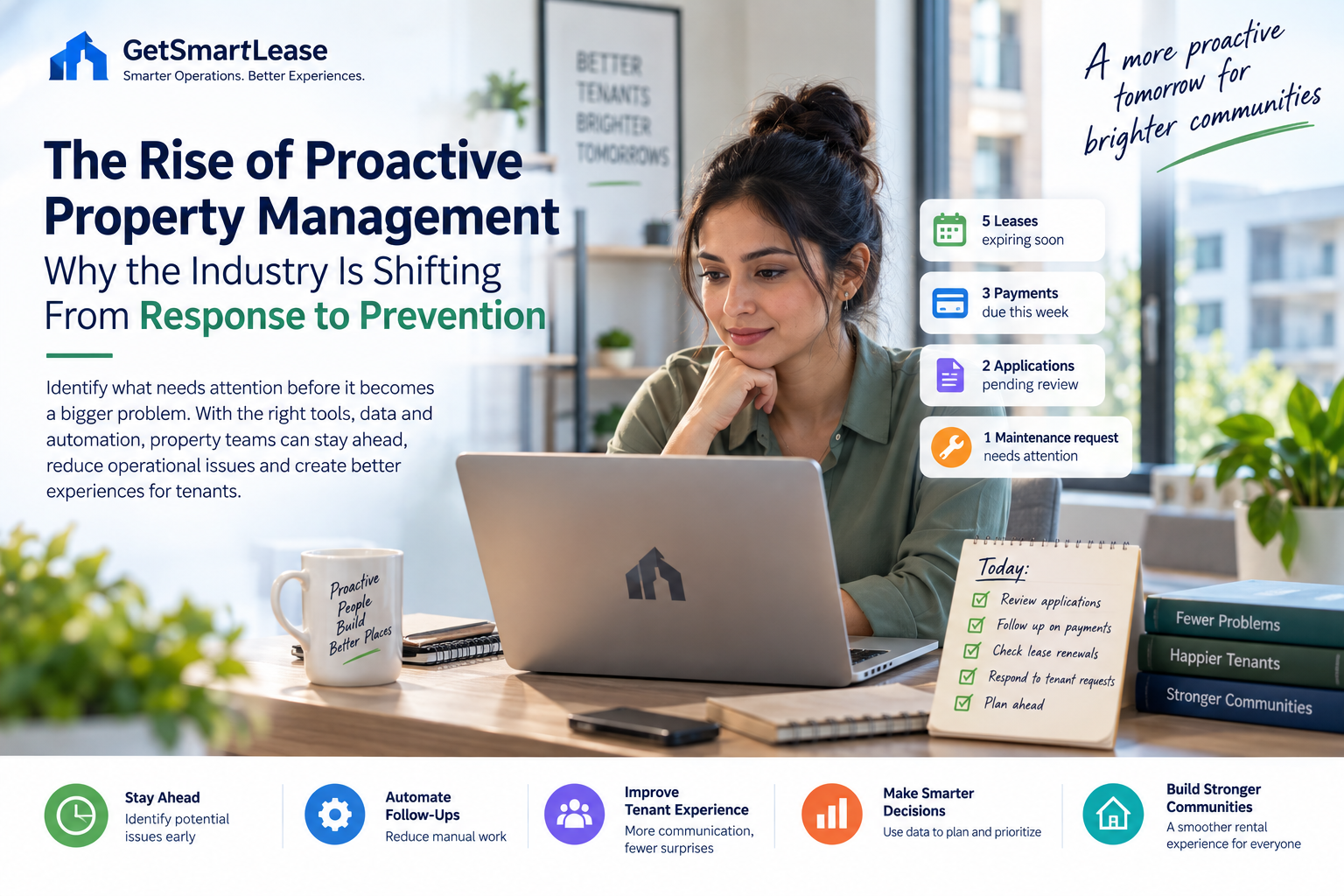
Imagine starting the day with a summary such as:
3 applications require attention.
5 leases are approaching renewal.
2 payments require follow-up.
4 tenant requests remain unresolved.
The value isn't simply having AI.
The value is helping employees understand where their attention will have the greatest impact.
8. Proactive Management Can Improve the Tenant Experience
Residents also benefit when property operations become more proactive.
A tenant would generally prefer a reminder before an important deadline rather than discovering afterward that something was missed.
Similarly, earlier communication around renewals, payments, documentation, or property issues can create a more predictable rental experience.
Good tenant experience isn't only about responding quickly.
Increasingly, it's about reducing the situations that require urgent responses in the first place.
From Task Management to Attention Management
This shift represents a broader change in property technology.
Traditional software helped teams record tasks.
Modern platforms increasingly help teams manage workflows.
The next generation may focus on managing attention.
Instead of expecting employees to constantly search for problems, technology can help surface the activities that matter most.
The progression looks like:
Record → Track → Alert → Prioritize → Predict
Each stage makes property operations increasingly proactive.
What This Means for Property Managers
As property technology evolves, teams can start asking different questions.
Instead of only asking:
“Can our system record this?”
They can ask:
- Can it tell us when something needs attention?
- Can repetitive follow-ups happen automatically?
- Can we identify delays before they affect tenants?
- Can we see upcoming lease and payment events?
- Can important tasks be prioritized?
- Can our data help us anticipate operational problems?
These capabilities can help teams spend less time searching for issues and more time resolving the ones that actually matter.
Looking Ahead
The property management industry isn't moving toward complete automation.
It's moving toward better anticipation.
People will remain essential for communication, decision-making, negotiation, and tenant relationships.
Technology's role is increasingly to help those people know what needs their attention—and when.
As automation, connected workflows, real-time data, and AI continue to develop, proactive property management could become less of a competitive advantage and more of an industry expectation.
The future may not be about responding to problems faster.
It may be about preventing more of those problems from becoming urgent in the first place.