
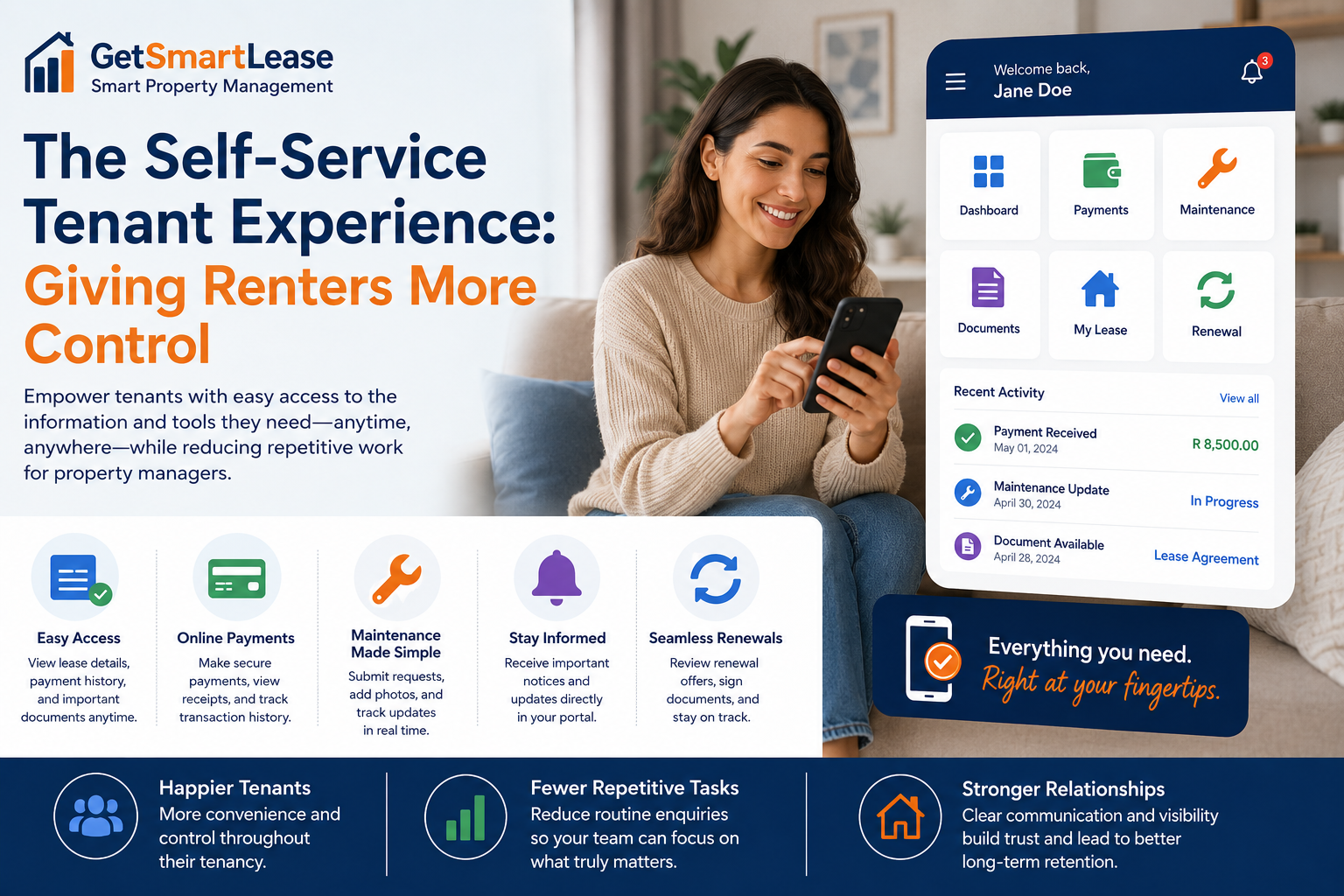
Convenience Is Becoming Part of the Tenant Experience
Think about how people manage everyday services today.
They check bank balances from their phones, track deliveries online, manage subscriptions through apps, and access important documents whenever they need them.
Rental experiences are moving in the same direction.
Tenants don't necessarily want to call or email their property manager every time they need basic information. Sometimes they simply want to check a payment, find a lease document, submit a maintenance request, or see what's happening with an existing issue.
This is where tenant self-service can make a meaningful difference.
Self-service isn't about removing property managers from the tenant relationship. It's about giving residents convenient access to routine services while allowing property teams to focus on situations that genuinely require personal assistance.
1. Make Important Information Easier to Access
One of the simplest frustrations in renting is not knowing where to find important information.
A tenant may need to check:
- Their lease dates
- Rental amount
- Payment history
- Outstanding balances
- Property information
- Important documents
- Maintenance request status
When this information is scattered across emails, PDFs, messages, and different systems, even a simple question can require contacting the property manager.
A centralized tenant portal can provide a single place for tenants to access relevant information.
Instead of asking:
"Can you resend my lease?"
or
"Did you receive my payment?"
tenants can find the information themselves when they need it.
That creates convenience for tenants and reduces repetitive requests for property management teams.
2. Simplify Rent Payments
Rent payment is one of the most regular interactions between tenants and property managers.
It should also be one of the easiest.
Tenants should be able to clearly understand:
How much is due?
When is it due?
Has my payment been received?
Digital payment experiences can help answer these questions while making transactions more convenient.
Depending on the system being used, tenants may be able to:
- View upcoming rent amounts
- Make payments online
- Receive payment confirmations
- Review previous transactions
- Access invoices or receipts
- Receive reminders before payments become overdue
For property managers, this can also mean less manual reconciliation and fewer questions about whether payments have been received.
A smoother payment experience benefits both sides.
3. Let Tenants Submit Maintenance Requests Digitally
Maintenance is another area where self-service can significantly improve the tenant experience.
Traditional maintenance reporting often depends on phone calls, emails, or messages.
That can create problems.
Important details may be missing. Requests may be difficult to track. Tenants may not know whether their message was received.
A structured digital maintenance request can collect important information from the beginning.
For example:
- Type of issue
- Description
- Property or unit
- Urgency
- Supporting photos where applicable
Once submitted, the tenant can receive confirmation that the request has been recorded.
This creates a clearer starting point for both the tenant and the property management team.
4. Provide Visibility After a Request Is Submitted
Self-service shouldn't stop after the tenant presses Submit.
One of the biggest opportunities to improve tenant experience is giving residents visibility into what happens next.
Consider a maintenance request.
A tenant may want to know whether it has been:
Received → Reviewed → Assigned → Scheduled → Completed
Without visibility, tenants may repeatedly contact management asking for updates.
A digital status experience can reduce that uncertainty.
Even when an issue takes time to resolve, tenants can see that progress is being made.
This is important because tenant satisfaction isn't determined only by resolution speed.
Visibility and communication also matter.
5. Make Lease Documents Available When Tenants Need Them
Lease documents contain information tenants may need throughout their tenancy.
But finding the original document months after move-in isn't always easy.
It may be buried in an old email, stored on another device, or difficult to locate among other files.
Providing secure digital access to important documents can make the experience much easier.
Depending on the rental process, this might include:
- Lease agreements
- Signed documents
- Payment records
- Invoices
- Property-related notices
- Other relevant tenancy documents
Instead of requesting another copy from property management, tenants can retrieve the information themselves.
That saves time on both sides.
6. Use Self-Service for Lease Renewals
Lease renewal is another process that can benefit from greater tenant visibility.
As a lease approaches expiration, tenants naturally begin asking questions.
When does my lease end?
Is renewal available?
Are the terms changing?
What do I need to do?
Property managers can improve this experience by making renewal information available early and clearly communicating the next steps.
A more digital renewal process might allow tenants to:
- Review upcoming lease expiration dates
- Receive renewal notifications
- Review proposed terms
- Submit renewal decisions
- Access updated documents
The goal isn't simply to digitize paperwork.
It's to make the entire process easier to understand and complete.
7. Self-Service Doesn't Mean No Human Support
This is an important distinction.
Not every tenant interaction should become automated.
Some situations require empathy, judgment, negotiation, or detailed explanation.
For example:
- Complex maintenance problems
- Payment disputes
- Lease disagreements
- Emergency situations
- Sensitive tenant concerns
- Unusual renewal circumstances
Technology works best when it handles predictable, repetitive interactions.
That gives property management teams more time to focus on situations where personal attention adds real value.
The ideal tenant experience combines both.
Digital convenience when tenants want independence.
Human support when tenants need help.
8. Make the Experience Mobile-Friendly
Tenants don't always manage rental tasks from a desktop computer.
They may need to report maintenance while standing in their kitchen, check a payment while commuting, or access a document while away from home.
That makes mobile accessibility increasingly important.
A good tenant experience should make common actions easy across devices.
Buttons should be easy to use.
Information should be easy to read.
Forms shouldn't require excessive typing.
Important actions shouldn't be hidden behind complicated navigation.
The simpler the experience, the more likely tenants are to actually use the available self-service tools.
9. Use Automation to Support Self-Service
Self-service and automation work particularly well together.
For example, after a tenant performs an action, the system can automatically provide relevant information.
A payment can trigger a confirmation.
A maintenance request can trigger an acknowledgment.
A status change can trigger an update.
An approaching lease expiration can trigger a reminder.
These small automated interactions help tenants stay informed without requiring property teams to manually send every message.
The result is not necessarily more communication.
It's more timely communication.
What Property Managers Gain From Tenant Self-Service
Tenant self-service is primarily designed to make renting more convenient, but the operational benefits can also be significant.
Consider how many routine requests property management teams receive:
"Can you send my lease again?"
"Has my rent been received?"
"What's happening with my maintenance request?"
"When does my lease expire?"
Individually, these questions don't take much time.
Across hundreds or thousands of tenants, however, they can create a substantial administrative workload.
Giving tenants access to routine information can reduce repetitive enquiries while helping property teams concentrate on more important operational tasks.
Finding the Right Balance
The best tenant experience isn't completely digital.
And it isn't completely manual.
It's a combination of both.
Technology can handle predictable interactions quickly and consistently, while people handle situations requiring understanding, flexibility, and judgment.
For property managers, finding this balance can create an experience that feels convenient without becoming impersonal.
Tenants get greater control over everyday rental tasks.
Property managers get fewer repetitive administrative requests.
And both sides gain better visibility into important rental activities.
Building a More Convenient Tenant Experience With GetSmartLease
Modern tenant experiences should make everyday rental interactions straightforward.
GetSmartLease helps bring important property management processes together so tenants and property teams can access the information they need throughout the rental lifecycle.
From tenant and lease information to payments, documents, and other property management activities, connected digital processes can reduce unnecessary friction and create greater visibility for everyone involved.
Technology shouldn't create distance between property managers and tenants.
Used effectively, it can do the opposite.
It removes repetitive tasks and gives property teams more time for the conversations and situations where human support matters most.
Give tenants control over the simple things, so your team can focus on the important ones.