
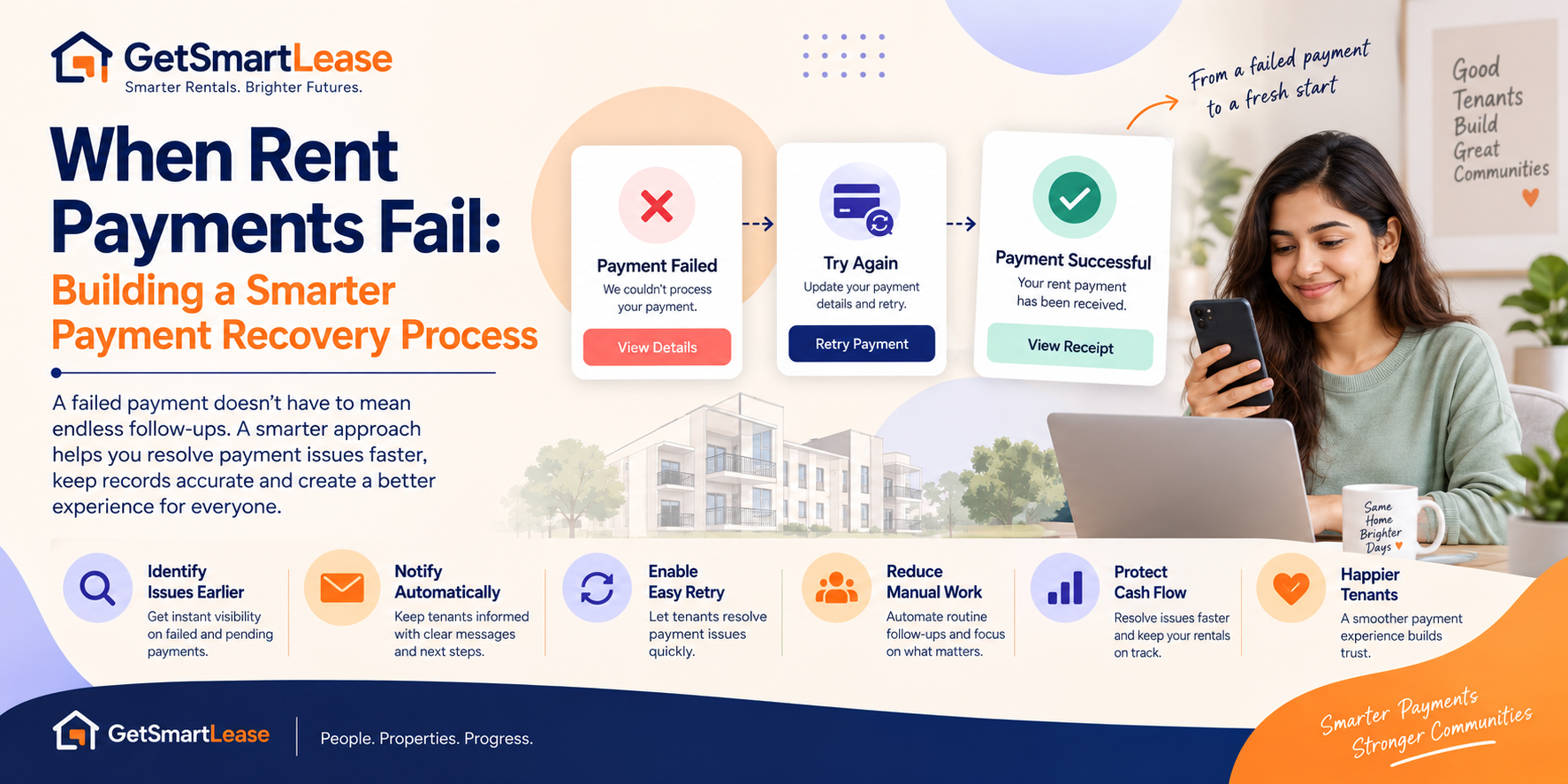
Digital payments have made paying rent faster and more convenient, but not every transaction goes according to plan.
A payment may fail. A transaction may remain pending. A tenant may use incorrect payment details. Or a property manager may see an outstanding balance without immediately knowing what happened.
The payment itself is only part of the challenge.
What happens after a payment problem occurs can determine how quickly it is resolved—and how much work it creates for both the tenant and the property team.
In a manual process, recovery can involve checking transactions, contacting tenants, sending reminders, updating records, and repeatedly checking whether another payment has been made.
A smarter payment recovery process takes a different approach.
It helps property managers identify payment problems earlier, communicate clearly, guide tenants toward the next action, and track the issue until it is resolved.
1. A Failed Payment Should Be Visible Immediately
The first step toward resolving a payment problem is knowing that it exists.
When payment information is scattered across different systems, failed or incomplete transactions can be difficult to identify quickly.
Property teams may only discover an issue when reviewing bank records or checking outstanding balances.
A smarter payment workflow provides clear statuses such as:
Paid | Pending | Failed | Overdue
This gives teams immediate visibility into which payments require attention.
Instead of searching for problems, they can focus directly on resolving them.
2. Tell Tenants What Happened
A generic message saying "Payment Failed" doesn't always give a tenant enough information to know what to do next.
Clear communication is an important part of payment recovery.
Where appropriate, tenants should understand:
- That the payment wasn't completed
- Which payment was affected
- The amount involved
- Whether another action is required
- How they can retry or resolve the issue
- Where they can get assistance
The goal isn't simply to notify the tenant that something went wrong.
It's to help them understand the next step.
3. Make Retrying a Payment Simple
Once a tenant knows that a payment has failed, resolving it should be straightforward.
If they need to search through old emails, contact the property manager for instructions, or repeat an unnecessarily complicated process, a small payment problem can quickly become a larger one.
A better recovery journey could be:
Payment Attempt → Payment Failed → Tenant Notified → Retry Available → Payment Completed → Status Updated
Reducing the number of steps between failure and resolution can help payments get back on track faster.
4. Avoid Turning Every Failed Payment Into Manual Follow-Up
Without automation, a failed payment often creates a new administrative task.
Someone has to identify the issue.
Someone has to contact the tenant.
Someone has to check whether the tenant responded.
Someone has to verify whether another payment was made.
And someone may have to update the records afterward.
When this happens across many properties, the workload can become significant.
Smart payment workflows can automate routine parts of this process while allowing property teams to step in when human attention is actually needed.
5. Use Reminders at the Right Time
Not every unresolved payment requires an immediate phone call.
Sometimes a clear notification and a reasonable amount of time to respond are enough.
A structured recovery process might look like:
Payment Failed → Immediate Notification
Still Unresolved → Reminder
Payment Still Outstanding → Property Team Follow-Up
This creates a more balanced approach.
Automation handles routine communication, while employees focus on situations that remain unresolved.
6. Stop Reminders When the Payment Is Resolved
Few payment experiences are more frustrating than receiving an overdue reminder after you've already paid.
This can happen when payment and communication systems aren't properly connected.
Once a successful payment is recorded, the associated recovery workflow should recognize that the issue has been resolved.
That means:
Payment Successful → Status Updated → Reminders Stopped → Receipt Available
Keeping payment status and communication connected helps prevent unnecessary messages and confusion.
7. Keep a Clear Recovery History
Payment recovery isn't only about collecting the outstanding amount.
It's also important to maintain accurate records of what happened.
A useful payment history might show:
- Original amount due
- Due date
- Payment attempts
- Transaction status
- Notifications sent
- Successful payment date
- Final payment confirmation
This creates a clearer record for both operational teams and tenants.
If questions arise later, employees don't have to reconstruct the entire situation from emails and separate systems.
8. Know When Automation Should Hand Over to a Person
Automation can make payment recovery more efficient, but it shouldn't remove human judgment.
Some payment situations require conversation.
A tenant may be experiencing a genuine problem. There may be an account discrepancy. A transaction might require investigation. Or repeated attempts may continue to fail.
A smart workflow should help identify these exceptions.
Instead of asking employees to manually manage every failed transaction, the system can help highlight the cases that genuinely require attention.
The goal is not:
Automate every interaction.
It is:
Automate routine steps so people have more time for situations where they can add value.
9. Protect Cash Flow by Acting Earlier
The longer an unresolved payment remains unnoticed, the harder it can become to manage.
Early visibility allows property teams to respond sooner.
If a payment fails on the due date and the problem is immediately visible, the tenant can be notified while the transaction is still fresh.
That is very different from discovering the problem days or weeks later during reconciliation.
Earlier detection plus faster communication can help reduce the time between a payment problem and its resolution.
10. Give Property Managers a Recovery Dashboard
Property managers shouldn't need to open individual tenant records just to understand the overall payment situation.
A centralized payment view can help teams quickly identify:
Successful Payments
Pending Payments
Failed Payments
Overdue Payments
Recovery in Progress
This turns payment recovery into a manageable workflow rather than a collection of disconnected tasks.
For larger portfolios, that visibility becomes increasingly valuable.
11. Measure Recovery Performance
Once payment recovery becomes a structured process, property teams can start learning from it.
Useful questions might include:
- How many payments fail?
- How quickly are failed payments resolved?
- How many are recovered after the first reminder?
- Which issues require manual intervention?
- How long do unresolved payments typically remain outstanding?
These insights can help teams identify weaknesses in the payment experience and continuously improve the process.
12. Make Recovery Part of the Tenant Experience
Payment recovery can easily be treated as purely a financial process.
But tenants experience it as part of their relationship with the property manager.
A confusing failed-payment experience can create stress.
A clear one can build confidence.
Tenants should know:
What happened → What they need to do → Whether the issue is resolved
Simple communication, easy next steps, and accurate payment status can turn a potentially frustrating situation into a manageable one.
From Payment Failure to Payment Resolution
The traditional approach to failed payments is often reactive.
A problem occurs, someone eventually notices it, the tenant is contacted, and employees manually follow the issue until payment is received.
Smart Payments can create a more structured journey:
Payment Due
↓
Payment Attempted
↓
Issue Detected
↓
Tenant Notified
↓
Resolution Action
↓
Payment Completed
↓
Records Updated
↓
Recovery Closed
Each stage provides clarity about what should happen next.
Final Thoughts
A good payment system shouldn't only work when everything goes right.
It should also make it easier to recover when something goes wrong.
Failed and incomplete rent payments will happen. The difference is how efficiently property teams can identify, communicate, resolve, and record them.
With better visibility, timely notifications, structured reminders, simpler retry options, and clear escalation paths, payment recovery can become less dependent on repetitive manual work.
For tenants, that means clearer guidance and less uncertainty.
For property managers, it means fewer unresolved transactions, better operational visibility, and more control over the collection process.
Smart Payments aren't only about processing successful transactions. They're about building a better path from payment problem to payment resolution.